Advertisements
Advertisements
Question
An object is placed at a distance of 20 cm in front of a concave lens of focal length 20 cm. find: the magnification of image.
Advertisements
Solution
Object distance, u = -20 cm
Focal length, f = -20 cm (concave lens)
For a lens, magnification is
m = `"v"/"u"`
`therefore "m" = (-10)/-20`
∴ m = + 0.5
RELATED QUESTIONS
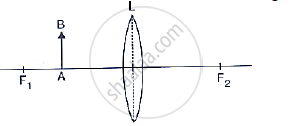
The following diagram shows an object AB and a converging lens L with foci F1 and F2. Draw two rays from the object AB and complete the diagram to locate the position of the image CD. Also mark on the diagram the position of eye from where the image can be viewed.
What is a magnifying glass?
A magnifying glass forms ______.
If the magnification produced by a lens is - 0.5, the correct statement is ______.
The maximum magnifying power of a convex lens of focal length 5 cm can be ______.
Name the lens used as a magnifying glass.
A convex lens produces on a screen an image twice the size of the object. If the position of image and object be interchanged, what will be the magnification then?
Draw a neat diagram to explain the action of a convergent (convex) lens as a reading glass (or magnifying glass). State the characteristics of the image formed.
What is a simple microscope or a magnifying glass? Draw a ray diagram to show its function.
Copy and complete the following ray diagram.