Advertisements
Advertisements
Question
The maximum magnifying power of a convex lens of focal length 5 cm can be ______.
Options
25
10
1
6
Advertisements
Solution
The maximum magnifying power of a convex lens of focal length 5 cm can be 6.
Explanation:
Focal length of convex lens, f = +5 cm
magnifying power of convex lens (simple microscope) is
m = 1 + `"D"/"f"`
D is the distance of distinct vision, D = 25 cm
m = 1 + `25/5` = 6
APPEARS IN
RELATED QUESTIONS
The following diagram shows an object AB and a converging lens L with foci F1 and F2 State three characteristics of the image in relation to the object.
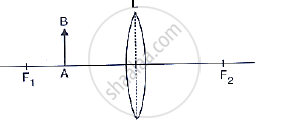
What information about the nature of image is real or virtual, do you get from the sign of magnification + or -?
An illuminated object lies at a distance 1.0 m from a screen. A convex lens is used to form the image of the object on a screen placed at a distance of 75 cm from the lens. Find:
- the focal length of the lens, and
- the magnification.
The magnification by a lens is +0.5. Name the lens and state how are u and v related?
What are conjugate foci?
What information we seek by the linear magnification of the image when it is positive or negative?
A convex lens produces on a screen an image twice the size of the object. If the position of image and object be interchanged, what will be the magnification then?
Show with the help of a ray diagram, the path of the ray when incident normally on the first surface of the glass block, through the block and the liquid.
Copy and complete the following ray diagram.
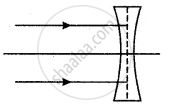
What is a magnifying glass (or a simple microscope)? Draw a ray diagram to show how a convex lens may be used as a magnifying glass. Where should the object be placed? State three characteristics of the image formed.
