Advertisements
Advertisements
Question
A healthy adult human excretes (on an average) _______ gm of urea/day.
Advertisements
Solution
A healthy adult human excretes (on an average) 25–30 gm of urea/day.
APPEARS IN
RELATED QUESTIONS
Ascending limb of Henle’s loop is ______ to water, whereas the descending limb is ______to it.
Answer the following in short.
What is urethra?
One of Harry’s organs is not functioning properly. There is extra fluid build up in his body causing swelling in his ankles and feet.
What should Harry do? Tick the correct answer.
Harry most probably needs a
Which one of the following in real sense is NOT an excretory activity?
The diagram given alongside represents an organ system in the human body. Study the same and answer the questions that follow:
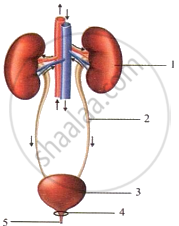
- Identify the system
- Label the parts marked 2 and 4. Mention the function of part 5.
- Name the structural and functional units of the part marked 1.
- What is the fluid that accumulates in part 3?
Which is the main nitrogenous waste present in it? - Draw a neat, labelled diagram showing the longitudinal section of part 1.
The diagram given below represents an organ system in the human body. Study the same and answer the questions that follow :
Name the structural and functional units of the part marked 1.
Choose the correct answer:
Orinithin cycle operates in ________
The given diagram represents a nephron and its blood supply. Study the diagram and answer the following question :
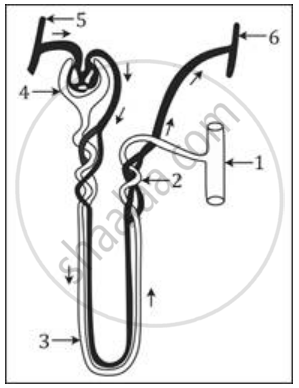
State the reason for the high hydrostatic pressure in the glomerulus.
Explain the Term: Malpighian body
What are some common excretory product?
Complete the following sentence with appropriate word:
The human liver converts ammonia into ______
Choose the correct option.
In reptiles, uric acid is stored in ______.
Identify the CORRECT statement with respect to blood vessels associated with the kidney.
Identify the labels (a, b, c, d) in the given diagram of the Malpighian corpuscle and choose the correct option.
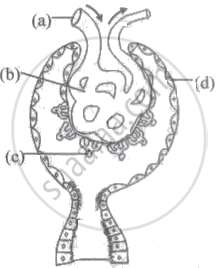
The pedicel of the podocytes are in dose contact with ______.
In the process of urine formation, the maximum amount of water from the glomerular filtrate is reabsorbed in the ______.
What is the contribution of Joseph E. Murray to Nephrology?
Erythropoietin hormone which stimulates R.B.C. formation is produced by ______.
Give two examples of the following:
Accessory excretory organs
Which of the following diagrams is correct with regard to the proximal (P) and distal (D) tubule of the Nephron.
