Advertisements
Advertisements
प्रश्न
A healthy adult human excretes (on an average) _______ gm of urea/day.
Advertisements
उत्तर
A healthy adult human excretes (on an average) 25–30 gm of urea/day.
APPEARS IN
संबंधित प्रश्न
Sketch and label ‘L.S. of human kidney’
One of Harry’s organs is not functioning properly. There is extra fluid build up in his body causing swelling in his ankles and feet.
What should Harry do? Tick the correct answer.
Which of Harry’s organs is not working properly?
Differentiate between the following pairs of term :
Excretion and katabolism
Name the main nitrogenous metabolic waste excreted out by mammals including humans.
The diagram given below represents an organ system in the human body. Study the same and answer the questions that follow :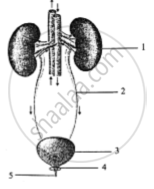
What is the fluid that accumulates in part 3?
Which is the main nitrogenous waste present in it?
Choose the odd one out in the following serie:
Urea, uric acid, haemoglobin.
Name the following:
Animals which excrete ammonia.
Why urine is acidic while blood is alkaline?
Sketch and label the ultrastructure of nephron.
Name the Following
Major excretory organs of man.
Name the Following
The act of passing urine.
Give Technical Terms:
What are the organic constituents of normal human urine?
Complete the following sentence with appropriate words:
Urine is collected in the ______.
Choose the Odd One Out:
Kidneys receive approximately ______ liters of blood.
The kidneys are made up of millions of excretory units called ______.
The inner visceral layer of glomerular capsule composed of specialised cells called ______.
Which of the following diagrams is correct with regard to the proximal (P) and distal (D) tubule of the Nephron.
Role of water vascular system in Echinoderms is:
- Respiration and Locomotion
- Excretion and Locomotion
- Capture and transport of food
- Digestion and Respiration
- Digestion and Excretion
Choose the correct answer from the options given below:
