Advertisements
Advertisements
प्रश्न
A healthy adult human excretes (on an average) _______ gm of urea/day.
Advertisements
उत्तर
A healthy adult human excretes (on an average) 25–30 gm of urea/day.
APPEARS IN
संबंधित प्रश्न
Tick the most appropriate answer.
The blood vessel that supplies impure blood to a kidney is the
Tick the most appropriate answer.
Plants maintain the concentration of sap inside their body with
Find the odd one out. Give a reason for your choice.
ureter, kidney, urinary bladder, lung, urethra
Excretion primarily involves
Write down the functional activity of the following parts,
Glomerulus …………………
What is a uriniferous tubule? How does it function?
Match the terms in Column I with those in Column II and write down the matching pairs
| Column I | Column II | |
| a | Bowman's Capsule | Renal artery |
| b | Contains more CO2 and less urea | Regulates amount of water excreted |
| c | Anti-diuretic hormone | Renal Vein |
| d | Contains more urea | Glomerulus |
Draw and label the diagram.
Nephron
The given diagram represents a nephron and its blood supply. Study the diagram and answer the following question :
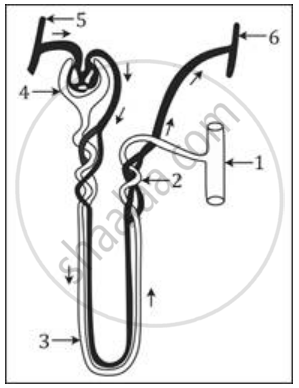
State the reason for the high hydrostatic pressure in the glomerulus.
Name the Following
The organ in which urine is stored before its elimination.
Name the Following
The gas excreted by the lungs.
Complete the following sentence with appropriate word:
The process of releasing urine is ______.
Mention, if the following statement is True or False. If false rewrite the wrong statement in its correct form:
A diuretic increases the amount of urine.
Which one of the following substance is not a constituent of sweat?
What is the CORRECT sequence of the different parts of the nephron from Malpighian corpuscle?
The function of PCT of the kidney is ______.
Which among the following procedures is used for cleaning the blood of a person by separating the waste substance from it?
The filtration units of kidneys are called
Detrusor muscles are present in the wall of ______.
