Advertisements
Advertisements
Question
(A) He knew the culprit but refused to admit it.
(B) Although………………………..
Advertisements
Solution
Although he knew that he was the culprit, he refused to admit it.
APPEARS IN
RELATED QUESTIONS
Read the following extract and answer the questions given below :
They whisper like drizzle
as they roam the streets
with a lost gaze as though
something they had thrown up
never returned to earth.
They shiver like December nights
in their dreamless sleep
on shop verandahs.
(1) Why do the old women in this extract roam the streets?
(2) What would you like to do for the betterment of the old people?
(3) Find out an example of 'onomatopoeia' from the first stanza of the extract.
(4) Pick out the expressions from the extract showing the sad situation of the old women.
Do you think Dahl is being extreme when he recommends that television sets should be tossed-out of our homes? Is there a balance which could be struck between watching television and reading books? What would that balance be?
What is the message of Maya Angelou’s poem?
What kind of person was Abou Ben Adhem?
How does the story “A Horse and Two Goats” develop the idea of the need to interact with people who have vastly different identities from your own?
The author shows death as a relief from a harsh life. Justify with reference to the story.
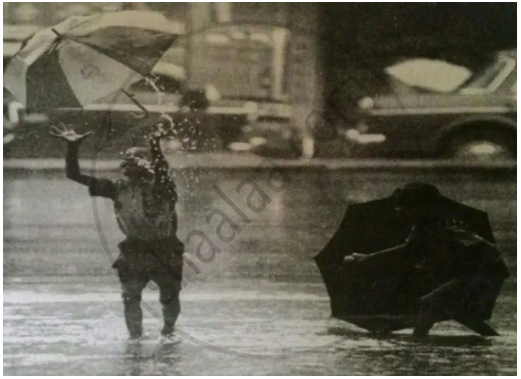
Study the picture given below. Write a story or a description or an account of what it suggests to you. Your composition may be about the subject of the picture or you may take suggestions from it; however, there must be a clear connection between the picture and your composition.
With close reference to the novel Ivanhoe discuss how the central plot revolves around the conflicts and tensions between the Normans and the Saxons.
Fill in the blank with an appropriate word:
The old woman could not get ……… the shock.
Read the extract given below and answer the questions that follow:
The morning stretched calm, beautiful, and warm.
Sprawling half-clad, I gazed out at the form
Of shimmering leaves and shadows. Suddenly
A strong flash, then another, startled me.
I saw the old stone lantern brightly lit.
(A Doctor’s Journal Entry for August 6, 1945: Vikram Seth)
(i) In which country did the incident described in the poem occur? What had caused the flashes? What happened to his home soon after?
(ii) Describe the injuries suffered by the Doctor.
(iii) What was his wife’s name? What happened to a house standing before them?
(iv) How does he describe the people he met on the way?
(v) Why were the people walking with their hands away from their bodies? What was common to all of them? What message does the poem convey?
Your teacher will speak the word given below. Write against two new words that rhyme with it.
young ______ ______
Imagine that you are the fellow pilgrim and you wish to share your experience of the incident in the poem.
Write a short article about it for a magazine/journal. Also, convey what change it has brought in your life.
Frame a pointwise Analysis of the poem ‘The worm’. Use the following points.
- Poem and poet:
- Theme:
- Tone:
- Structure and stanzas:
- Rhyme and Rhythm:
- Language and Imagery:
- Figures of Speech:
Given in a mixed order below are some good human attributes of the family. Pick out from the box and write it against the line that reflects it.
After some days, Elizabeth informed that she wanted the family to move to a safer place.
Think and respond with ‘YES’ or ‘NO’.
When you are faced with a very serious problem or some grave danger, what do you experience?
| Your feelings | panic | |
| wishing you were never born | ||
| hopelessness | ||
| helplessness | ||
| no emotion | ||
| calmness and composure | ||
| willingness to tackle it | ||
| Your reactions | break down and cry | |
| run away and hide | ||
| pray to God | ||
| ask for help | ||
| build up courage | ||
| take it as a challenge |
Your goal, this year, is to successfully pass out from secondary school. So let us be SMART and note down the following.
(a) Specific Area:
(Subjects) and number of units/lessons
- English 4 units
- ...........
- ...........
- ...........
- ...........
- ...........
(b) Measurable:
Comparison of scores in previous examinations and in recent one.
| Test I | Test II | Semester I | |
| 1. | Poor | Fair | Fair |
| 2. | |||
| 3. | |||
| 4. | |||
| 5. | |||
| 6. |
(c) Achievable goal:
(Target scores/performance in SSC Exams.)
- Good %
- ...........
- ...........
- ...........
- ...........
- ...........
(d) Realisitc approach:
Plan of action that matches with your expertise/resources.
For example:
- Make a study time table and follow it regularly.
- ...........
- ...........
- ...........
- ...........
(e) Time-bound Action:
Days required for revision
| Subject | Days for revision | |
| 1. | English | |
| 2. | ||
| 3. | ||
| 4. | ||
| 5. |
Make a poster of any natural disaster, giving details about the devastation caused.
Look at the picture given below and frame your own slogan.

Make the children write their own story. The following questions will help them to write. Ask them to gather information from their parents before writing and to give a title.
- When were you born?
- Where were you born?
- What is your father’s name and what is he?
- What is your mother’s name and what is she?
- What is your birth order?
- Do you have any nickname, if yes, reason for that?
- An interesting incident that happened in your life.
Write some sentences about the picture.

She, is, has, girl, shirt, pants, beautiful, pink, blue, long, hair.
Letters to friends and close family are written in the same way as you speak to them.
|
Krishna Boys’ Hostel writer’s address Model Public School Kolkata 10th July 2000 date My dear Ma, greeting This is my first letter after the summer vacation. We started our classes the day after we reached the hostel. I have settled in well. introduction We have a new teacher for clay modeling and pottery. She tells us how to make fruits and vegetables with clay. We then paint them. They look so real. body We have an inter-house poetry recitation coming up in August. I am really excited about it. It is a long poem but we learn it together with our teacher. It is nice to be back in school with my friends and teachers. I remember you and Baba a lot. Give my love to grandmother and grandfather. ending Do write back soon. Your loving son Pratap, closing |
After reading the letter, answer the following questions.
- Who has written the letter?________
- To whom has the letter been written? ________
- Where is the writer of the letter? _________
- What is the name of his hostel? _________
- On which date was this letter written?________
Words like morning, evening, watering end in ing. Write six more words to which ing can be added at the end to form a new word.
- ______.
- ______.
- ______
- ______.
- ______
- ______.
In the sentence below the capital letter, comma, full stop and question mark are missing. Put these in the correct place.
the tailor went to the market mr singh
Find out stories about other great people’s lives and their childhood and write these in your notebook. Collect at least two such stories and share them with your friends.
You could think of famous
- scientists
- religious people
- freedom fighters
- brave children
- astronauts
- artists
What did Bob share with the cop about their friendship?
Why did Woman 1 panic more than the others?
While waiting in the studio the narrator kept reading ______.
How did Miss Meadows express her joy, when she returned to the music class?
What provisions should be made in public places so that everyone gets the same access to public facilities?
Write a composition (in approximately 400-450 words) on the following subject:
During the summer break, you joined a group of young people who read to the elderly at a senior citizens home. Narrate your experience of reading to the elderly and the interactions you had with them. How did this experience impact you?
