Advertisements
Advertisements
Question
‘ A friend in need is a friend indeed’. Does this hold good in all situations? Share your views with your class.
Advertisements
Solution
The saying, “A friend in need is a friend indeed” is relevant to only those situations when both the friends pursue the goals with justifiable means. I read an interesting story written by O. Henry entitle “After twenty years”. Two boyhood chums, Bob and Jimmy, decided to pursue their dream careers and decide to meet at Big Joe Brady’s Restaurant. Jimmy becomes a policeman and Bob a criminal and notorious robber. Jimmy recognizes the features of the most wanted criminal by Chicago police in Bob. The friend’s need is to help him escape but duty consciousness gives him the painful choice of sending a plain clothes man to arrest him. So, the saying “A friend in need is a friend indeed” is not applicable on all occasions. When there is a debate with the conscience on moral grounds and professional ethics, one can’t continue to be a friend “in need”.
APPEARS IN
RELATED QUESTIONS
Form groups and use the following topic for discussion. Take the help of your college library and your teacher.
Equality before law
Figures of speech
Anaphora: Repetition of a word or a phrase at the beginning of a sequence of sentences, paragraphs, and lines.
(e.g.) How handsome are your gauzy wings, how brilliant are your eyes!
Identify the figures of speech.
”Your eyes are like the diamond bright, but mine are dull as lead!”
“The building actually rests on the well laid out foundation and hence is strong and still.” How can this be related to a family? Discuss with your partner and share your views in the class.
Read the clues given below and develop your story. Narrate your story to the class.
Robert Bruce - King - lying on the ground in a dejected mood - failed to defeat his enemies - was thinking of giving up the attempt - saw a spider falling down from the ceiling - the ceiling far away - wondered how it would get there - the spider fell back again - again it tried - again it fell - it made nine such attempts - no success - climbed up once more - at last succeeded in reaching the roof - Bruce imitated its example - he too tried once again - was successful.
I used to admire ______.
“Who took my English book?”
He was curious to know who ______.
“Do you know why she is unhappy?”
He asked me if ______ unhappy.
Read the different verb form where they remain the same in the direct and indirect speech in the following case. Fill in the blank with missing indirect speech.
If the reporting verb is in the present tense.
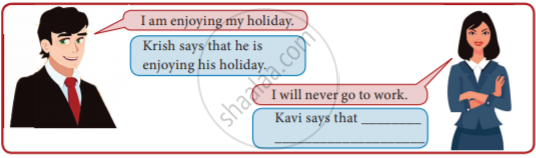
Read the different verb form where they remain the same in the direct and indirect speech in the following case. Fill in the blank with missing indirect speech.
When we report a universal truth (something that is always true)
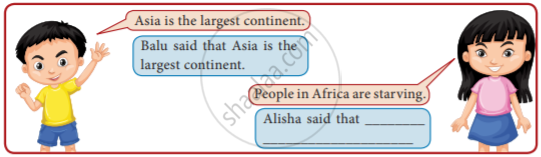
Read the conversation of the simple machines. Take roles to play. Then discuss in pairs to describe any simple machine. Create your own storyboard and take roles to play.
Jack: Don't you know how simple machines make your life easy?
Jimmy: Um... I don't know what simple machines are.
Jack: Simple machines are mechanical devices for applying force like a wedge or ramp.
Jimmy: Oh! wow! How I did not know this!
Jack: Like the wheels on hospital bed and IV pole. They help you move people faster by reducing the friction.
Jimmy: Is the stick over there that the TV is attached to, is that a simple machine too?
Jack: Yes it is, it's a lever. The wheels on the bus are simple machines, they make the bus move.
Jimmy: What about the doors?
Jack: 'Yeah' the driver pulls a lever and the doors open and you climb up the inclined plane aka the stairs. The cable in the elevator is wrapped around a groove in the wheel and axle, an electric motor pulls the cable, lifting the car between floors.
Jimmy: So the wheels on the rolling chair are too by rolling the chair back instead of lifting the chair back.
Jack: 'Yes' they are, they move the chair and reduce the friction.
Can you do an art work or a craft work on your own?
Answer the following:
|
A Tiny Little Plant Deep in the heart of a little seed, Out came the bright Sunshine, A little plant woke up to see, |
List the rhyming words in the first three lines.
Change the following into Indirect Speech.
“Are you coming home with me?” he asked.
Change the following into Indirect Speech.
“Halt!” shouted the officer to his men.
Change the following into Indirect Speech.
“Run away, children,” said their mother.
Change the following into Direct Speech.
The stranger asked Nasrin where she lived.
Some letter are missing in each word.
pl ______ se
Some letter are missing in each word.
t ______ se
Describe some of the sounds you hear at night.
Are you afraid of the dark? Why?
What is the word that starts with 'c' , rhymes with ‘near’ and ‘fear’, and means easy to see, hear and understand?
What is the script for children who cannot see called?
Do you think that –
Hiawatha called the birds ‘chickens’ and the beasts ‘brothers’? What do you think this shows?
Do you think that –
Do you know the secret language of any animal? Tell the class about it.
Work in pairs and arrive at five points that bring out the benefits and challenges of living in either a nuclear family or a joint family. Share your views with your class.
Given below are a few proverb. Prepare a short speech of two minutes on one of the proverb.
Together we can achieve more.
Ray Bradbury’s “All Summer in a Day” is a piece of science fiction. Discuss plots of similar stories with your partner and share your ideas with the class.
