Advertisements
Advertisements
Question
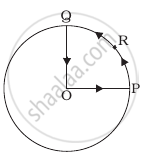
A cyclist starts from centre O of a circular park of radius 1 km and moves along the path OPRQO as shown figure. If he maintains constant speed of 10 ms–1, what is his acceleration at point R in magnitude and direction?
Advertisements
Solution
According to the problem, the path of the cyclist is OPRQO.
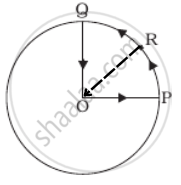
The cyclist is in uniform circular motion and it is given that linear velocity = 10 m/s, R = 1 km = 1000 m. As we know whenever an object is performing a circular motion, acceleration is called centripetal acceleration and is always directed towards the centre. So cyclist experiences a centripetal force (acceleration) at point R towards the centre.
The centripetal acceleration at R is given by the relation, `a_c = v^2/r`
⇒ `a_c = (10)^2/1000`
= `100/10^3`
= 0.1 m/s2 along RO.
APPEARS IN
RELATED QUESTIONS
A particle rotates in U.C.M. with tangential velocity V along a horizontal circle of diameter ‘D' . Total angular displacement of the particle in time 't' is..........
How does uniform circular motion differ from uniform linear motion?
Why is the motion of a body moving with a constant speed around a circular path said to be accelerated?
Give an example of motion in which speed remains uniform, but the velocity changes.
In a uniform circular motion, the speed continuously changes because of the direction of motion changes.
Complete a sentence and explain it.
When an object is in uniform circular motion, its ______ changes at every point.
What is a conical pendulum?
Solve the following problem.
A particle moves in a circle with a constant speed of 15 m/s. The radius of the circle is 2 m. Determine the centripetal acceleration of the particle.
The ratio of angular speed of a hour-hand to the second-hand of a watch is ____________.
Two particles P and Q are moving in concentric circles of rarui rp and rQ respectively. If their period of revolutions are in ratio 2 : 3, then ratio of their centripetal acceleration is ____________.
The angular speed of the minute hand of a clock in degrees per second is ______.
A cyclist is riding with a speed of 43.2 km/h. As he approaches a circular turn on the road of radius 60 m, he applies brakes and reduces his speed at constant rate of 1.8 ms-2. The magnitude of the net acceleration of the cyclist is ______.
In uniform motion, an object travels equal ______ in ______ interval of time.
A body moving along a circular path of radius R with velocity v, has centripetal acceleration a. If its velocity is made equal to 2v. What will be the centripetal acceleration?
A particle is performing a uniform circular motion along a circle of radius R. In half the period of revolution, its displacement and distance covered are respectively.
Two bodies of masses 10 kg and 5 kg moving in concentric orbits of radii R and r such that their periods are the same. Then the ratio between their centripetal accelerations is ______.
A body of mass m is moving in circle of radius r with a constant speed v. The work done by the centripetal force in moving the body over half the circumference of the circle is ______.
The relationship between an object's linear velocity (v) and its angular velocity (ω) in a circular path of radius (r) is given by:
By applying Kepler's third law to the formula for centripetal force, Newton concluded that the force acting on a planet is:
