Advertisements
Advertisements
Question
A particle rotates in U.C.M. with tangential velocity V along a horizontal circle of diameter ‘D' . Total angular displacement of the particle in time 't' is..........
Options
vt
(v/D)-t
vt/2D
2vt/D
Advertisements
Solution
`(2("vt"))/D`
Velocity= v ; Diameter= D →Radius= `D/2`
`omega=theta/t andv=r*omega`
`therefore v=D/2*theta/t`
`therefore theta=(2vt)/D`
APPEARS IN
RELATED QUESTIONS
Draw a neat labelled diagram of conical pendulum. State the expression for its periodic time in terms of length.
For a particle performing uniform circular motion `vecv=vecomegaxxvecr`obtain an expression for linear acceleration of the particle performing non-uniform circular motion.
How does uniform circular motion differ from uniform linear motion?
A uniform circular motion is an accelerated motion. Explain it. State whether the acceleration is uniform or variable? Name the force responsible to cause this acceleration. What is the direction of force at any instant? Draw a diagram in support of your answer.
A piece of stone tied at the end of a thread is whirled in a horizontal circle with uniform speed by hand. Answer the following questions:
- Is the velocity of stone uniform or variable?
- Is the acceleration of stone uniform or variable?
- What is the direction of acceleration of stone at any instant?
- Which force provides the centripetal force required for circular motion?
- Name the force and its direction which acts on the hand.
The motion of the moon around the earth in a circular path is an accelerated motion.
A uniform metre rule of mass 100g is balanced on a fulcrum at mark 40cm by suspending an unknown mass m at the mark 20cm.
To which side the rule will tilt if the mass m is moved to the mark 10cm ?
Answer the following question.
Show that the centripetal force on a particle undergoing uniform circular motion is -mrω2.
Solve the following problem.
A car moves in a circle at a constant speed of 50 m/s and completes one revolution in 40 s. Determine the magnitude of the acceleration of the car.
Which one of the following is most likely not a case of uniform circular motion?
The ratio of the angular speed of minute hand and hour hand of a watch is ____________.
A particle is moving in uniform circular motion with speed 'V' and radius 'R'. The angular acceleration of the particle is ______.
Select the WRONG statement.
A body of mass ·m' is moving along a circle of radius 'r' with linear speed 'v'. Now, to change the linear speed to `V/2` and to move it along the circle of radius '4r', required change in the centripetal force of the body is ______.
A particle is perfonning uniform circular motion. If 'θ', 'ω', 'α' and ' a' are its angular displacement, angular velocity, angular acceleration, and centripetal acceleration respectively, then which of the following is 'WRONG'?
The angular speed of the minute hand of a clock in degrees per second is ______.
A string of length `l` is fixed at one end and carries a mass 'm' at the other end. The mass is revolving along a horizontal circle of radius 'r' making 'θ' as the semi-vertical angle of cone and `(1/pi)` revolutions per second around the vertical axis through fixed end. The tension in the string is ______.
A body moves in a uniform circular motion ______.
Statement A: Uniform circular motion is a case of accelerated motion
Statement B: In the third equation of motion we do not have the term time
Which of the following is correct about uniform circular motion
- the direction of motion is continuously changed
- the direction of motion is not changed
- speed and direction both remain constant
- speed is constant but the direction is changing
In uniform motion, an object travels equal ______ in ______ interval of time.
It is possible to have objects moving with uniform velocity but non-uniform acceleration.
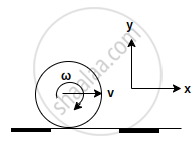
A disc of radius 5 cm rolls on a horizontal surface with linear velocity v = 1`hat"i"` m/s and angular velocity 50 rad/s. Height of particle from ground on rim of disc which has velocity in vertical direction is ______ cm.
A wheel is rotating at 900 rpm about its axis. When the power is cut off it comes to rest in 1 min. The angular retardation (assumed to be uniform (in rad s-1) is ______.
A thin uniform circular disc of mass M and radius R is rotating in a horizontal plane about an axis passing through its centre and perpendicular to its plane with an angular velocity ω. Another disc of same dimensions, but of mass `1/4`M is placed gently on the first disc co-axially. The. angular velocity of the system is ______.
The acceleration of a point on the rim of a flywheel 1 m in diameter, if it makes 1200 rpm is ______.
The kinetic energy K of a particle moving along a circle of radius R depends on the distance covered s as K = as2, where a is a constant. The force acting on the particle is ______.
A particle moving with uniform speed in a circular path maintains ______.
