Advertisements
Advertisements
Question
Which of the following graph represents uniform motion of a moving particle?
Options
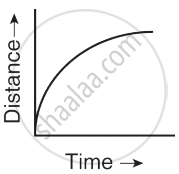

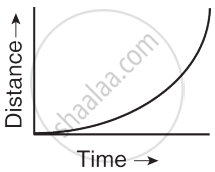
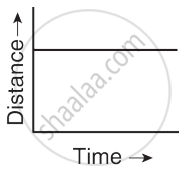
Advertisements
Solution

APPEARS IN
RELATED QUESTIONS
State True or False
The earth moves around the sun with a uniform.
A uniform linear motion is unaccelerated, while a uniform circular motion is an accelerated motion.
Which of the following quantity remains constant in a uniform circular motion?
The angle subtended by the vector A = `5hat"i" + 3hat"j" + 12hat"k"` with the X-axis is ______.
A particle is moving in uniform circular motion with speed 'V' and radius 'R'. The angular acceleration of the particle is ______.
A wheel is 0.25 m in radius. When it makes 15 revolutions per minute, its linear speed at the point on circumference is ____________.
A body moves in a uniform circular motion ______.
The distance of the Sun from earth is 1.5 × 10¹¹ m and its angular diameter is (2000) s when observed from the earth. The diameter of the Sun will be ______.
A thin uniform circular disc of mass M and radius R is rotating in a horizontal plane about an axis passing through its centre and perpendicular to its plane with an angular velocity ω. Another disc of same dimensions, but of mass `1/4`M is placed gently on the first disc co-axially. The. angular velocity of the system is ______.
The relationship between an object's linear velocity (v) and its angular velocity (ω) in a circular path of radius (r) is given by:
