Advertisements
Advertisements
Question
A certain sound has a frequency of 256 hertz and a wavelength of 1.3 m.
1) Calculate the speed with which this sound travels
2) What difference would be felt by a listener between the above sound and another sound traveling at the same speed, but of wavelength 2.6 m?
Advertisements
Solution
1) For first sound, f = 256 Hz and λ = 1.3 m
We know that
Speed v = f x λ = 256 x 1.3
→ v = 332.8 m s-1
Thus, the sound travels with a speed of 332.8 m s-1
2) For the second case, λ = 2.6 m and v = 332.8 m s-1
Frequency, f = `v/lambda = 332.8/2.6`
→ f = 128 Hz
The frequency of the first sound is more that of the second sound.
∴ The first sound will be shriller than the second sound
APPEARS IN
RELATED QUESTIONS
The displacement distance graph of two sound waves A and B, travelling in a medium, are as shown in the diagram below.
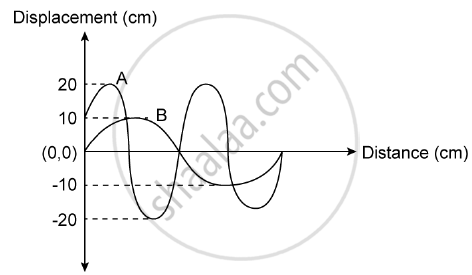
Study the two sound waves and compare their:
- Amplitudes
- Wavelengths
State two factors on which the speed of a wave travelling in a medium depends.
What is a stethoscope ? Name the principle on which a stethoscope works.
Write the approximate value of the speed of sound in air.
What is meant by echo depth sounding?
State two factors on which the natural frequency of a body depends.
When a sound is made from a distance of 18 m, in front of a tall building, it is found to get repeated again. Which phenomenon is associated with this observation? Give a brief explanation of this phenomenon?
Draw a diagram representing a wave of amplitude 4 cm and wavelength 2 m. If the frequency of the wave is 150 Hz, calculate its velocity.
(i) A man stands at a distance of 68 m from a cliff and fires a gun. After what time interval will he hear the echo, if the speed of sound in air is 340 ms−1?
(ii) If the man had been standing at a distance of 12 m from the cliff would he have heard a clear echo?
