Advertisements
Advertisements
Question
A body cools from 62°C to 54°C in 10 minutes and to 48°C in the next 10 minutes. Find the temperature of the surroundings.
Advertisements
Solution
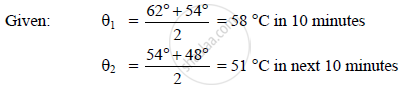
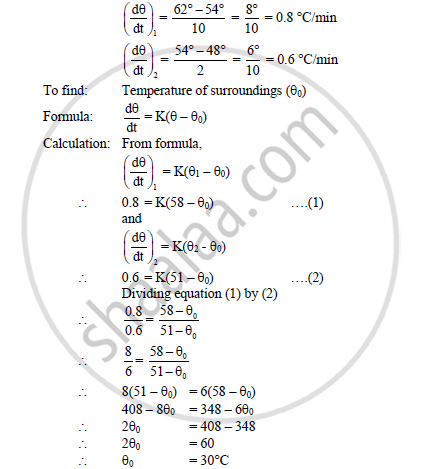
Temperature of surroundings is 30°C
APPEARS IN
RELATED QUESTIONS
A metal sphere cools at the rate of 4°C / min. when its temperature is 50°C. Find its rate of cooling at 45°C if the temperature of surroundings is 25°C.
Two copper spheres of radii 6 cm and 12 cm respectively are suspended in an evacuated enclosure. Each of them are at a temperature 15°C above the surroundings. The ratio of their rate of loss of heat is.................
- 2:1
- 1:4
- 1:8
- 8:1
Compute the temperature at which the r.m.s. speed of nitrogen molecules is 832 m/s. [Universal gas constant, R = 8320 J/k mole K, molecular weight of nitrogen = 28.]
It is said that mercury is used in defining the temperature scale because it expands uniformly with temperature. If the temperature scale is not yet defined, is it logical to say that a substance expands uniformly with temperature?
Is heat a conserved quantity?
In a calorimeter, the heat given by the hot object is assumed to be equal to the heat taken by the cold object. Does it mean that heat of the two objects taken together remains constant?
The atmospheric temperature in the cities on sea-coast change very little. Explain
Water equivalent of a body is measured in ___________ .
Which of the following pairs of physical quantities may be represented in the same unit?
The heat capacity of a body depends on
(a) the heat given
(b) the temperature raised
(c) the mass of the body
(d) the material of the body
If heat is supplied to a solid, its temperature
(a) must increase
(b) may increase
(c) may remain constant
(d) may decrease
The temperature of a solid object is observed to be constant during a period. In this period
(a) heat may have been supplied to the body
(b) heat may have been extracted from the body
(c) no heat is supplied to the body
(d) no heat is extracted from the body
A railway track (made of iron) is laid in winter when the average temperature is 18°C. The track consists of sections of 12.0 m placed one after the other. How much gap should be left between two such sections, so that there is no compression during summer when the maximum temperature rises to 48°C? Coefficient of linear expansion of iron = 11 × 10–6 °C–1.
A circular hole of diameter 2.00 cm is made in an aluminium plate at 0°C. What will be the diameter at 100°C? α for aluminium = 2.3 × 10⁻⁵ °C–1.
A steel rod of length 1 m rests on a smooth horizontal base. If it is heated from 0°C to 100°C, what is the longitudinal strain developed?
A steel ball that is initially at a pressure of 1.0 × 10⁵ Pa is heated from 20°C to 120°C, keeping its volume constant.
Find the pressure inside the ball. Coefficient of linear expansion of steel = 12 × 10–6 °C–1and bulk modulus of steel = 1.6 × 10¹¹ Nm–2.
Define one mole.
Our normal body temperature is ______.
Two objects are said to be in thermal contact if they can exchange heat energy.
Heat is measured in Celsius or centigrade.
Analogy
Evaporation:: 100°C: Freezing:: ______.
Two identical beakers A and B contain equal volumes of two different liquids at 60°C each and is left to cool down. Liquid in A has a density of 8 × 10² kg/m3 and specific heat of 2000 J kg-1 K-1 while the liquid in B has a density of 103 kg m-3 and specific heat of 4000 J kg-1 K-1. Which of the following best describes their temperature versus time graph schematically? (assume the emissivity of both the beakers to be the same.)
Heat given to a body that raises its temperature by 1°C is ______.
The temperature of a liquid drops from 365 K to 361 K in 2 min. Find the time during which the temperature of the liquid drops from 344 K to 342 K.
(Take, room temperature = 293 K)
What is the SI unit of heat?
Near the melting point of a solid, the heat supplied does NOT raise the temperature. Instead, what does it do?
What is the approximate interatomic spacing in gases at NTP (Normal Temperature and Pressure)?
The concept of thermal equilibrium, where heat flows between bodies until they reach the same temperature, is the basis of which law of thermodynamics?
