Advertisements
Advertisements
प्रश्न
A body cools from 62°C to 54°C in 10 minutes and to 48°C in the next 10 minutes. Find the temperature of the surroundings.
Advertisements
उत्तर
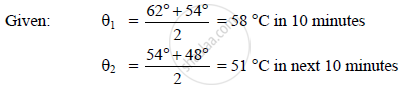
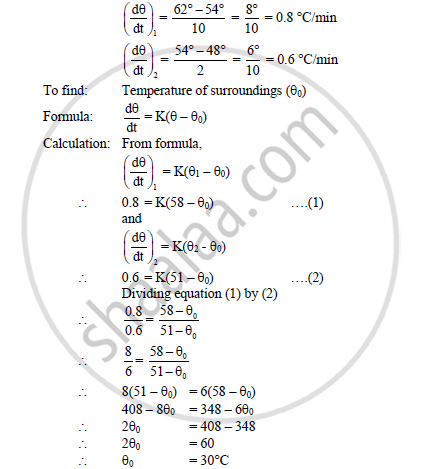
Temperature of surroundings is 30°C
APPEARS IN
संबंधित प्रश्न
Define emissive power and coefficient of emmision of a body.
A metal sphere cools at the rate of 4°C / min. when its temperature is 50°C. Find its rate of cooling at 45°C if the temperature of surroundings is 25°C.
The dimensions of emissive power are ______.
What is the temperature of the triple-point of water on an absolute scale whose unit interval size is equal to that of the Fahrenheit scale?
1000 tiny mercury droplets coalesce to form a bigger drop. In this process, temperature of the drop _______ .
(A) increases
(B) may increase or decrease
(C) decreases
(D) does not change
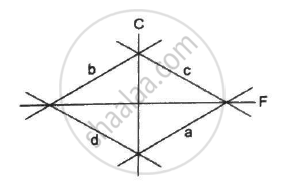
Which of the curves in the following figure represents the relation between Celsius and Fahrenheit temperatures?
Is heat a conserved quantity?
A spinning wheel A is brought in contact with another wheel B, initially at rest. Because of the friction at contact, the second wheel also starts spinning. Which of the following energies of the wheel B increases?
(a) Kinetic
(b) Total
(c) Mechanical
(d) Internal
A railway track (made of iron) is laid in winter when the average temperature is 18°C. The track consists of sections of 12.0 m placed one after the other. How much gap should be left between two such sections, so that there is no compression during summer when the maximum temperature rises to 48°C? Coefficient of linear expansion of iron = 11 × 10–6 °C–1.
The densities of wood and benzene at 0°C are 880 kg m3 and 900 kg m–3 , respectively. The coefficients of volume expansion are 1.2 × 10⁻³ °C–1 for wood and 1.5 × 10⁻³ °C–1for benzene. At what temperature will a piece of wood just sink in benzene?
A steel wire of cross-sectional area 0.5 mm2 is held between two fixed supports. If the wire is just taut at 20°C, determine the tension when the temperature falls to 0°C. Coefficient of linear expansion of steel is 1.2 × 10⁻⁵ °C–1 and its Young's modulus is 2.0 × 10⁻¹¹ Nm–2.
Define one mole.
Temperature and Heat are ______
Our normal body temperature is ______.
Two tumblers of A and B have water at 50°C temperature. If the water from A and B is poured into tumbler C. The temperature of C is ______.
Temperature in the form of energy.
Analogy
Evaporation:: 100°C: Freezing:: ______.
What is the SI unit of heat?
When two bodies at different temperatures are placed in contact, heat flows from ______.
Near the melting point of a solid, the heat supplied does NOT raise the temperature. Instead, what does it do?
1 calorie is equal to how many joules?
The concept of thermal equilibrium, where heat flows between bodies until they reach the same temperature, is the basis of which law of thermodynamics?
