Advertisements
Advertisements
प्रश्न
A body cools from 62°C to 54°C in 10 minutes and to 48°C in the next 10 minutes. Find the temperature of the surroundings.
Advertisements
उत्तर
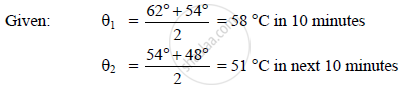
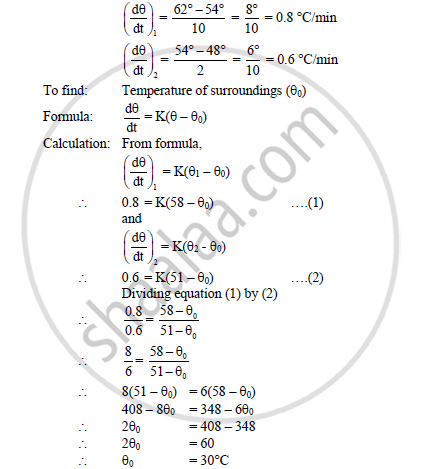
Temperature of surroundings is 30°C
APPEARS IN
संबंधित प्रश्न
A metal sphere cools at the rate of 4°C / min. when its temperature is 50°C. Find its rate of cooling at 45°C if the temperature of surroundings is 25°C.
Compute the temperature at which the r.m.s. speed of nitrogen molecules is 832 m/s. [Universal gas constant, R = 8320 J/k mole K, molecular weight of nitrogen = 28.]
A metal ball cools from 64 °C to 50 °C in 10 minutes and to 42 °C in next 10 minutes. The ratio of rates of fall of temperature during the two intervals is _______.
The susceptibility of magnesium at 300K is 1.2 x 10⁻⁵. At what temperature will the susceptibility increase to 1.8 X 10⁻⁵?
Does the temperature of a body depend on the frame from which it is observed?
It is said that mercury is used in defining the temperature scale because it expands uniformly with temperature. If the temperature scale is not yet defined, is it logical to say that a substance expands uniformly with temperature?
The temperature of water at the surface of a deep lake is 2°C. The temperature expected at the bottom is
An aluminium sphere is dipped into water at 10°C. If the temperature is increased, the force of buoyancy
A spinning wheel is brought in contact with an identical wheel spinning at identical speed. The wheels slow down under the action of friction. Which of the following energies of the first wheel decreases?
(a) Kinetic
(b) Total
(c) Mechanical
(d) Internal
A spinning wheel A is brought in contact with another wheel B, initially at rest. Because of the friction at contact, the second wheel also starts spinning. Which of the following energies of the wheel B increases?
(a) Kinetic
(b) Total
(c) Mechanical
(d) Internal
When a solid melts or a liquid boils, the temperature does not increase even when heat is supplied. Where does the energy go?
A person's skin is more severely burnt when put in contact with 1 g of steam at 100°C than when put in contact with 1 g of water at 100°C. Explain
Water equivalent of a body is measured in ___________ .
The heat capacity of a body depends on
(a) the heat given
(b) the temperature raised
(c) the mass of the body
(d) the material of the body
The temperature of a solid object is observed to be constant during a period. In this period
(a) heat may have been supplied to the body
(b) heat may have been extracted from the body
(c) no heat is supplied to the body
(d) no heat is extracted from the body
A resistance thermometer reads R = 20.0 Ω, 27.5 Ω, and 50.0 Ω at the ice point (0°C), the steam point (100°C) and the zinc point (420°C), respectively. Assuming that the resistance varies with temperature as Rθ = R0 (1 + αθ + βθ2), find the values of R0, α and β. Here θ represents the temperature on the Celsius scale.
The volume of a glass vessel is 1000 cc at 20°C. What volume of mercury should be poured into it at this temperature so that the volume of the remaining space does not change with temperature? Coefficients of cubical expansion of mercury and glass are 1.8 × 10⁻⁶ °C–1 and 9.0 × 10⁻⁶ °C–1 , respectively.
The densities of wood and benzene at 0°C are 880 kg m3 and 900 kg m–3 , respectively. The coefficients of volume expansion are 1.2 × 10⁻³ °C–1 for wood and 1.5 × 10⁻³ °C–1for benzene. At what temperature will a piece of wood just sink in benzene?
Answer the following question.
Clearly, state the difference between heat and temperature?
Our normal body temperature is ______.
Temperature in the form of energy.
Two identical beakers A and B contain equal volumes of two different liquids at 60°C each and is left to cool down. Liquid in A has a density of 8 × 10² kg/m3 and specific heat of 2000 J kg-1 K-1 while the liquid in B has a density of 103 kg m-3 and specific heat of 4000 J kg-1 K-1. Which of the following best describes their temperature versus time graph schematically? (assume the emissivity of both the beakers to be the same.)
Heat given to a body that raises its temperature by 1°C is ______.
What is the SI unit of heat?
What is the dimensional formula of heat?
Which state of matter has particles that vibrate about fixed equilibrium positions?
