Advertisements
Advertisements
Question
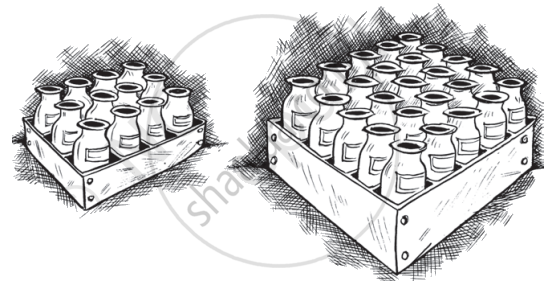
A batch of bottles was packed in 25 boxes with 12 bottles in each box. If the same batch is packed using 20 bottles in each box, how many boxes would be filled?
Advertisements
Solution
Let the number of boxes filled, by using 20 bottles in each box, be x.
The following table is obtained:
| Number of bottles | 12 | 20 |
| Number of boxes | 25 | x |
The more the number of bottles, the less will be the number of boxes.
Therefore,
12 × 25 = 20 × x
`x = (12 xx 25)/20`
x = 15
Hence, the number of boxes required to pack these bottles is 15.
RELATED QUESTIONS
Find the constant of variation from the table given below:
| x | 3 | 5 | 7 | 9 |
| y | 12 | 20 | 28 | 36 |
Set up a table and solve the following problems. Use unitary method to verify the answer.
In a hostel of 50 girls, there are food provisions for 40 days. If 30 more girls join the hostel, how long will these provisions last?
Mohanrao took 10 days to finish a book, reading 40 pages every day. How many pages must be read in a day to finish it in 8 days?
16 taps can fill a petrol tank in 18 minutes. The time taken for 9 taps to fill the same tank will be _________ minutes
6 pumps are required to fill a water sump in 1 hr 30 minutes. What will be the time taken to fill the sump if one pump is switched off?
Six men can complete a work in 12 days. Two days later, 6 more men joined them. How many days will they take to complete the remaining work?
When the speed is kept fixed, time and distance vary inversely with each other.
If a tree 24 m high casts a shadow of 15 m, then the height of a pole that casts a shadow of 6 m under similar conditions is 9.6 m.
Write whether the following statement vary directly, vary inversely with each other, or neither of the two.
Increase in cost and number of shirts that can be purchased if the budget remains the same.
Find the values of x and y if a and b are in inverse proportion:
- 12 x 8
- 30 5 y
