Advertisements
Advertisements
प्रश्न
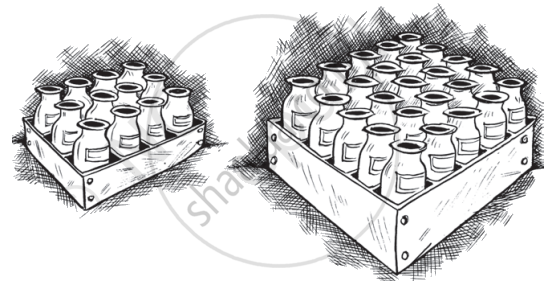
A batch of bottles was packed in 25 boxes with 12 bottles in each box. If the same batch is packed using 20 bottles in each box, how many boxes would be filled?
Advertisements
उत्तर
Let the number of boxes filled, by using 20 bottles in each box, be x.
The following table is obtained:
| Number of bottles | 12 | 20 |
| Number of boxes | 25 | x |
The more the number of bottles, the less will be the number of boxes.
Therefore,
12 × 25 = 20 × x
`x = (12 xx 25)/20`
x = 15
Hence, the number of boxes required to pack these bottles is 15.
संबंधित प्रश्न
Which of the following quantities vary inversely as other?
The length x of a journey by bus and price y of the ticket.
6 pumps are required to fill a water sump in 1 hr 30 minutes. What will be the time taken to fill the sump if one pump is switched off?
12 cows can graze a field for 10 days. 20 cows can graze the same field for _______ days
4 typists are employed to complete a work in 12 days. If two more typists are added, they will finish the same work in _________ days
A flood relief camp has food stock by which 80 people can be benefited for 60 days. After 10 days 20 more people have joined the camp. Calculate the number of days of food shortage due to the addition of 20 more people?
If two quantities p and q vary inversely with each other, then ______
If on increasing a, b decreases in such a manner that ______ remains ______ and positive, then a and b are said to vary inversely with each other.
Length of a side of an equilateral triangle and its perimeter vary inversely with each other.
If x varies inversely as y and x = 20 when y = 600, find y when x = 400.
If a and b vary inversely to other, then find the values of p, q, r ; x, y, z and l, m, n.
| a | l | 9 | n | 6 |
| b | 5 | m | 25 | 10 |
