Advertisements
Advertisements
Question
A and B can polish the floors of a building in 10 days. A alone can do \[\frac{1}{4}\] th of it in 12 days. In how many days can B alone polish the floor ?
Advertisements
Solution
\[\text{ It is given that A and B can polish the floors of the building in 10 days } . \]
\[ \therefore \text{ Work done by } \left( A + B \right) \text{ in 1 day } = \frac{1}{10}\]
\[\text{ Now, A alone can do } \frac{1}{4} \text{ th of the work in 12 days } . \]
\[ \therefore \text{ Time taken by A alone to do the complete work } = \left( 4 \times 12 \right) = 48 \text{ days} \]
\[ \Rightarrow \text{ Work done by A in 1 day }= \frac{1}{48}\]
\[ \text{ Now, work done by B in 1 day = Work done by } \left( A + B \right) \text{ in 1 day } - \text { Work done by A in 1 day } \]
\[ = \frac{1}{10} - \frac{1}{48}\]
\[ = \frac{24 - 5}{240} = \frac{19}{240}\]
\[ \text{ Thus, B alone can polish the floor in } \frac{240}{19} \text{ days or } 12\frac{12}{19} \text{ days } . \]
RELATED QUESTIONS
Fill in the blank in of the following so as to make the statement true:
x and y are said to vary directly with each other if for some positive number k ....,...... = k.
Two taps A and B can fill an overhead tank in 10 hours and 15 hours respectively. Both the taps are opened for 4 hours and they B is turned off. How much time will A take to fill the remaining tank?
Two mobiles cost 16,000 rupees. How much money will be required to buy 13 such mobiles?
If C = kd
(i) what is the relation between C and d?
(ii) find k when C = 30 and d = 6
(iii) find C, when d = 10
l varies directly as m and l is equal to 5, when `m = 2/3`. Find l when `m = 16/3`.
Campus and Welfare Committee of school is planning to develop a blue shade for painting the entire school building. For this purpose various shades are tried by mixing containers of blue paint and white paint. In the following mixtures, decide which is a lighter shade of blue and also find the lightest blue shade among all of them.
| Mixture C | Mixture D |
 |
 |
If one container has one litre paint and the building requires 105 litres for painting, how many container of each type is required to paint the building by darkest blue shade?
Match each of the entries in Column I with the appropriate entry in Column II
| Column I | Column II |
| 1. x and y vary inversely to each other | A. `x/y` = Constant |
| 2. Mathematical representation of inverse variation of quantities p and q |
B. y will increase in proportion |
| 3. Mathematical representation of direct variation of quantities m and n |
C. xy = Constant |
| 4. When x = 5, y = 2.5 and when y = 5, x = 10 | D. `p oo 1/q` |
| 5. When x = 10, y = 5 and when x = 20, y = 2.5 | E. y will decrease in proportion |
| 6. x and y vary directly with each other | F. x and y are directly proportional |
| 7. If x and y vary inversely then on decreasing x | G. `m oo n` |
| 8. If x and y vary directly then on decreasing x | H. x and y vary inversely |
| I. `p oo q` | |
| J. `m oo 1/n` |
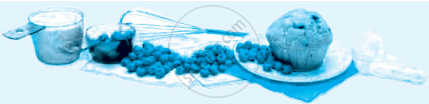
A recipe for a particular type of muffins requires 1 cup of milk and 1.5 cups of chocolates. Riya has 7.5 cups of chocolates. If she is using the recipe as a guide, how many cups of milk will she need to prepare muffins?
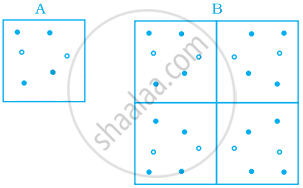
Pattern B consists of four tiles like pattern A. Write a proportion involving red dots and blue dots in pattern A and B. Are they in direct proportion? If yes, write the constant of proportion.