Advertisements
Advertisements
Question
If 600 rupees buy 15 bunches of feed, how many will 1280 rupees buy?
Advertisements
Solution 1
Let us suppose x bunches of feed can be bought for 1280 rupees.
The number of bunches of feed and their cost vary in direct proportion.
∴ `15/600 = "x"/1280`
⇒ x = `(15 xx 1280)/600`
⇒ x = `(15 xx128)/60`
⇒ x = `(1920)/60`
x = 32
Hence, 32 bunches of feed can be bought for 1280 rupees.
Solution 2
We are given that 600 rupees can buy 15 bunches of feed.
First, find the cost of 1 bunch:
⇒ `600/15 = 40` rupees per bunch
Now, calculate how many bunches 1280 rupees can buy:
⇒ `1280/40 = 32`
Thus, 1280 rupees can buy 32 bunches of feed.
RELATED QUESTIONS
In Question 2 above, if 1 part of a red pigment requires 75 mL of base, how much red pigment should we mix with 1800 mL of base?
A car is travelling at the average speed of 50 km/hr. How much distance would it travel in 12 minutes?
A group of 21 students paid ₹ 840 as the entry fee for a magic show. How many students entered the magic show if the total amount paid was ₹ 1680?
The perimeter of a circle and its diameter vary ______ with each other.
Write whether the following statement vary directly, vary inversely with each other, or neither of the two.
Simple interest on a given sum and the rate of interest.
The variable x varies directly as y and x = 80 when y is 160. What is y when x is 64?
The mass of an aluminum rod varies directly with its length. If a 16 cm long rod has a mass of 192 g, find the length of the rod whose mass is 105 g.
Match each of the entries in Column I with the appropriate entry in Column II
| Column I | Column II |
| 1. x and y vary inversely to each other | A. `x/y` = Constant |
| 2. Mathematical representation of inverse variation of quantities p and q |
B. y will increase in proportion |
| 3. Mathematical representation of direct variation of quantities m and n |
C. xy = Constant |
| 4. When x = 5, y = 2.5 and when y = 5, x = 10 | D. `p oo 1/q` |
| 5. When x = 10, y = 5 and when x = 20, y = 2.5 | E. y will decrease in proportion |
| 6. x and y vary directly with each other | F. x and y are directly proportional |
| 7. If x and y vary inversely then on decreasing x | G. `m oo n` |
| 8. If x and y vary directly then on decreasing x | H. x and y vary inversely |
| I. `p oo q` | |
| J. `m oo 1/n` |
Here is a keyboard of a harmonium: What is the ratio of black keys to all keys on the given keyboard.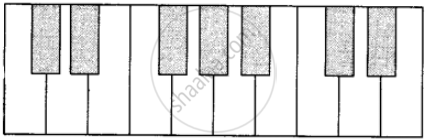
The students of Anju’s class sold posters to raise money. Anju wanted to create a ratio for finding the amount of money her class would make for different numbers of posters sold. Could Anju’s class raise exactly Rs 2,000? If so, how many posters would they need to sell? If not, why?
