Advertisements
Advertisements
Question
Mohan takes 9 hours to mow a large lawn. He and Sohan together can mow it in 4 hours. How long will Sohan take to mow the lawn if he works alone?
Advertisements
Solution
\[\text{ Time taken by Mohan to do the work = 9 hours} \]
\[\text{ Time taken by Mohan and Sohan to do the work = 4 hours } \]
\[ \therefore \text{ Work done by Mohan } = \frac{1}{9}\]
\[\text{ Work done by Mohan and Sohan } = \frac{1}{4}\]
\[ \therefore \text{ Work done by Sohan } = \frac{1}{4} - \frac{1}{9}\]
\[ = \frac{9 - 4}{36} = \frac{5}{36}\]
\[\text{ Thus, Sohan can do the work in } \frac{36}{5} \text{ hours i . e } . 7\frac{1}{5}\text{ hours } .\]
RELATED QUESTIONS
Sita can finish typing a 100 page document in 9 hours. Mita in 6 hours and Rita in 12 hours. How long will they take to type a 100 page document if they work together?
A cistern has two inlets A and B which can fill it in 12 hours and 15 hours respectively. An outlet can empty the full cistern in 10 hours. If all the three pipes are opened together in the empty cistern, how much time will they take to fill the cistern completely?
Distance travelled by a bus and time taken are in direct proportion
If the distance travelled by a rickshaw in one hour is 10 km, then the distance travelled by the same rickshaw with the same speed in one minute is ______.
Both x and y vary directly with each other and when x is 10, y is 14, which of the following is not a possible pair of corresponding values of x and y?
If x = 5y, then x and y vary ______ with each other.
An auto rickshaw takes 3 hours to cover a distance of 36 km. If its speed is increased by 4 km/h, the time taken by it to cover the same distance is ______.
In a camp, there is enough flour for 300 persons for 42 days. How long will the flour last if 20 more persons join the camp?
Campus and Welfare Committee of school is planning to develop a blue shade for painting the entire school building. For this purpose various shades are tried by mixing containers of blue paint and white paint. In the following mixtures, decide which is a lighter shade of blue and also find the lightest blue shade among all of them.
| Mixture C | Mixture D |
 |
 |
If one container has one litre paint and the building requires 105 litres for painting, how many container of each type is required to paint the building by darkest blue shade?
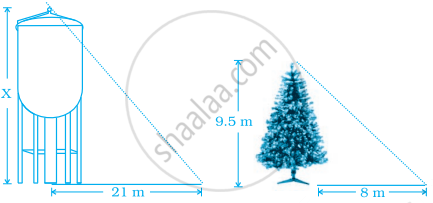
A water tank casts a shadow 21 m long. A tree of height 9.5 m casts a shadow 8 m long at the same time. The lengths of the shadows are directly proportional to their heights. Find the height of the tank.