Advertisements
Online Mock Tests
Chapters
1: GST [Goods and Service Tax]
2: Banking (Recurring Deposit Account)
3: Shares and Dividend
Unit 2. Algebra
4: Linear Inequations (In one variable)
5: Quadratic Equations
6: Solving (simple) Problems (Based on Quadratic Equations)
7: Ratio and Proportion (Including Properties and Uses)
8: Factorization of Polynomials (Remainder and Factor Theorems)
9: Matrices
10: Arithmetic Progression
11: Geometric Progression
Unit 3. Co-ordinate Geometry
12: Reflection
13: Section Formula and Mid-Point Formula
14: Equation of a Line
Unit 4. Geometry
15: Similarity (With Applications to Maps and Models)
▶ 16: Loci (Locus and Its Constructions)
17: Circles
18: Tangents and Intersecting Chords
19: Constructions (Circles)
Unit 5. Mensuration
20: Cylinder, Cone and Sphere
Unit 6. Trigonometry
21: Trigonometrical Identities
22: Height and Distances
Unit 7. Statistics
23: Graphical Representation
24: Measure of Central Tendency (Mean, Median, Quartiles and Mode)
25: Probability

Advertisements
Solutions for Chapter 16: Loci (Locus and Its Constructions)
Below listed, you can find solutions for Chapter 16 of CISCE Selina for कन्साइस माठेमटिक्स [इंग्रजी] इयत्ता १० आयसीएसई.
Selina solutions for कन्साइस माठेमटिक्स [इंग्रजी] इयत्ता १० आयसीएसई 16 Loci (Locus and Its Constructions) EXERCISE 16 (A) [Pages 241 - 242]
Multiple Choice Type: Choose the correct answer from the options given below.
P is a point on perpendicular bisector of side BC of △ABC, then ______.
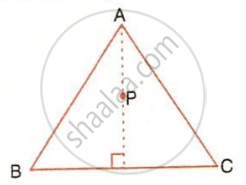
PA = PB
PB = PC
PA = PC
none of these
P is a point on bisector of angle A of △ABC. Then:
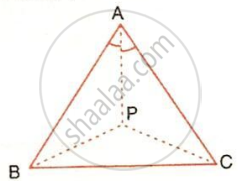
P is equidistant from the vertices B and C.
PA = PC
PA = PB
P is equidistant from sides AB and AC.
The perpendicular bisector of side AB and bisector of angle ∠A of △ABC meet at point P. Then:
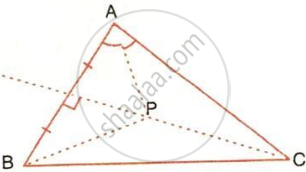
PA = PB
PA = PC
PB = PC
PB bisects ∠ABC
Using the information in the given diagram, state if:
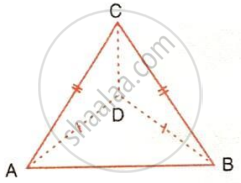
AD = DC
BD = DC
CD bisects angle ACB
angle CAD is greater than angle DAB
Bisector of ∠B of △ABC intersects side AC at point P, then point P is ______.
equidistant from vertices A and C
PA = PB
PB = PC
equidistant from sides AB and BC
Given: PQ is perpendicular bisector of side AB of the triangle ABC.

Prove: Q is equidistant from A and B.
Given: CP is bisector of angle C of ΔABC.

Prove: P is equidistant from AC and BC.
Given: AX bisects angle BAC and PQ is perpendicular bisector of AC which meets AX at point Y.

Prove:
- X is equidistant from AB and AC.
- Y is equidistant from A and C.
Construct a triangle ABC, in which AB = 4.2 cm, BC = 6.3 cm and AC = 5 cm. Draw perpendicular bisector of BC which meets AC at point D. Prove that D is equidistant from B and C.
In each of the given figures; PA = PB and QA = QB.
| i. |  |
| ii. | 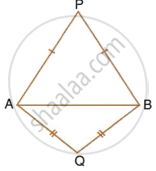 |
Prove, in each case, that PQ (produce, if required) is perpendicular bisector of AB. Hence, state the locus of the points equidistant from two given fixed points.
Construct a triangle ABC in which angle ABC = 75°, AB = 5 cm and BC = 6.4 cm. Draw perpendicular bisector of side BC and also the bisector of angle ACB. If these bisectors intersect each other at point P; prove that P is equidistant from B and C; and also from AC and BC.
In parallelogram ABCD, side AB is greater than side BC and P is a point in AC such that PB bisects angle B. Prove that P is equidistant from AB and BC.
In triangle LMN, bisectors of interior angles at L and N intersect each other at point A. Prove that:
- Point A is equidistant from all the three sides of the triangle.
- AM bisects angle LMN.
Use ruler and compasses only for this question.
- Construct ΔABC, where AB = 3.5 cm, BC = 6 cm and ∠ABC = 60°.
- Construct the locus of points inside the triangle which are equidistant from BA and BC.
- Construct the locus of points inside the triangle which are equidistant from B and C.
- Mark the point P which is equidistant from AB, BC and also equidistant from B and C. Measure and record the length of PB.
Selina solutions for कन्साइस माठेमटिक्स [इंग्रजी] इयत्ता १० आयसीएसई 16 Loci (Locus and Its Constructions) EXERCISE 16 (B) [Pages 244 - 245]
Multiple Choice Type: Choose the correct answer from the options given below.
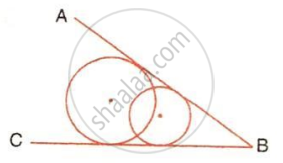
The locus of the centres of all the circles, which are tangents to the arms AB and BC of angle ABC is ______.
perpendicular bisector of arm AB
perpendicular bisector of arm BC
bisector of angle ABC
none of these
P is a moving point and AB is a chord of a circle. If P moves, within this circle, in such a way that it is at equal distances from points A and B. The locus of P is ______.
a chord perpendicular to chord AB
a chord that bisects the chord AB
a diameter of the circle
the diameter of the circle which is perpendicular to chord AB
AB is a line segment. A point P moves in such a way that the triangle APB is always an isosceles triangle with base AB. The locus of point P is the line which ______.
is parallel to AB.
is perpendicular to AB.
is perpendicular bisector of AB.
passes through the mid-point of AB.
AB is a line segment and P is a moving point that moves in such a way that it is always equidistant from AB. The locus of point P is the line which ______.
is parallel to AB and through point P.
is perpendicular to AB through point P.
is perpendicular bisector of AB.
passes through the mid-point of AB.
A point P moves in such a way that it is at a distance less than or equal to 5 cm from a fixed point O. The locus of point P is ______.
a circle with radius 5 cm.
a circle with OP as radius.
a circle with diameter of 10 cm.
a circle of radius 5 cm (including circumference of the circle and inside of it) and the fixed point O as its centre.
Describe the locus of points at distances less than 3 cm from a given point.
Describe the locus of points at a distance 2 cm from a fixed line.
Describe the locus of the centre of a wheel of a bicycle going straight along a level road.
Describe the locus of the moving end of the minute hand of a clock.
Describe the locus of a stone dropped from the top of a tower.
Describe the locus of a runner, running around a circular track and always keeping a distance of 1.5 m from the inner edge.
Describe the locus of the door handle, as the door opens.
Describe the locus of points inside a circle and equidistant from two fixed points on the circumference of the circle.
Describe the locus of the centres of all circles passing through two fixed points.
Describe the locus of vertices of all isosceles triangles having a common base.
Describe the locus of a point P, so that:
AB2 = AP2 + BP2,
where A and B are two fixed points.
Describe the locus of a point in rhombus ABCD, so that it is equidistant from
- AB and BC;
- B and D.
Describe the locus of points at distances less than 3 cm from a given point.
Describe the locus of points at distances greater than 4 cm from a given point.
Describe the locus of points at distances less than or equal to 2.5 cm from a given point.
Describe the locus of points at distances greater than or equal to 35 mm from a given point.
Describe the locus of the centre of a given circle which rolls around the outside of a second circle and is always touching it.
Describe the locus of the centres of all circles that are tangent to both the arms of a given angle.
Describe the locus of the mid-points of all chords parallel to a given chord of a circle.
Describe the locus of points within a circle that are equidistant from the end points of a given chord.
A straight line AB is 8 cm long. Draw and describe the locus of a point which is:
- always 4 cm from the line AB.
- equidistant from A and B.
Mark the two points X and Y, which are 4 cm from AB and equidistant from A and B. Describe the figure AXBY.
Selina solutions for कन्साइस माठेमटिक्स [इंग्रजी] इयत्ता १० आयसीएसई 16 Loci (Locus and Its Constructions) TEST YOURSELF [Pages 245 - 246]
Multiple Choice Type: Choose the correct answer from the options given below.
The locus of a point which is equidistant from two non-parallel lines AB and CD is ______.
perpendicular to AB.
perpendicular to CD.
bisector of angle between AB and CD.
perpendicular bisector of CD.
Three isosceles triangles PBC, QBC and RBC are on the same base, then ______.
P, Q and R are collinear.
△PQR is isosceles triangle.
Q lies on the circumference of a circle with BC as diameter.
Q is mid-point of line segment PR.
Locus of the centres of the circles passing through two fixed points A and B is ______.
a line parallel to line segment AB.
the bisector of line segment AB.
perpendicular to line segment AB.
perpendicular bisector of line segment AB.
A point is equidistant from the sides of an obtuse angle triangle. The point is called ______.
circumcentre of the triangle
incentre of the triangle
centroid of the triangle
orthocentre of the triangle
In △ABC, point P moves such that it remains at a fixed distance (i.e. radius) of 2.8 cm from vertex B. The locus of point P is ______.
bisector of angle ABC.
a line parallel to BC and at a distance of 2.8 cm from it.
circle with centre at point B and radius = 2.8 cm.
perpendicular bisector of BC.
Draw an ∠ABC = 60°, having AB = 4.6 cm and BC = 5 cm. Find a point P equidistant from AB and BC; and also equidistant from A and B.
On a graph paper, draw the lines x = 3 and y = –5. Now, on the same graph paper, draw the locus of the point which is equidistant from the given lines.
On a graph paper, draw the line x = 6. Now, on the same graph paper, draw the locus of the point which moves in such a way that its distantce from the given line is always equal to 3 units
Ruler and compasses may be used in this question. All construction lines and arcs must be clearly shown and be of sufficient length and clarity to permit assessment.
- Construct a ΔABC, in which BC = 6 cm, AB = 9 cm and angle ABC = 60°.
- Construct the locus of all points inside triangle ABC, which are equidistant from B and C.
- Construct the locus of the vertices of the triangles with BC as base and which are equal in area to triangle ABC.
- Mark the point Q, in your construction, which would make ΔQBC equal in area to ΔABC, and isosceles.
- Measure and record the length of CQ.
Construct an isosceles triangle ABC such that AB = 6 cm, BC = AC = 4 cm. Bisect ∠C internally and mark a point P on this bisector such that CP = 5 cm. Find the points Q and R which are 5 cm from P and also 5 cm from the line AB.
Construct a triangle BCP given BC = 5 cm, BP = 4 cm and ∠PBC = 45°.
- Complete the rectangle ABCD such that:
- P is equidistant from AB and BC.
- P is equidistant from C and D.
- Measure and record the length of AB.
Use ruler and compass only for the following question. All construction lines and arcs must be clearly shown.
- Construct a ΔABC in which BC = 6.5 cm, ∠ABC = 60°, AB = 5 cm.
- Construct the locus of points at a distance of 3.5 cm from A.
- Construct the locus of points equidistant from AC and BC.
- Mark 2 points X and Y which are at a distance of 3.5 cm from A and also equidistant from AC and BC. Measure XY.
Solutions for 16: Loci (Locus and Its Constructions)
Selina solutions for कन्साइस माठेमटिक्स [इंग्रजी] इयत्ता १० आयसीएसई chapter 16 - Loci (Locus and Its Constructions)
Shaalaa.com has the CISCE Mathematics कन्साइस माठेमटिक्स [इंग्रजी] इयत्ता १० आयसीएसई CISCE solutions in a manner that help students grasp basic concepts better and faster. The detailed, step-by-step solutions will help you understand the concepts better and clarify any confusion. Selina solutions for Mathematics कन्साइस माठेमटिक्स [इंग्रजी] इयत्ता १० आयसीएसई CISCE 16 (Loci (Locus and Its Constructions)) include all questions with answers and detailed explanations. This will clear students' doubts about questions and improve their application skills while preparing for board exams.
Further, we at Shaalaa.com provide such solutions so students can prepare for written exams. Selina textbook solutions can be a core help for self-study and provide excellent self-help guidance for students.
Concepts covered in कन्साइस माठेमटिक्स [इंग्रजी] इयत्ता १० आयसीएसई chapter 16 Loci (Locus and Its Constructions) are Points Equidistant from Two Given Points, Points Equidistant from Two Intersecting Lines, Summary of Important Results on Locus, Locus, Important Points on Concurrency in a Triangle, Points Equidistant from Two Given Points, Points Equidistant from Two Intersecting Lines, Summary of Important Results on Locus, Locus, Important Points on Concurrency in a Triangle, Points Equidistant from Two Given Points, Points Equidistant from Two Intersecting Lines, Summary of Important Results on Locus, Locus, Important Points on Concurrency in a Triangle.
Using Selina कन्साइस माठेमटिक्स [इंग्रजी] इयत्ता १० आयसीएसई solutions Loci (Locus and Its Constructions) exercise by students is an easy way to prepare for the exams, as they involve solutions arranged chapter-wise and also page-wise. The questions involved in Selina Solutions are essential questions that can be asked in the final exam. Maximum CISCE कन्साइस माठेमटिक्स [इंग्रजी] इयत्ता १० आयसीएसई students prefer Selina Textbook Solutions to score more in exams.
Get the free view of Chapter 16, Loci (Locus and Its Constructions) कन्साइस माठेमटिक्स [इंग्रजी] इयत्ता १० आयसीएसई additional questions for Mathematics कन्साइस माठेमटिक्स [इंग्रजी] इयत्ता १० आयसीएसई CISCE, and you can use Shaalaa.com to keep it handy for your exam preparation.
