Advertisements
Advertisements
प्रश्न
In parallelogram ABCD, side AB is greater than side BC and P is a point in AC such that PB bisects angle B. Prove that P is equidistant from AB and BC.
Advertisements
उत्तर
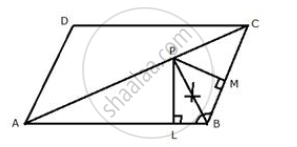
Construction: From P, draw PL ⊥ AB and PM ⊥ BC
Proof: In ΔPLB and ΔPMB
∠PLB = ∠PMB ...(Each = 90°)
∠PBL = ∠PBM ...(Given)
PB = PB ...(Common)
∴ By Angle – angle side criterion of congruence,
ΔPLB ≅ ΔPMB ...(AAS postulate)
The corresponding parts of the congruent triangles are congruent
∴ PL = PM ...(C.P.C.T.)
Hence, P is equidistant from AB and BC
APPEARS IN
संबंधित प्रश्न
Construct a right angled triangle PQR, in which ∠Q = 90°, hypotenuse PR = 8 cm and QR = 4.5 cm. Draw bisector of angle PQR and let it meets PR at point T. Prove that T is equidistant from PQ and QR.
Use ruler and compasses only for this question.
- Construct ΔABC, where AB = 3.5 cm, BC = 6 cm and ∠ABC = 60°.
- Construct the locus of points inside the triangle which are equidistant from BA and BC.
- Construct the locus of points inside the triangle which are equidistant from B and C.
- Mark the point P which is equidistant from AB, BC and also equidistant from B and C. Measure and record the length of PB.
The given figure shows a triangle ABC in which AD bisects angle BAC. EG is perpendicular bisector of side AB which intersects AD at point F.
Prove that:

F is equidistant from A and B.
In the given triangle ABC, find a point P equidistant from AB and AC; and also equidistant from B and C.

Describe the locus of points at a distance 2 cm from a fixed line.
Sketch and describe the locus of the vertices of all triangles with a given base and a given altitude.
In a quadrilateral ABCD, if the perpendicular bisectors of AB and AD meet at P, then prove that BP = DP.
Prove that the common chord of two intersecting circles is bisected at right angles by the line of centres.
Find the locus of the centre of a circle of radius r touching externally a circle of radius R.
Use ruler and compasses for the following question taking a scale of 10 m = 1 cm. A park in a city is bounded by straight fences AB, BC, CD and DA. Given that AB = 50 m, BC = 63 m, ∠ABC = 75°. D is a point equidistant from the fences AB and BC. If ∠BAD = 90°, construct the outline of the park ABCD. Also locate a point P on the line BD for the flag post which is equidistant from the corners of the park A and B.
