Advertisements
Advertisements
प्रश्न
Given: ∠BAC, a line intersects the arms of ∠BAC in P and Q. How will you locate a point on line segment PQ, which is equidistant from AB and AC? Does such a point always exist?
Advertisements
उत्तर
Since, locus of points equidistant from AB and AC is the bisector of ∠BAC. Draw the bisector of ∠BAC intersecting PQ at R.
Since,R is on the bisector, so it is equidistant from AB and AC.
Yes, such a point always exists as there will be definitely a point where angular bisector and line will intersect.
Hence, R is the required point.
APPEARS IN
संबंधित प्रश्न
The given figure shows a triangle ABC in which AD bisects angle BAC. EG is perpendicular bisector of side AB which intersects AD at point F.
Prove that:

F is equidistant from AB and AC.
The bisectors of ∠B and ∠C of a quadrilateral ABCD intersect each other at point P. Show that P is equidistant from the opposite sides AB and CD.
Draw a line AB = 6 cm. Draw the locus of all the points which are equidistant from A and B.
Draw an angle ABC = 75°. Draw the locus of all the points equidistant from AB and BC.
Describe the locus of the door handle, as the door opens.
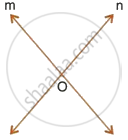
In the given figure, obtain all the points equidistant from lines m and n; and 2.5 cm from O.
Prove that the common chord of two intersecting circles is bisected at right angles by the line of centres.
Find the locus of the centre of a circle of radius r touching externally a circle of radius R.
ΔPBC and ΔQBC are two isosceles triangles on the same base. Show that the line PQ is bisector of BC and is perpendicular to BC.
ΔPBC, ΔQBC and ΔRBC are three isosceles triangles on the same base BC. Show that P, Q and R are collinear.
