Advertisements
Advertisements
प्रश्न
In a quadrilateral PQRS, if the bisectors of ∠ SPQ and ∠ PQR meet at O, prove that O is equidistant from PS and QR.
Advertisements
उत्तर
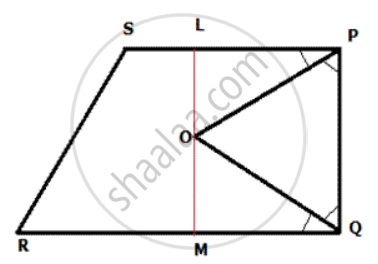
OP bisects ∠ SPQ and OQ bisects ∠ PQR.
Draw OM perpendirular to RQ and OL perpendirular to SP
Now in Δ OQM and Δ OLP
∠ OLP = ∠ OMQ
∠ OPL = ∠OQM
OP= OQ
Therefore, Δ OQM and Δ OLP are oongruent.
Hence, OL = OM
O is equidistant from PS and QR. Proved.
APPEARS IN
संबंधित प्रश्न
In each of the given figures; PA = PB and QA = QB.
| i. |  |
| ii. |  |
Prove, in each case, that PQ (produce, if required) is perpendicular bisector of AB. Hence, state the locus of the points equidistant from two given fixed points.
In parallelogram ABCD, side AB is greater than side BC and P is a point in AC such that PB bisects angle B. Prove that P is equidistant from AB and BC.
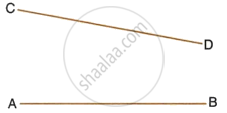
In the figure given below, find a point P on CD equidistant from points A and B.
Describe the locus of the centre of a wheel of a bicycle going straight along a level road.
Describe the locus of a point in rhombus ABCD, so that it is equidistant from
- AB and BC;
- B and D.
Describe the locus of points at distances greater than or equal to 35 mm from a given point.
In the given figure, obtain all the points equidistant from lines m and n; and 2.5 cm from O.

In a quadrilateral ABCD, if the perpendicular bisectors of AB and AD meet at P, then prove that BP = DP.
ΔPBC and ΔQBC are two isosceles triangles on the same base. Show that the line PQ is bisector of BC and is perpendicular to BC.
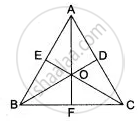
In Fig. AB = AC, BD and CE are the bisectors of ∠ABC and ∠ACB respectively such that BD and CE intersect each other at O. AO produced meets BC at F. Prove that AF is the right bisector of BC.