Advertisements
Advertisements
प्रश्न
In a quadrilateral PQRS, if the bisectors of ∠ SPQ and ∠ PQR meet at O, prove that O is equidistant from PS and QR.
Advertisements
उत्तर
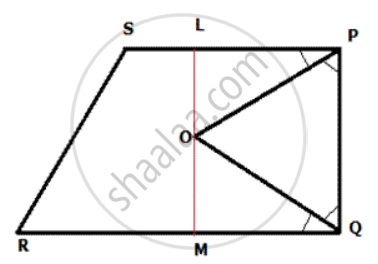
OP bisects ∠ SPQ and OQ bisects ∠ PQR.
Draw OM perpendirular to RQ and OL perpendirular to SP
Now in Δ OQM and Δ OLP
∠ OLP = ∠ OMQ
∠ OPL = ∠OQM
OP= OQ
Therefore, Δ OQM and Δ OLP are oongruent.
Hence, OL = OM
O is equidistant from PS and QR. Proved.
APPEARS IN
संबंधित प्रश्न
In triangle LMN, bisectors of interior angles at L and N intersect each other at point A. Prove that:
- Point A is equidistant from all the three sides of the triangle.
- AM bisects angle LMN.
The bisectors of ∠B and ∠C of a quadrilateral ABCD intersect each other at point P. Show that P is equidistant from the opposite sides AB and CD.
Describe the locus of a stone dropped from the top of a tower.
Describe the locus of a point in rhombus ABCD, so that it is equidistant from
- AB and BC;
- B and D.
Describe the locus of points at distances less than 3 cm from a given point.
Describe the locus of points at distances greater than 4 cm from a given point.
Describe the locus of points at distances greater than or equal to 35 mm from a given point.
By actual drawing obtain the points equidistant from lines m and n; and 6 cm from a point P, where P is 2 cm above m, m is parallel to n and m is 6 cm above n.
A straight line AB is 8 cm long. Draw and describe the locus of a point which is:
- always 4 cm from the line AB.
- equidistant from A and B.
Mark the two points X and Y, which are 4 cm from AB and equidistant from A and B. Describe the figure AXBY.
Find the locus of points which are equidistant from three non-collinear points.
