Advertisements
Advertisements
प्रश्न
Describe the locus of the moving end of the minute hand of a clock.
Advertisements
उत्तर
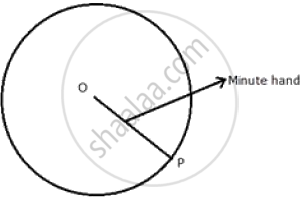
The locus of the moving end of the minute hand of the clock will be a circle where radius will be the length of the minute hand.
APPEARS IN
संबंधित प्रश्न
The given figure shows a triangle ABC in which AD bisects angle BAC. EG is perpendicular bisector of side AB which intersects AD at point F.
Prove that:

F is equidistant from AB and AC.
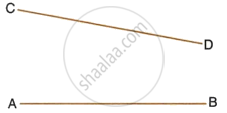
In the figure given below, find a point P on CD equidistant from points A and B.
Describe the locus of a stone dropped from the top of a tower.
The speed of sound is 332 metres per second. A gun is fired. Describe the locus of all the people on the earth’s surface, who hear the sound exactly one second later.
Describe the locus of points at distances greater than 4 cm from a given point.
Describe the locus of points at distances less than or equal to 2.5 cm from a given point.
Describe the locus of points at distances greater than or equal to 35 mm from a given point.
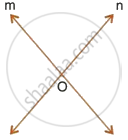
In the given figure, obtain all the points equidistant from lines m and n; and 2.5 cm from O.
A straight line AB is 8 cm long. Draw and describe the locus of a point which is:
- always 4 cm from the line AB.
- equidistant from A and B.
Mark the two points X and Y, which are 4 cm from AB and equidistant from A and B. Describe the figure AXBY.
Draw a triangle ABC in which AB = 6 cm, BC = 4.5 cm and AC = 5 cm. Draw and label:
- the locus of the centres of all circles which touch AB and AC,
- the locus of the centres of all the circles of radius 2 cm which touch AB.
Hence, construct the circle of radius 2 cm which touches AB and AC .
