Advertisements
Chapters
Geography
2: Shaping of the Earth’s Surface
3: Atmosphere and Climate
History
4: Early Humans and Beginning of Civilisation
▶ 5: State and Society up to 1000 CE
Political Science
6: Democracy
7: Elections
Economics
8: Building Blocks in Economics: The Problem of Choice
9: The Price Puzzle: What Drives the Market
![NCERT solutions for सोशल सायन्स अंडरस्टॅंडिंग सोसायटी इंडिया अँड बियॉन्ड पार्ट १ [इंग्रजी] इयत्ता ९ chapter 5 - State and Society up to 1000 CE - Shaalaa.com](/images/social-science-understanding-society-india-and-beyond-part-1-english-class-9_6:459c35e86f274147a517b882e2baab81.jpg "NCERT solutions for सोशल सायन्स अंडरस्टॅंडिंग सोसायटी इंडिया अँड बियॉन्ड पार्ट १ [इंग्रजी] इयत्ता ९ chapter 5 - State and Society up to 1000 CE")
Advertisements
Solutions for Chapter 5: State and Society up to 1000 CE
Below listed, you can find solutions for Chapter 5 of CBSE NCERT for सोशल सायन्स अंडरस्टॅंडिंग सोसायटी इंडिया अँड बियॉन्ड पार्ट १ [इंग्रजी] इयत्ता ९.
NCERT solutions for सोशल सायन्स अंडरस्टॅंडिंग सोसायटी इंडिया अँड बियॉन्ड पार्ट १ [इंग्रजी] इयत्ता ९ 5 State and Society up to 1000 CE Intext Questions [Pages 95 - 129]
The Big Questions
How did society organise themselves prior to 1000 CE?
How did states organise themselves prior to 1000 CE?
How did states and societies emerge and spread to different parts of the Indian subcontinent?
How did the ideas of dharma and chakravarti samrāṭ help create unity in social values and governance, and promote the idea of the Indian subcontinent as one political entity?
How did different social, administrative, and occupational groups take shape over time and come together culturally?
LET’S EXPLORE
As you read the chapter, follow the timeline at the bottom of each page. Notice the important events, changes, and connections across time. Think about which event interests you the most and why. By the end of the chapter, share one event you would like to explore further and document:
- What happened?
- When did it happen?
- Why do you think it matters?
LET’S RECALL
In previous grades, you have read that the name ‘Bharata’ first appears in the Ṛig Veda. It is used in reference to the ‘Bharata jana’, or the people who were ruled by the family of the Bharatas. What does this tell us about how early communities identified themselves and their rulers?
THINK ABOUT IT
In modern democracies, heads of government exercise power but are bound by constitutions and parliaments, which function as representative bodies that check the powers of elected leaders. Do the roles of the rājā and the assemblies in Vedic times suggest a similar principle? Can we say that systems of governance in Indian history, since their early institutionalised forms, were guided by the idea of ensuring people’s participation in the political process?
LET’S ANALYSE
If you visualise the maps of the Indian subcontinent of the second and first millennium BCE, you will find more settlements concentrated in the Ganga region in the latter map. Archaeological findings from this region during the first millennium BCE provide increasing evidence of the use of iron implements, a wider variety of grain, and the characteristic PGW pottery. Further, in the second half of the first millennium BCE, particularly in the middle Ganga region (from present-day Prayagraj to eastern Bihar), there is evidence of a refined ‘deluxe ware’ called NBPW, known for its smooth, glossy black surface. Archaeologically, this phase marks the emergence of a richer, more advanced material culture. Literary sources from this period also contain numerous references to expanding agricultural activities, increased grain output, greater crop variety particularly paddy and the use of iron implements.
Can you identify the crucial factors behind this change?
THINK ABOUT IT
Texts such as the Mahābhārata and the Arthaśhāstra describe the king’s duties as protecting people and ensuring justice. Why do you think it was important for rulers to protect people and ensure justice? What do these descriptions tell us about ideas of governance and the relationship between rulers and subjects during that period?
THINK ABOUT IT
Why do you think different rulers chose to record their inscriptions on the same stone instead of a new one? Discuss your answers with your classmates.
How would dividing a kingdom into provinces, districts, and villages have helped rulers manage their empires? What similarities can you identify between these administrative divisions and the system of governance in India today?
Read the verse given above and discuss it in groups. As you do so, think like historians look for clues in the source and use them to understand what life may have been like.
While discussing, keep these questions in mind:
- What does the source tell us? (evidence)
- What can we understand from it? (interpretation)
- What might it not tell us? (limits of the source)
Now answer the following:
- What occupations are mentioned in the family described in the verse? What does this indicate about the nature of occupations in Vedic society?
- How does the above verse challenge the idea that social status and occupation were fixed by birth?
- What different occupations do you find in contemporary society?
After the discussion, compare your group’s responses with those of another group and note the similarities and differences in interpretation. Did all groups interpret the source in the same way? What does this tell us about how historians use evidence to understand the past?
LET’S EXPLORE
Compare your school life with the life of a student in a gurukula in early India. Think about aspects such as daily routine, subjects studied, relationship with teachers, discipline, and living arrangements. What advantages and challenges do you think each system of education might have for students?
THINK ABOUT IT
Why do you think irrigational structures like dams and canals were considered so important that their construction was recorded in inscriptions?
NCERT solutions for सोशल सायन्स अंडरस्टॅंडिंग सोसायटी इंडिया अँड बियॉन्ड पार्ट १ [इंग्रजी] इयत्ता ९ 5 State and Society up to 1000 CE Questions and activities [Pages 134 - 135]
How did political organisation change from the Vedic period to the age of large empires such as the Mauryas and the Guptas? Explain the administrative system of the early Indian states.
Describe the role of the king, important officers, and the methods used to govern large territories.
After studying this chapter, what do you think were the most important features of the state and society in India before 1000 CE?
What do early texts such as the Ṛig Veda, Arthaśhāstra, and the Mahābhārata reveal about politics?
What do early texts such as the Ṛig Veda, Arthaśhāstra, and the Mahābhārata reveal about social life?
What can we learn from early Indian society about varṇa and the role of women?
Explain how assemblies like sabhā and samiti limited the power of the rājā. Which modern institutions perform similar functions today?
What does the term varṇa refer to in early Indian society?
What does the term jāti refer to in early Indian society?
How were varṇa and jāti different, and what factors may have contributed to the formation of various jātis?
Why do you think education in early India emphasised both knowledge and moral values? How this have benefited society?
Look at the major trade routes of early India Fig. How do you think these routes helped people in the exchange of goods, skills, beliefs, and cultural practices?
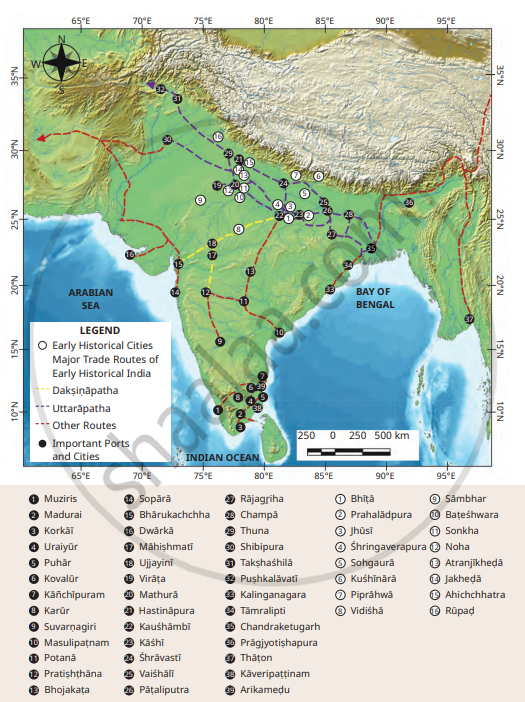
What might have been the advantages of ruling a large empire in the absence of modern communication systems?
What might have been the challenges of ruling a large empire in the absence of modern communication systems?
Many ideas about governance come from texts composed by scholars and advisors of the king. What might be some limitations of relying only on such sources?
Read the source and answer the questions:
|
The Nāśhik cave inscription (2nd century CE) of Uṣhavadāta records: “Uṣhavadāta, son of Dinika, son-in-law of king Nahapāna … has bestowed this cave on the Saṁgha generally; he has also given a perpetual endowment, three thousand - 3000 kāhāpaṇas, which, for the members of the Saṁgha of any sect, and any origin dwelling in this cave, will serve as cloth money and money for outside life (kuśhaṇa); and those kāhāpaṇas have been invested in guild dwelling at Govadhana - 2000 in a weavers’ guild, interest one pratika (monthly) for the hundred, (and) 1000 in another weaver’s guild, interest three quarters of a paḍika (monthly) for the hundred.” |
- What does this source tell us about the economic role of guilds?
- Why were guilds trusted with money deposits?
- Identify the donor and the donees from the given source.
Mark and locate on the map of India the following important centres: Pāṭaliputra, Nāśhik, Ujjayinī, Vikramśhila, Kānchipuram, Mathurā, Rājgṛiha.
Prepare a short presentation or poster on the following:
Life in the Vedic society
Prepare a short presentation or poster on the following:
Early education system (gurukula)
Prepare a short presentation or poster on the following:
Trade and guilds in early India
Prepare a short presentation or poster on the following:
Role of women in early Indian society
Solutions for 5: State and Society up to 1000 CE
NCERT solutions for सोशल सायन्स अंडरस्टॅंडिंग सोसायटी इंडिया अँड बियॉन्ड पार्ट १ [इंग्रजी] इयत्ता ९ chapter 5 - State and Society up to 1000 CE
Shaalaa.com has the CBSE Mathematics सोशल सायन्स अंडरस्टॅंडिंग सोसायटी इंडिया अँड बियॉन्ड पार्ट १ [इंग्रजी] इयत्ता ९ CBSE solutions in a manner that help students grasp basic concepts better and faster. The detailed, step-by-step solutions will help you understand the concepts better and clarify any confusion. NCERT solutions for Mathematics सोशल सायन्स अंडरस्टॅंडिंग सोसायटी इंडिया अँड बियॉन्ड पार्ट १ [इंग्रजी] इयत्ता ९ CBSE 5 (State and Society up to 1000 CE) include all questions with answers and detailed explanations. This will clear students' doubts about questions and improve their application skills while preparing for board exams.
Further, we at Shaalaa.com provide such solutions so students can prepare for written exams. NCERT textbook solutions can be a core help for self-study and provide excellent self-help guidance for students.
Concepts covered in सोशल सायन्स अंडरस्टॅंडिंग सोसायटी इंडिया अँड बियॉन्ड पार्ट १ [इंग्रजी] इयत्ता ९ chapter 5 State and Society up to 1000 CE are .
Using NCERT सोशल सायन्स अंडरस्टॅंडिंग सोसायटी इंडिया अँड बियॉन्ड पार्ट १ [इंग्रजी] इयत्ता ९ solutions State and Society up to 1000 CE exercise by students is an easy way to prepare for the exams, as they involve solutions arranged chapter-wise and also page-wise. The questions involved in NCERT Solutions are essential questions that can be asked in the final exam. Maximum CBSE सोशल सायन्स अंडरस्टॅंडिंग सोसायटी इंडिया अँड बियॉन्ड पार्ट १ [इंग्रजी] इयत्ता ९ students prefer NCERT Textbook Solutions to score more in exams.
Get the free view of Chapter 5, State and Society up to 1000 CE सोशल सायन्स अंडरस्टॅंडिंग सोसायटी इंडिया अँड बियॉन्ड पार्ट १ [इंग्रजी] इयत्ता ९ additional questions for Mathematics सोशल सायन्स अंडरस्टॅंडिंग सोसायटी इंडिया अँड बियॉन्ड पार्ट १ [इंग्रजी] इयत्ता ९ CBSE, and you can use Shaalaa.com to keep it handy for your exam preparation.
