Advertisements
Chapters
Geography
2: Shaping of the Earth’s Surface
3: Atmosphere and Climate
History
4: Early Humans and Beginning of Civilisation
5: State and Society up to 1000 CE
Political Science
▶ 6: Democracy
7: Elections
Economics
8: Building Blocks in Economics: The Problem of Choice
9: The Price Puzzle: What Drives the Market
![NCERT solutions for सोशल सायन्स अंडरस्टॅंडिंग सोसायटी इंडिया अँड बियॉन्ड पार्ट १ [इंग्रजी] इयत्ता ९ chapter 6 - Democracy - Shaalaa.com](/images/social-science-understanding-society-india-and-beyond-part-1-english-class-9_6:459c35e86f274147a517b882e2baab81.jpg "NCERT solutions for सोशल सायन्स अंडरस्टॅंडिंग सोसायटी इंडिया अँड बियॉन्ड पार्ट १ [इंग्रजी] इयत्ता ९ chapter 6 - Democracy")
Advertisements
Solutions for Chapter 6: Democracy
Below listed, you can find solutions for Chapter 6 of CBSE NCERT for सोशल सायन्स अंडरस्टॅंडिंग सोसायटी इंडिया अँड बियॉन्ड पार्ट १ [इंग्रजी] इयत्ता ९.
NCERT solutions for सोशल सायन्स अंडरस्टॅंडिंग सोसायटी इंडिया अँड बियॉन्ड पार्ट १ [इंग्रजी] इयत्ता ९ 6 Democracy Intext Questions [Pages 137 - 157]
The Big Questions
How has the idea of democracy evolved over time and shaped our understanding of it today?
What are the different forms of democracy?
How is democracy practised in India and other parts of the world?
What are the essential features of a democracy, and how do they extend beyond government institutions
What are the challenges faced by Indian democracy?
THINK ABOUT IT
Why is it important that the ultimate source of power rests with the people in a democracy?
How does people’s participation through voting strengthen popular sovereignty?
LET’S EXPLORE
The Constitution not only guarantees Fundamental Rights to citizens but also outlines their Fundamental Duties and the Directive Principles of State Policy. Discuss their significance and identify the differences among them.
The Right to Education (Article 21A) was added in 2009, ensuring free and compulsory education for children aged 6 to 14. Discuss its significance.
THINK ABOUT IT
What do you think would happen if the same organ of the government made laws, implemented them, and enforced them? Share your thoughts with your classmates.
LET’S EXPLORE
The first column of the table below lists some key features of democracy in India. Fill in the second column with suitable examples from your state, town, or village. One row has been completed for you.
| Features of Democracy | Examples |
| Popular Sovereignty | |
| Rule of Law | |
| Separation of Powers | |
| Fundamental Rights | |
| Accountability and Transparency | Parliamentary procedures such as Question Hour and the auditing of government accounts ensure accountability. Laws like the Right to Information provide transparency |
| Multi-Party System |
LET’S EXPLORE
Select your ideal team from Fig., and give reasons for your selection.
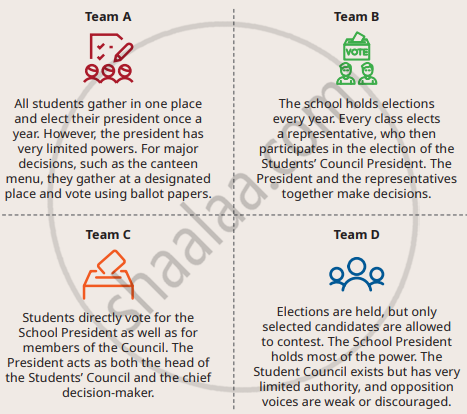
| Work in pairs or small groups. Choose any two of India’s neighbouring countries (Afghanistan, Bangladesh, Bhutan, China, Maldives, Myanmar, Nepal, Pakistan, or Sri Lanka) and find out the following: |
- Does the country hold regular elections?
- Who chooses the Head of the Government?
- Is there more than one political party?
- How much freedom do citizens have to express their opinions and criticise the government?
How would you describe this system? Give reasons for your answer.
- Democratic or Partially democratic or Non-democratic
A democratic system seeks to promote participation, ensure fairness, limit the concentration of power, and resolve disagreements peacefully. Identify examples from the above case study that reflect these features.
India continues to work towards more inclusive institutions. Discuss in class about the advantages of increased representation of women in the legislature.
THINK ABOUT IT
As we studied in earlier grades, the village serves as a unit of grassroots democracy in India, empowering rural communities to participate in decision-making processes. Many Indian leaders, such as Chaudhary Charan Singh and Babu Jagjivan Ram, who emerged from these rural backgrounds, advocated for the rights of the rural poor and other marginalised sections of society.
Explore and discuss the contributions of eminent Indian leaders who worked towards strengthening grassroots democracy.
LET’S EXPLORE
In small groups, identify two or three examples of information shared on social media that you believe may be misleading or false. Discuss what made you question their reliability and how such information can influence people’s opinions. Reflect on why access to accurate and authentic information is important in a democracy.
LET’S EXPLORE
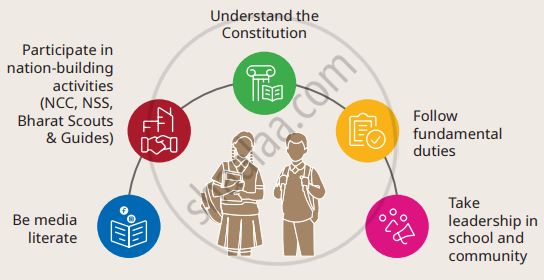
Observe Fig., and explore the various other digital and non-digital ways through which you can participate in a democracy.
THINK, DISCUSS, ACT
Think: How do your actions as a student contribute to your school community and to democracy in a larger context?
Discuss: Talk to your classmates about a social or community issue that you care about. How can you, as a student, make a difference?
Act: Choose one activity to fulfil your civic responsibility this month. Reflect on how your actions contribute to strengthening democracy and community spirit.
NCERT solutions for सोशल सायन्स अंडरस्टॅंडिंग सोसायटी इंडिया अँड बियॉन्ड पार्ट १ [इंग्रजी] इयत्ता ९ 6 Democracy Questions and activities [Pages 158 - 159]
Read the passage and answer the questions that follow:
| A school cabinet was responsible for planning a Republic Day celebration, and members had different opinions on which activities to include. After a discussion, they decided to vote, and the activities supported by the majority were selected. |
- Which democratic values are reflected in this situation?
- How does voting help resolve differences of opinion?
- Why is the majority decision important in a democracy?
- Mention responsibilities of elected representatives after a decision is made.
How would democracy be affected if citizens stopped following laws and civic responsibilities? Explain with an example.
Which situation best reflects the idea of popular sovereignty and why?
A law is passed without public discussion
Citizens vote to choose their representatives
A court gives a final judgment
A minister takes an independent decision
The Rule of Law is violated when ______.
Laws are applied equally to all
Courts review government actions
Powerful individuals are treated above the law
Citizens challenge laws through legal means
Why is the Rule of Law essential for protecting democracy?
Is voting alone enough to make a country democratic? Support your answer with examples from the chapter.
Social media allows people to express opinions freely.
How can this strengthen democracy?
Social media allows people to express opinions freely.
How can it weaken democracy if used irresponsibly?
Write a paragraph on what democracy means to you as a young citizen.
Conduct a model parliament session or Gram Sabha in class on local issues cleanliness, responsibilities towards public property, or school safety.
Democratic institutions in India, such as Parliament.
Prepare a short note explaining:
- Its role in democracy
- How it ensures accountability and participation.
Democratic institutions in India, such as the Election Commission.
Prepare a short note explaining:
- Its role in democracy
- How it ensures accountability and participation.
Democratic institutions in India, such as the judiciary.
Prepare a short note explaining:
- Its role in democracy
- How it ensures accountability and participation.
Democratic institutions in India, such as the Panchayat.
Prepare a short note explaining:
- Its role in democracy
- How it ensures accountability and participation.
What role does the Constitution play in strengthening democracy in India?
What challenges do you think democracy in India faces today?
Solutions for 6: Democracy
NCERT solutions for सोशल सायन्स अंडरस्टॅंडिंग सोसायटी इंडिया अँड बियॉन्ड पार्ट १ [इंग्रजी] इयत्ता ९ chapter 6 - Democracy
Shaalaa.com has the CBSE Mathematics सोशल सायन्स अंडरस्टॅंडिंग सोसायटी इंडिया अँड बियॉन्ड पार्ट १ [इंग्रजी] इयत्ता ९ CBSE solutions in a manner that help students grasp basic concepts better and faster. The detailed, step-by-step solutions will help you understand the concepts better and clarify any confusion. NCERT solutions for Mathematics सोशल सायन्स अंडरस्टॅंडिंग सोसायटी इंडिया अँड बियॉन्ड पार्ट १ [इंग्रजी] इयत्ता ९ CBSE 6 (Democracy) include all questions with answers and detailed explanations. This will clear students' doubts about questions and improve their application skills while preparing for board exams.
Further, we at Shaalaa.com provide such solutions so students can prepare for written exams. NCERT textbook solutions can be a core help for self-study and provide excellent self-help guidance for students.
Concepts covered in सोशल सायन्स अंडरस्टॅंडिंग सोसायटी इंडिया अँड बियॉन्ड पार्ट १ [इंग्रजी] इयत्ता ९ chapter 6 Democracy are .
Using NCERT सोशल सायन्स अंडरस्टॅंडिंग सोसायटी इंडिया अँड बियॉन्ड पार्ट १ [इंग्रजी] इयत्ता ९ solutions Democracy exercise by students is an easy way to prepare for the exams, as they involve solutions arranged chapter-wise and also page-wise. The questions involved in NCERT Solutions are essential questions that can be asked in the final exam. Maximum CBSE सोशल सायन्स अंडरस्टॅंडिंग सोसायटी इंडिया अँड बियॉन्ड पार्ट १ [इंग्रजी] इयत्ता ९ students prefer NCERT Textbook Solutions to score more in exams.
Get the free view of Chapter 6, Democracy सोशल सायन्स अंडरस्टॅंडिंग सोसायटी इंडिया अँड बियॉन्ड पार्ट १ [इंग्रजी] इयत्ता ९ additional questions for Mathematics सोशल सायन्स अंडरस्टॅंडिंग सोसायटी इंडिया अँड बियॉन्ड पार्ट १ [इंग्रजी] इयत्ता ९ CBSE, and you can use Shaalaa.com to keep it handy for your exam preparation.
