Advertisements
Online Mock Tests
Chapters
▶ 2: Sectors of the Indian Economy
3: Money and Credit
4: Globalisation and the Indian Economy
5: Consumer Rights
![NCERT solutions for सोशल सायन्स अंडरस्टॅंडिंग इकॉनॉमिक्स डेवलपमेंट [इंग्रजी] इयत्ता १० chapter 2 - Sectors of the Indian Economy - Shaalaa.com](/images/social-science-understanding-economic-development-english-class-10_6:85bdf698b6c240edbabfd600621e35fb.jpg "NCERT solutions for सोशल सायन्स अंडरस्टॅंडिंग इकॉनॉमिक्स डेवलपमेंट [इंग्रजी] इयत्ता १० chapter 2 - Sectors of the Indian Economy")
Advertisements
Solutions for Chapter 2: Sectors of the Indian Economy
Below listed, you can find solutions for Chapter 2 of CBSE NCERT for सोशल सायन्स अंडरस्टॅंडिंग इकॉनॉमिक्स डेवलपमेंट [इंग्रजी] इयत्ता १०.
NCERT solutions for सोशल सायन्स अंडरस्टॅंडिंग इकॉनॉमिक्स डेवलपमेंट [इंग्रजी] इयत्ता १० 2 Sectors of the Indian Economy Intext Questions [Pages 21 - 33]
LET’S WORK THESE OUT
| EXAMPLE | WHAT DOES THIS SHOW? |
| Imagine what would happen if farmers refuse to sell sugarcane to a particular sugar mill. The mill will have to shut down. | This is an example of the secondary or industrial sector being dependent on the primary. |
| Imagine what would happen to cotton cultivation if companies decide not to buy from the Indian market and import all cotton they need from other countries. Indian cotton cultivation will become less profitable and the farmers may even go bankrupt, if they cannot quickly switch to other crops. Cotton prices will fall. | |
| Farmers buy many goods such as tractors, pumpsets, electricity, pesticides and fertilisers. Imagine what would happen if the price of fertilisers or pumpsets go up. Cost of cultivation of the farmers will rise and their profits will be reduced. | |
| People working in industrial and service sectors need food. Imagine what would happen if there is a strike by transporters and lorries refuse to take vegetables, milk, etc. from rural areas. Food will become scarce in urban areas whereas farmers will be unable to sell their products. |
Complete the above table to show how sectors are dependent on each other.
Explain the difference between primary, secondary and tertiary sectors using examples other than those mentioned in the text.
Classify the following list of occupations under primary, secondary and tertiary sectors:
- Tailor
- Basket weaver
- Flower cultivator
- Milk vendor
- Fishermen
- Priest
- Courier
- Workers in match factory
- Moneylender
- Gardener
- Potter
- Bee-keeper
- Astronaut
- Call centre employee
Students in a school are often classified into primary and secondary or junior and senior. What is the criterion that is used? Do you think this is a useful classification? Discuss.
LET’S WORK THESE OUT
What does the history of developed countries indicate about the shifts that have taken place between sectors?
Correct and arrange the important aspects for calculating GDP from this Jumble.
| To count goods and services we add the numbers that are produced. We count all those that were produced in the last five years. Since we shouldn’t leave out anything we add up all these goods and services. |
Discuss with your teacher how you could calculate the total value of a good or service by using the method of value added at each stage.
LET’S WORK THESE OUT
Answer the following questions by looking at the graph:
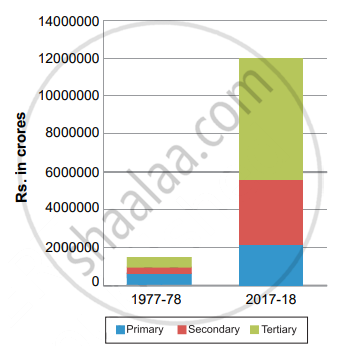
- Which was the largest producing sector in 1977–78?
- Which is the largest producing sector in 2017–18?
- Can you say which sector has grown the most over forty years?
- What was the GDP of India in 2017–18?
LET’S WORK THESE OUT
Complete the table using the data given in the graphs and answer the question that follows. Ignore if data are not available for some years.
Share of Sectors in GVA
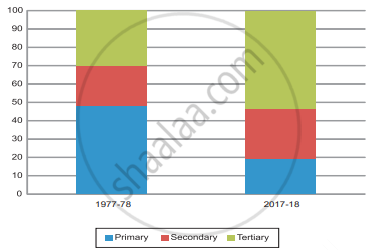
Share of Sectors in Employment (%)
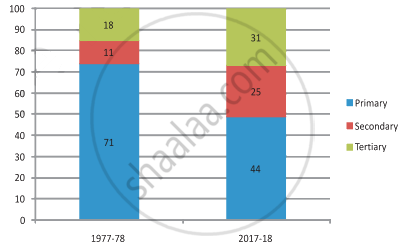
| Share of Primary Sector in GDP and Employment | ||
| 1977-78 | 2017-18 | |
| Share in Gross Value Added (GVA) | ||
| Share in employment | ||
What are the changes that you observe in the primary sector over a span of forty years?
Choose the correct answer:
Underemployment occurs when people ______.
do not want to work
are working in a lazy manner
are working less than what they are capable of doing
are not paid for their work
Compare and contrast the changes in India with the pattern that was observed for developed countries. What kind of changes between sectors were desired but did not happen in India?
Why should we be worried about underemployment?
What groups of people do you think are unemployed or underemployed in your area? Can you think of some measures that could be taken up for them?
LET’S WORK THESE OUT
Why do you think MGNREGA 2005 or Viksit Bharat-G RAM G 2025 is referred to as ‘Right to work’?
Imagine that you are the village head. In that capacity, suggest some activities that you think should be taken up under this Act that would also increase the income of people? Discuss.
How would income and employment increase if farmers were provided with irrigation and marketing facilities?
In what ways can employment be increased in urban areas?
LET’S WORK THESE OUT
Look at the following examples. Which of these are unorganised sector activities?
- A teacher taking classes in a school
- A headload worker carrying a bag of cement on his back in a market
- A farmer irrigating her field
- A doctor in a hospital treating a patient
- A daily wage labourer working under a contractor
- A factory worker going to work in a big factory
- A handloom weaver working in her house
Talk to someone who has a regular job in the organised sector and another who works in the unorganised sector. Compare and contrast their working conditions in all aspects.
How would you distinguish between organised and unorganised sectors? Explain in your own words.
The table below shows the estimated number of workers in India in the organised and unorganised sectors in the late 1990s. Read the table carefully. Fill in the missing data and answer the questions that follow.
| Workers in different sectors (In Millions) | |||
| Sector | Organised | Unorganised | Total |
| Primary | 1 | 232 | |
| Secondary | 41 | 74 | 115 |
| Tertiary | 40 | 88 | 128 |
| Total | 82 | ||
| Total in Percentage | 100% | ||
- What is the percentage of people in the unorganised sector in agriculture?
- Do you agree that agriculture is an unorganised sector activity? Why?
- If we look at the country as a whole, we find that ______% of the workers in India are in the unorganised sector. Organised sector employment is available to only about ______% of the workers in India.
LET’S RECALL
With so many activities taking place around us, one needs to use the process of classification to think in a useful manner. The criterion for classification could be many, depending on what we desire to find out. The process of classification helps to analyse a situation.
In dividing the economic activities into three sectors - primary, secondary, tertiary - the criterion used was the ‘nature of activity’. On the basis of this classification, we were able to analyse the pattern of total production and employment in India. Similarly, we divided the economic activities into organised and unorganised and used the classification to look at employment in the two sectors.
What was the most important conclusion that was derived from the classification exercises? What were the problems and solutions that were indicated? Can you summarise the information in the following table?
Classifying economic activities
| Sector | Criteria used | Most important conclusion | Problems indicated and how they can be tackled |
| Primary, Secondary, Tertiary | Nature of activity | ||
| Organised, Unorganised |
NCERT solutions for सोशल सायन्स अंडरस्टॅंडिंग इकॉनॉमिक्स डेवलपमेंट [इंग्रजी] इयत्ता १० 2 Sectors of the Indian Economy Exercises [Pages 35 - 37]
Fill in the blank using the correct option given in the bracket:
Employment in the service sector ______ increased to the same extent as production. (has/has not)
Fill in the blank using the correct option given in the bracket:
Workers in the ______ sector do not produce goods. (tertiary/agricultural)
Fill in the blank using the correct option given in the bracket:
Most of the workers in the ______ sector enjoy job security. (organised/unorganised)
Fill in the blank using the correct option given in the bracket:
A ______ proportion of labourers in India are working in the unorganised sector. (large/small)
Fill in the blanks using the correct option given in the bracket:
Cotton is a ______ product and cloth is a ______ product. (natural/manufactured)
Fill in the blank using the correct option given in the bracket:
The activities in primary, secondary and tertiary sectors are ______. (independent/interdependent)
Choose the most appropriate answer.
The sectors are classified into public and private sector on the basis of ______.
employment conditions
the nature of economic activity
ownership of enterprises
number of workers employed in the enterprise
Production of a commodity, mostly through the natural process, is an activity in ______ sector.
primary
secondary
tertiary
information technology
GDP is the total value of ______ produced during a particular year.
all goods and services
all final goods and services
all intermediate goods and services
all intermediate and final goods and services
In terms of GVA the share of tertiary sector in 2017-18 is between ______ per cent.
20 to 30
30 to 40
50 to 60
60 to 70
Match the following:
| Problems faced by farming sector | Some possible measures |
| 1. Unirrigated land | (a) Setting up agro-based mills |
| 2. Low prices for crops | (b) Cooperative marketing societies |
| 3. Debt burden | (c) Procurement of food grains by government |
| 4. No job in the offseason | (d) Construction of canals by the government |
| 5. Compelled to sell their grains to the local traders soon after harvest | (e) Banks to provide credit with low interest |
Find the odd one out and say why.
Tourist guide, dhobi, tailor, potter
Find the odd one out and say why.
Teacher, doctor, vegetable vendor, lawyer
Find the odd one out and say why.
Postman, cobbler, soldier, police constable
Find the odd one out and say why.
MTNL, Indian Railways, Air India, Jet Airways, All India Radio
A research scholar looked at the working people in the city of Surat and found the following.
| Place of work | Nature of employment | Percentage of working people |
| In offices and factories registered with the government | Organised | 15 |
| Own shops, office, clinics in marketplaces with formal license | 15 | |
| People working on the street, construction workers, domestic workers | 20 | |
| Working in small workshops usually not registered with the government |
|
Complete the table. What is the percentage of workers in the unorganised sector in this city?
Do you think the classification of economic activities into primary, secondary and tertiary is useful? Explain how.
For each of the sectors that we came across in this chapter, why should one focus on employment and GVA? Could there be other issues which should be examined? Discuss.
Make a long list of all kinds of work that you find adults around you doing for a living. In what way can you classify them? Explain your choice.
How is the tertiary sector different from other sectors? Illustrate with a few examples.
What do you understand by disguised unemployment? Explain with an example each from the urban and rural areas.
Distinguish between open unemployment and disguised unemployment.
“Tertiary sector is not playing any significant role in the development of Indian economy.” Do you agree? Give reasons in support of your answer.
Service sector in India employs two different kinds of people. Who are these?
Workers are exploited in the unorganised sector. Do you agree with this view? Give reasons in support of your answer.
How are the activities in the economy classified on the basis of employment conditions?
Compare the employment conditions prevailing in the organised and unorganised sectors.
Explain the objective of implementing the NREGA 2005.
Explain the objective of implementing the Viksit Bharat-G RAM G 2025.
Using examples from your area compare and contrast the activities and functions of private and public sectors.
Discuss and fill the following table giving one example each from your area.
| Well managed organisation | Badly managed organisation | |
| Public sector | ||
| Private Sector |
Give a few examples of public sector activities and explain why the government has taken them up.
Explain how public sector contributes to the economic development of a nation.
The workers in the unorganised sector need protection on the following issues: wages, safety and health. Explain with examples.
A study in Ahmedabad found that out of 15,00,000 workers in the city, 11,00,000 worked in the unorganised sector. The total income of the city in this year (1997-1998) was Rs 60,000 million. Out of this Rs 32,000 million was generated in the organised sector. Present this data as a table. What kind of ways should be thought of for generating more employment in the city?
The following table gives the GVA in Rupees (Crores) by the three sectors:
| Year | Primary | Secondary | Tertiary |
| 2001-02 | 13,23,000 | 10,40,000 | 19,31,000 |
| 2021-22 | 24,79,400 | 40,73,000 | 73,25,000 |
- Calculate the share of the three sectors in GDP for 2000 and 2013.
- Show the data as a bar diagram similar to Graph 2 in the chapter.
- What conclusions can we draw from the bar graph?
Solutions for 2: Sectors of the Indian Economy
NCERT solutions for सोशल सायन्स अंडरस्टॅंडिंग इकॉनॉमिक्स डेवलपमेंट [इंग्रजी] इयत्ता १० chapter 2 - Sectors of the Indian Economy
Shaalaa.com has the CBSE Mathematics सोशल सायन्स अंडरस्टॅंडिंग इकॉनॉमिक्स डेवलपमेंट [इंग्रजी] इयत्ता १० CBSE solutions in a manner that help students grasp basic concepts better and faster. The detailed, step-by-step solutions will help you understand the concepts better and clarify any confusion. NCERT solutions for Mathematics सोशल सायन्स अंडरस्टॅंडिंग इकॉनॉमिक्स डेवलपमेंट [इंग्रजी] इयत्ता १० CBSE 2 (Sectors of the Indian Economy) include all questions with answers and detailed explanations. This will clear students' doubts about questions and improve their application skills while preparing for board exams.
Further, we at Shaalaa.com provide such solutions so students can prepare for written exams. NCERT textbook solutions can be a core help for self-study and provide excellent self-help guidance for students.
Concepts covered in सोशल सायन्स अंडरस्टॅंडिंग इकॉनॉमिक्स डेवलपमेंट [इंग्रजी] इयत्ता १० chapter 2 Sectors of the Indian Economy are Sectors of Economic Activities, Historical Change in Economic Sectors, Primary, Secondary and Tertiary Sectors in India, Concept for Employment Generation, Division of Sectors as Organised and Unorganised, Protective Measures for Unorganised Sector Workers, Overview of Sectors of the Indian Economy, Sectors in Terms of Ownership: Public and Private Sectors, Sectors of Economic Activities, Comparing the Three Sectors, Primary, Secondary and Tertiary Sectors in India, Division of Sectors as Organised and Unorganised.
Using NCERT सोशल सायन्स अंडरस्टॅंडिंग इकॉनॉमिक्स डेवलपमेंट [इंग्रजी] इयत्ता १० solutions Sectors of the Indian Economy exercise by students is an easy way to prepare for the exams, as they involve solutions arranged chapter-wise and also page-wise. The questions involved in NCERT Solutions are essential questions that can be asked in the final exam. Maximum CBSE सोशल सायन्स अंडरस्टॅंडिंग इकॉनॉमिक्स डेवलपमेंट [इंग्रजी] इयत्ता १० students prefer NCERT Textbook Solutions to score more in exams.
Get the free view of Chapter 2, Sectors of the Indian Economy सोशल सायन्स अंडरस्टॅंडिंग इकॉनॉमिक्स डेवलपमेंट [इंग्रजी] इयत्ता १० additional questions for Mathematics सोशल सायन्स अंडरस्टॅंडिंग इकॉनॉमिक्स डेवलपमेंट [इंग्रजी] इयत्ता १० CBSE, and you can use Shaalaa.com to keep it handy for your exam preparation.
