State the principle of reversibility of light.
[4] Refraction of Light at Plane Surfaces
Chapter: [4] Refraction of Light at Plane Surfaces
Concept: undefined >> undefined
Define the absolute refractive index of a medium.
[4] Refraction of Light at Plane Surfaces
Chapter: [4] Refraction of Light at Plane Surfaces
Concept: undefined >> undefined
Define the term refractive index of a medium. What do you understand by the statement 'the refractive index of glass is 1.5 for white light'?
[4] Refraction of Light at Plane Surfaces
Chapter: [4] Refraction of Light at Plane Surfaces
Concept: undefined >> undefined
Is dispersion same as deviation?
[4] Refraction of Light at Plane Surfaces
Chapter: [4] Refraction of Light at Plane Surfaces
Concept: undefined >> undefined
Name the factors on which the deviation produced by a prism depends.
[4] Refraction of Light at Plane Surfaces
Chapter: [4] Refraction of Light at Plane Surfaces
Concept: undefined >> undefined
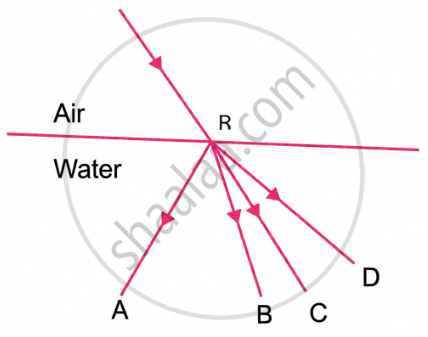
A ray of light passes from air to water. In fig., which of the ray A, B, C and D is the correct refracted ray?
[4] Refraction of Light at Plane Surfaces
Chapter: [4] Refraction of Light at Plane Surfaces
Concept: undefined >> undefined
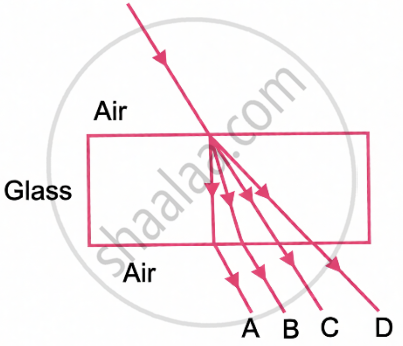
In the fig. name the ray which represents the correct path of light while passing through a glass block.
[4] Refraction of Light at Plane Surfaces
Chapter: [4] Refraction of Light at Plane Surfaces
Concept: undefined >> undefined
Fill in the blank to complete the following sentence:
When light travels from a rarer to a denser medium, it bends ...........
[4] Refraction of Light at Plane Surfaces
Chapter: [4] Refraction of Light at Plane Surfaces
Concept: undefined >> undefined
Explain the meaning of the term refraction. A ray of monochromatic light is incident from air on a glass slab. Draw a ray diagram indicating the change in its path till it emerges out of the slab.
[4] Refraction of Light at Plane Surfaces
Chapter: [4] Refraction of Light at Plane Surfaces
Concept: undefined >> undefined
State two uses of a total reflecting prism as a reflector in place of a plane mirror.
[4] Refraction of Light at Plane Surfaces
Chapter: [4] Refraction of Light at Plane Surfaces
Concept: undefined >> undefined
Draw an í- `delta` graph for a mono chromatic raY through a glass prism of a plane and mark
(i) `delta` m, the angle of mínimum devíation
(íí) Any two values of i for which value of `delta` ís same.
[4] Refraction of Light at Plane Surfaces
Chapter: [4] Refraction of Light at Plane Surfaces
Concept: undefined >> undefined
Can you guess the focal length of a plane mirror?
[4] Refraction of Light at Plane Surfaces
Chapter: [4] Refraction of Light at Plane Surfaces
Concept: undefined >> undefined
Show by a diagram the refraction of two incident rays parallel to the principle axis passing through a convex lens by treating it as a combination of a glass block and two triangular glass prisms.
[4] Refraction of Light at Plane Surfaces
Chapter: [4] Refraction of Light at Plane Surfaces
Concept: undefined >> undefined
Show by a diagram, the refraction of two incident rays parallel to the principle axis passing through a concave lens by treating it as a combination of a glass block and two triangular glass prisms.
[4] Refraction of Light at Plane Surfaces
Chapter: [4] Refraction of Light at Plane Surfaces
Concept: undefined >> undefined
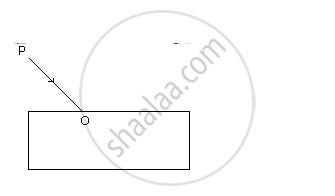
In the fig., PO is a ray of light incident on a rectangular glass block.
(a) Complete the path of the ray through the block.
(b) In the diagram, mark the angle of incidence (i) and the angle of refraction (r) at the first interface. How is the refractive index of glass related to the angles I and r?
(c) Mark angle of emergence by the letter e. How are the angles i and e related?
(d) Which two rays are parallel to each other? Name them.
(e) Indicate in the diagram the lateral displacement between the emergent ray and the incident ray.
[4] Refraction of Light at Plane Surfaces
Chapter: [4] Refraction of Light at Plane Surfaces
Concept: undefined >> undefined
Fig shows a lens as a combination of a glass block and two prisms.
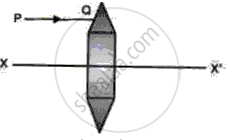
(i) Name the lens formed by the combination.
(ii) what is the XX' called?
(iii) Complete the ray diagram and show the path of the incident ray PQ after passing through the lens.
(iv) The final emergent ray will either meet XX' at a point or appear to come from a point on XX'. what is the point called?
[4] Refraction of Light at Plane Surfaces
Chapter: [4] Refraction of Light at Plane Surfaces
Concept: undefined >> undefined
Fig shows a lens as a combination of a glass block and two prisms.
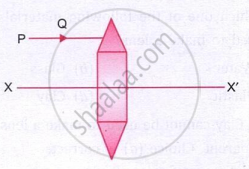
- Name the lens formed by the combination.
- What is the line XX' called?
- Complete the path of the incident ray PQ after passing through the lens.
- The final emergent ray either meets XX' at a point or appears to come from a point on XX'. Label it as F, What is this point called?
[4] Refraction of Light at Plane Surfaces
Chapter: [4] Refraction of Light at Plane Surfaces
Concept: undefined >> undefined
Will dispersion result when a monochromatic light passes through a prism?
[4] Refraction of Light at Plane Surfaces
Chapter: [4] Refraction of Light at Plane Surfaces
Concept: undefined >> undefined
Draw a diagram to show the splitting of white light into its constituent colours.
[4] Refraction of Light at Plane Surfaces
Chapter: [4] Refraction of Light at Plane Surfaces
Concept: undefined >> undefined
State any two ways of increasing the frequency of vibration of a stretched string.
[4] Refraction of Light at Plane Surfaces
Chapter: [4] Refraction of Light at Plane Surfaces
Concept: undefined >> undefined
