CBSE Science (English Medium) इयत्ता १२ Important Questions for Physics - Moving Charges and Magnetism
Advertisements
Advertisements
Chapter wise important questions with answers and solutions for Physics in CBSE Science (English Medium) इयत्ता १२.
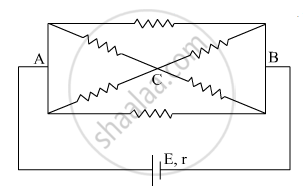
The current is drawn from a cell of emf E and internal resistance r connected to the network of resistors each of resistance r as shown in the figure. Obtain the expression for
- the current draw from the cell and
- the power consumed in the network.
पाठ: [4] Moving Charges and Magnetism
State Kirchhoff's rules for an electric network. Using Kirchhoff's rules, obtain the balance condition in terms of the resistances of four arms of Wheatstone bridge.
पाठ: [4] Moving Charges and Magnetism
Define the current sensitivity of a galvanometer ?
पाठ: [4] Moving Charges and Magnetism
Write current sensitivity of a galvanomete S.I. unit.
पाठ: [4] Moving Charges and Magnetism
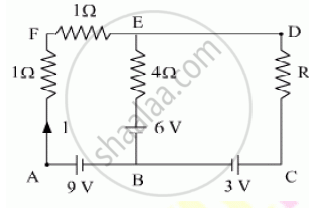
Using Kirchhoff’s rules determine the value of unknown resistance R in the circuit so that no current flows through 4 Ω resistance. Also find the potential difference between A and D.
पाठ: [4] Moving Charges and Magnetism
Read the following paragraph and answer the questions.
|
Consider the experimental set-up shown in the figure. This jumping ring experiment is an outstanding demonstration of some simple laws of Physics. A conducting non-magnetic ring is placed over the vertical core of a solenoid. When current is passed through the solenoid, the ring is thrown off. |

- Explain the reason for the jumping of the ring when the switch is closed in the circuit.
- What will happen if the terminals of the battery are reversed and the switch is closed? Explain.
- Explain the two laws that help us understand this phenomenon.
पाठ: [4] Moving Charges and Magnetism
- Assertion (A): The deflecting torque acting on a current-carrying loop is zero when its plane is perpendicular to the direction of the magnetic field.
- Reason (R): The deflecting torque acting on a loop of the magnetic moment `vecm` in a magnetic field `vecB` is given by the dot product of `vecm` and `vecB`.
पाठ: [4] Moving Charges and Magnetism
A galvanometer shows full-scale deflection for current Ig. A resistance R1 is required to convert it into a voltmeter of range (0 - V) and a resistance R2 to convert it into a voltmeter of range (0 - 2V). Find the resistance of the galvanometer.
पाठ: [4] Moving Charges and Magnetism
Briefly explain various ways to increase the strength of the magnetic field produced by a given solenoid.
पाठ: [4] Moving Charges and Magnetism
Obtain an expression for the energy stored in a solenoid of self-inductance ‘L’ when the current through it grows from zero to ‘I’.
पाठ: [4] Moving Charges and Magnetism
Find the condition under which the charged particles moving with different speeds in the presence of electric and magnetic field vectors can be used to select charged particles of a particular speed.
पाठ: [4] Moving Charges and Magnetism
Can a galvanometer as such be used for measuring the current? Explain.
पाठ: [4] Moving Charges and Magnetism
Sketch a schematic diagram depicting oscillating electric and magnetic fields of an em wave propagating along + z-direction ?
पाठ: [4] Moving Charges and Magnetism
Two long straight parallel conductors 'a' and 'b', carrying steady currents Ia and Ib are separated by a distance d. Write the magnitude and direction of the magnetic field produced by the conductor 'a' at the points along the conductor 'b'. If the currents are flowing in the same direction, what is the nature and magnitude of the force between the two conductors?
पाठ: [4] Moving Charges and Magnetism
Show with the help of a diagram how the force between the two conductors would change when the currents in them flow in the opposite directions?
पाठ: [4] Moving Charges and Magnetism
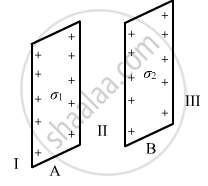
Two infinitely large plane thin parallel sheets having surface charge densities σ1 and σ2 (σ1 > σ2) are shown in the figure. Write the magnitudes and directions of the net fields in the regions marked II and III.
पाठ: [4] Moving Charges and Magnetism
The motion of copper plate is damped when it is allowed to oscillate between the two poles of a magnet. What is the cause of this damping?
पाठ: [4] Moving Charges and Magnetism
Figure shows two circuits each having a galvanometer and a battery of 3V.
When the galvanometers in each arrangement do not show any deflection, obtain the ratio R1/R2.

पाठ: [4] Moving Charges and Magnetism
Define mutual inductance between two long coaxial solenoids. Find out the expression for the mutual inductance of inner solenoid of length l having the radius r1 and the number of turns n1 per unit length due to the second outer solenoid of same length and r2 number of turns per unit length.
पाठ: [4] Moving Charges and Magnetism
A rectangular loop of size l × b carrying a steady current I is placed in a uniform magnetic field `vecB`. Prove that the torque `vectau`acting on the loop is give by `vectau =vecm xx vecB,`where `vecm` is the magnetic moment of the loop.
