Advertisements
Advertisements
प्रश्न
Define mutual inductance between two long coaxial solenoids. Find out the expression for the mutual inductance of inner solenoid of length l having the radius r1 and the number of turns n1 per unit length due to the second outer solenoid of same length and r2 number of turns per unit length.
Advertisements
उत्तर
Mutual Inductance
The ability of production of induced emf in one coil, due to varying current in the neighbouring coil is called mutual inductance.
Magnetic flux, Φ = MI Where, M is called coefficient of mutual induction
Mutual Inductance of Two Long Solenoids
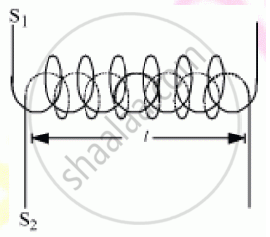
Consider two long solenoids S1 and S2 of same length l, such that solenoid S2 surrounds solenoid S1 completely.
Φ21 = M21I1
Where, M21 is the coefficient of mutual induction of the two solenoids
Magnetic field produced inside solenoid S1 on passing current through it,
B1 = μ0n1I1
Magnetic flux linked with each turn of solenoid S2 will be equal to B1 times the area of cross-section of solenoid S1.
Magnetic flux linked with each turn of the solenoid S2 = B1A
Therefore, total magnetic flux linked with the solenoid S2,
Φ21 = B1A × n2l = μ0n1I1× A× n2l
Φ21 = μ0n1n2lAI1
∴ M21 = μ0n1n2Al
Similarly, the mutual inductance between the two solenoids, when current is passed through solenoid S2 and induced emf is produced in solenoid S1, is given by
M12 = μ0n1n2Al
∴M12 = M21 = M (say)
Hence, coefficient of mutual induction between the two long solenoids
`M = mu_0n_1n_2Al`
संबंधित प्रश्न
Obtain an expression for the energy stored in a solenoid of self-inductance ‘L’ when the current through it grows from zero to ‘I’.
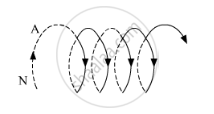
An observer to the left of a solenoid of N turns each of cross section area 'A' observes that a steady current I in it flows in the clockwise direction. Depict the magnetic field lines due to the solenoid specifying its polarity and show that it acts as a bar magnet of magnetic moment m = NIA.
Define self-inductance of a coil.
Draw and compare the pattern of the magnetic field lines in the two cases ?
How is the magnetic field inside a given solenoid made strong?
A long solenoid of radius 2 cm has 100 turns/cm and carries a current of 5 A. A coil of radius 1 cm having 100 turns and a total resistance of 20 Ω is placed inside the solenoid coaxially. The coil is connected to a galvanometer. If the current in the solenoid is reversed in direction, find the charge flown through the galvanometer.
In the formula \(B = \mu_0 n I\) for the magnetic field inside a long solenoid, what does the quantity \(n\) represent?
Why is the magnetic field approximately zero outside a long solenoid?
What is the magnetic field at the ends (edge) of a long solenoid carrying current \(I\)?
A long solenoid has \(n = 1000\) turns/m and carries a current of \(I = 5\) A. Taking \(\mu_0 = 4\pi \times 10^{-7}\), what is the magnetic field inside the solenoid?
