Advertisements
Advertisements
प्रश्न
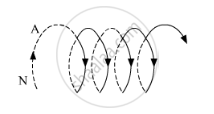
An observer to the left of a solenoid of N turns each of cross section area 'A' observes that a steady current I in it flows in the clockwise direction. Depict the magnetic field lines due to the solenoid specifying its polarity and show that it acts as a bar magnet of magnetic moment m = NIA.
Advertisements
उत्तर
Given that the current flows in the clockwise direction for an observer on the left side of the solenoid. This means that left face of the solenoid acts as south pole and right face acts as north pole. Inside a bar magnet, the magnetic field lines are directed from south to north. Therefore, the magnetic field lines are directed from left to right in the solenoid.
Magnetic moment of single current carrying loop is given by
m'=IA
where
I = Current flowing through the loop
A = area of the loop
So, magnetic moment of the whole solenoid is given by
m=Nm'=N(IA)
APPEARS IN
संबंधित प्रश्न
A closely wound solenoid 80 cm long has 5 layers of windings of 400 turns each. The diameter of the solenoid is 1.8 cm. If the current carried is 8.0 A, estimate the magnitude of B inside the solenoid near its centre.
Define self-inductance of a coil.
Define mutual inductance between two long coaxial solenoids. Find out the expression for the mutual inductance of inner solenoid of length l having the radius r1 and the number of turns n1 per unit length due to the second outer solenoid of same length and r2 number of turns per unit length.
In what respect is a toroid different from a solenoid?
A tightly-wound solenoid of radius a and length l has n turns per unit length. It carries an electric current i. Consider a length dx of the solenoid at a distance x from one end. This contains n dx turns and may be approximated as a circular current i n dx. (a) Write the magnetic field at the centre of the solenoid due to this circular current. Integrate this expression under proper limits to find the magnetic field at the centre of the solenoid. (b) verify that if l >> a, the field tends to B = µ0ni and if a >> l, the field tends to `B =(mu_0nil)/(2a)` . Interpret these results.
The length of a solenoid is 0.4 m and the number turns in it is 500. A current of 3 amp, is flowing in it. In a small coil of radius 0.01 m and number of turns 10, a current of 0.4 amp. is flowing. The torque necessary to keep the axis of this coil perpendicular to the axis of solenoid will be ______.
The magnetic field inside a long solenoid is given by which of the following formulas?
During the construction of a solenoid, why is enamelled copper wire used for winding the helical turns?
In the working principle of a solenoid, how does each individual turn of the coil behave?
In the Amperian loop derivation for a solenoid, what is the contribution of side \(ab\) (inside, along the axis) to the line integral \(\oint \vec{B} \cdot d\vec{l}\)?
