Advertisements
Advertisements
प्रश्न
A wire AB is carrying a steady current of 10 A and is lying on the table. Another wire CD carrying 6 A is held directly above AB at a height of 2 mm. Find the mass per unit length of the wire CD so that it remains suspended at its position when left free. Give the direction of the current flowing in CD with respect to that in AB. [Take the value of g = 10 ms−2]
Advertisements
उत्तर
Force per unit length between the current carrying wires is given as:
`F = (μ_0)/(4pi) (2I_1I_2)/r `,where I1 = current in wire AB = 10 A and I2 = current in wire CD = 6 A`
r = distance between wires = 2 mm = 2 × 10⁻³ m.
Let m be the mass per unit length of wire CD. As the force balances the weight of the wire
`therefore (μ_0)/(4pi) (2I_1I_2)/r = mg => 10^-7 xx (2xx10xx6)/(2xx10^-3) = m xx 10`
`therefore m = 10^-7 xx (2 xx 10 xx xx 6)/(2 xx 10^-3) xx 1/10 = 6 xx 10^-4 kg \ m^-1`
APPEARS IN
संबंधित प्रश्न
Derive the expression for the magnetic field due to a solenoid of length ‘2l’, radius ‘a’ having ’n’ number of turns per unit length and carrying a steady current ‘I’ at a point
on the axial line, distance ‘r’ from the centre of the solenoid. How does this expression compare with the axial magnetic field due to a bar magnet of magnetic moment ‘m’?
An observer to the left of a solenoid of N turns each of cross section area 'A' observes that a steady current I in it flows in the clockwise direction. Depict the magnetic field lines due to the solenoid specifying its polarity and show that it acts as a bar magnet of magnetic moment m = NIA.
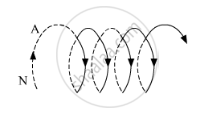
How is the magnetic field inside a given solenoid made strong?
The magnetic field inside a tightly wound, long solenoid is B = µ0 ni. It suggests that the field does not depend on the total length of the solenoid, and hence if we add more loops at the ends of a solenoid the field should not increase. Explain qualitatively why the extra-added loops do not have a considerable effect on the field inside the solenoid.
The length of a solenoid is 0.4 m and the number turns in it is 500. A current of 3 amp, is flowing in it. In a small coil of radius 0.01 m and number of turns 10, a current of 0.4 amp. is flowing. The torque necessary to keep the axis of this coil perpendicular to the axis of solenoid will be ______.
A solenoid is defined as a long helical coil of insulated wire with many closely spaced turns. Which geometric condition must it satisfy to be classified as a 'long' solenoid?
During the construction of a solenoid, why is enamelled copper wire used for winding the helical turns?
In the Ampere's Law derivation for a solenoid, why does side \(cd\) (lying outside the solenoid) contribute nothing to \(\oint \vec{B} \cdot d\vec{l}\)?
Which of the following correctly compares the field inside a toroid with the field inside a solenoid?
A long solenoid has \(n = 1000\) turns/m and carries a current of \(I = 5\) A. Taking \(\mu_0 = 4\pi \times 10^{-7}\), what is the magnetic field inside the solenoid?
