Advertisements
Advertisements
प्रश्न
A tightly-wound, long solenoid carries a current of 2.00 A. An electron is found to execute a uniform circular motion inside the solenoid with a frequency of 1.00 × 10⁸ rev s−1. Find the number of turns per metre in the solenoid.
Advertisements
उत्तर
Given:
Magnitude of current in the solenoid, i = 2 A
Frequency of the electron, \[f = 1 \times {10}^8\] rev/s
Mass of the electron, \[\text{ m }= 9 . 1 \times {10}^{- 31}\] kg
Charge of the electron, \[q = 1 . 6 \times {10}^{- 19} C\]
We know that the magnetic field inside a solenoid is given by
B = µ0ni
If a particle executes uniform circular motion inside a magnetic field, the frequency of the particle is given by
\[f = \frac{qB}{2\pi m}\]
\[ \Rightarrow B = \frac{2\pi mf}{q}\]
\[ \Rightarrow \mu_0 ni = \frac{2\pi mf}{q} [\text{ Using } (1)]\]
\[ \Rightarrow n = \frac{2\pi mf}{\mu_0 qi}\]
\[ = \frac{2\pi \times 9 . 1 \times {10}^{- 31} \times 1 \times {10}^8}{4\pi \times {10}^{- 7} \times 1 . 6 \times {10}^{- 19} \times 2}\]
\[ = 1420 \] turns/m
APPEARS IN
संबंधित प्रश्न
Derive the expression for the magnetic field due to a solenoid of length ‘2l’, radius ‘a’ having ’n’ number of turns per unit length and carrying a steady current ‘I’ at a point
on the axial line, distance ‘r’ from the centre of the solenoid. How does this expression compare with the axial magnetic field due to a bar magnet of magnetic moment ‘m’?
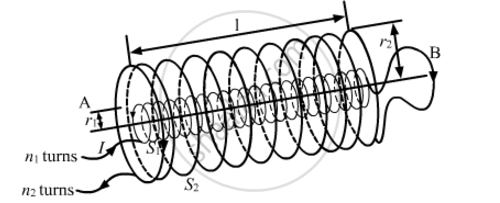
Two long coaxial insulated solenoids, S1 and S2 of equal lengths are wound one over the other as shown in the figure. A steady current "I" flow thought the inner solenoid S1 to the other end B, which is connected to the outer solenoid S2 through which the same current "I" flows in the opposite direction so as to come out at end A. If n1 and n2 are the number of turns per unit length, find the magnitude and direction of the net magnetic field at a point (i) inside on the axis and (ii) outside the combined system
Define the term self-inductance of a solenoid.
A wire AB is carrying a steady current of 12 A and is lying on the table. Another wire CD carrying 5 A is held directly above AB at a height of 1 mm. Find the mass per unit length of the wire CD so that it remains suspended at its position when left free. Give the direction of the current flowing in CD with respect to that in AB. [Take the value of g = 10 ms−2]
A wire AB is carrying a steady current of 6 A and is lying on the table. Another wire CD carrying 4 A is held directly above AB at a height of 1 mm. Find the mass per unit length of the wire CD so that it remains suspended at its position when left free. Give the direction of the current flowing in CD with respect to that in AB. [Take the value of g = 10 ms−2]
In what respect is a toroid different from a solenoid?
How is the magnetic field inside a given solenoid made strong?
A long solenoid of radius 2 cm has 100 turns/cm and carries a current of 5 A. A coil of radius 1 cm having 100 turns and a total resistance of 20 Ω is placed inside the solenoid coaxially. The coil is connected to a galvanometer. If the current in the solenoid is reversed in direction, find the charge flown through the galvanometer.
A current of 1.0 A is established in a tightly wound solenoid of radius 2 cm having 1000 turns/metre. Find the magnetic energy stored in each metre of the solenoid.
A long solenoid carrying a current produces a magnetic field B along its axis. If the current is doubled and the number of turns per cm is halved, the new value of magnetic field will be equal to ______.
A solenoid is defined as a long helical coil of insulated wire with many closely spaced turns. Which geometric condition must it satisfy to be classified as a 'long' solenoid?
In the formula \(B = \mu_0 n I\) for the magnetic field inside a long solenoid, what does the quantity \(n\) represent?
A solenoid has a total of \(N\) turns wound uniformly over a length \(l\). What is the expression for the number of turns per unit length?
In the Ampere's Law derivation for a solenoid, what is the contribution of the perpendicular sides \(bc\) (inside to outside) and \(da\) (outside to inside) to \(\oint \vec{B} \cdot d\vec{l}\)?
Applying Ampere's Law to the rectangular loop around a solenoid, the line integral equals \(Bl\) and the enclosed current is \(nlI\). Which sequence of steps correctly yields the magnetic field inside?
Which statement about the ends of a solenoid versus a toroid is correct?
