Advertisements
Advertisements
On the basis of electron drift, derive an expression for resistivity of a conductor in terms of number density of free electrons and relaxation time. On what factors does resistivity of a conductor depend?
Concept: Drift of Electrons and the Origin of Resistivity
Why alloys like constantan and manganin are used for making standard resistors?
Concept: Drift of Electrons and the Origin of Resistivity
Two wires of equal length, one of copper and the other of manganin have the same resistance. Which wire is thicker?
Concept: Resistivity of Various Materials
Define relaxation time of the free electrons drifting in a conductor. How is it related to the drift velocity of free electrons? Use this relation to deduce the expression for the electrical resistivity of the material.
Concept: Drift of Electrons and the Origin of Resistivity
A conductor of length ‘l’ is connected to a dc source of potential ‘V’. If the length of the conductor is tripled by gradually stretching it, keeping ‘V’ constant, how will (i) drift speed of electrons and (ii) resistance of the conductor be affected? Justify your answer.
Concept: Drift of Electrons and the Origin of Resistivity
Two cells of emf E1, E2 and internal resistance r1 and r2 respectively are connected in parallel as shown in the figure.
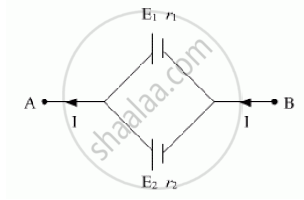
Deduce the expressions for
(1) the equivalent e.m.f of the combination
(2) the equivalent resistance of the combination, and
(3) the potential difference between the point A and B.
Concept: Cells, EMF, and Internal Resistance
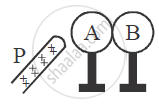
Two metallic spheres A and B kept on insulating stands are in contact with each other. A positively charged rod P is brought near the sphere A as shown in the figure. The two spheres are separated from each other, and the rod P is removed. What will be the nature of charges on spheres A and B?
Concept: Ohm's Law
A metal sphere is kept on an insulting stands. A negatively charged rod is brought near it, then the sphere is earthed as shown. On removing the earthing, and taking the negatively charged rod away, what will be the nature of charge on the sphere? Give reason for your answer.

Concept: Ohm's Law
Solve the following question.
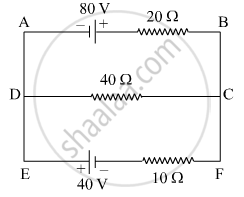
Using Kirchhoff’s rules, calculate the current through the 40 Ω and 20 Ω resistors in the following circuit.
Concept: Kirchhoff’s Laws
Answer the following question.
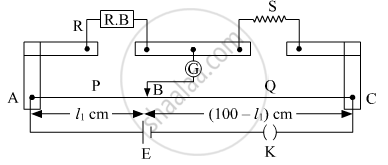
What is the end error in a meter bridge? How is it overcome? The resistances in the two arms of the metre bridge are R = Ω and S respectively. When the resistance S is shunted with equal resistance, the new balance length found to be 1.5 l1, where l2 is the initial balancing length. calculate the value of s.
Concept: Cells, EMF, and Internal Resistance
A conductor of length ‘l’ is rotated about one of its ends at a constant angular speed ‘ω’ in a plane perpendicular to a uniform magnetic field B. Plot graphs to show variations of the emf induced across the ends of the conductor with
- angular speed ω and
- length of the conductor l.
Concept: Cells, EMF, and Internal Resistance
A current of 0.8 A flows in a conductor of 40 Ω for 1 minute. The heat produced in the conductor will be ______.
Concept: Ohm's Law
A cell of emf E is connected across an external resistance R. When current 'I' is drawn from the cell, the potential difference across the electrodes of the cell drops to V. The internal resistance 'r' of the cell is ______.
Concept: Cells, EMF, and Internal Resistance
Define relaxation time.
Concept: Drift of Electrons and the Origin of Resistivity
Derive an expression for resistivity of a conductor in terms of the number density of charge carriers in the conductor and relaxation time.
Concept: Drift of Electrons and the Origin of Resistivity
Obtain an expression for the energy stored in a solenoid of self-inductance ‘L’ when the current through it grows from zero to ‘I’.
Concept: Solenoid
Find the condition under which the charged particles moving with different speeds in the presence of electric and magnetic field vectors can be used to select charged particles of a particular speed.
Concept: Motion in a Magnetic Field
Can a galvanometer as such be used for measuring the current? Explain.
Concept: Moving Coil Galvanometer
Sketch a schematic diagram depicting oscillating electric and magnetic fields of an em wave propagating along + z-direction ?
Concept: Motion in a Magnetic Field
