Definitions [1]
Three natural numbers (a,b,c) form a Pythagorean triplet if:
c2 = a2 + b2
(where c is the largest number)
Examples:
(3,4,5), (5,12,13), (8,15,17)
Formulae [1]
If a > b, then:
(a2 + b2, a2 − b2, 2ab) is a Pythagorean triplet.
Theorems and Laws [11]
If m and n are real numbers and m > n, if m2 + n2, m2 – n2 and 2 mn are the sides of the triangle, then prove that the triangle is right-angled. (Use the converse of the Pythagoras theorem). Find out two Pythagorian triplets using convenient values of m and n.
Given: m > n, the sides of the triangle are m2 + n2, m2 – n2 and 2 mn.
To prove: The triangle has a right angle.
Proof: (m2 + n2)2 = (m2 – n2)2 + (2 mn)2
(m2)2 + (n2)2 + 2 m2n2 = (m2)2 + (n2)2 – 2 m2n2 + 4 m2n2
m4 + n4 + 2 m2n2 = m4 + n4 + 2 m2n2
The fact that both sides are equal.
So, the triangle supplied is a right-angled triangle according to the converse of the Pythagoras theorem.
| m2 + n2 | m2 – n2 | 2 mn | Pythagorean triplets | |
|
m = 3 and n = 1 m = 4 and n = 1 |
32 + 12 = 10 42 + 12 = 17 |
32 – 12 = 8 42 – 12 = 15 |
2 × 3 × 1 = 6 2 × 4 × 1 = 8 |
(6, 8, 10) (8, 15, 17) |
Two Pythagorean triplets are, therefore (6, 8, 10) and (8, 15, 17).
AB, BC and AC are three sides of a right-angled triangle having lengths 6 cm, 8 cm and 10 cm, respectively. To verify the Pythagoras theorem for this triangle, fill in the boxes:
ΔABC is a right-angled triangle and ∠ABC = 90°.
So, by the Pythagoras theorem,
`square` + `square` = `square`
Substituting 6 cm for AB and 8 cm for BC in L.H.S.
`square` + `square` = `square` + `square`
= `square` + `square`
= `square`
Substituting 10 cm for AC in R.H.S.
`square` = `square`
= `square`
Since, L.H.S. = R.H.S.
Hence, the Pythagoras theorem is verified.
ΔABC is a right-angled triangle and ∠ABC = 90°.
So, by the Pythagoras' theorem,
AB2 + BC2 = AC2
Substituting 6 cm for AB and 8 cm for BC in L.H.S.
AB2 + BC2 = 62 + 82
= 36 + 64
= 100
Substituting 10 cm for AC in R.H.S.
AC2 = 102
= 100
Since, L.H.S. = R.H.S.
Hence, the Pythagoras theorem is verified.
In an equilateral ΔABC, AD ⊥ BC, prove that AD2 = 3BD2.
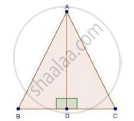
We have, ΔABC is an equilateral Δ and AD ⊥ BC
In ΔADB and ΔADC
∠ADB = ∠ADC [Each 90°]
AB = AC [Given]
AD = AD [Common]
Then, ΔADB ≅ ΔADC [By RHS condition]
∴ BD = CD = BC/2 .......(i) [Corresponding parts of similar Δ are proportional]
In, ΔABD, by Pythagoras theorem
AB2 = AD2 + BD2
⇒ BC2 = AD2 + BD2 [AB = BC given]
⇒ [2BD]2 = AD2 + BD2 [From (i)]
⇒ 4BD2 − BD2 = AD2
⇒ 3BD2 = AD2
In the following figure, D is the mid-point of side BC and AE ⊥ BC. If BC = a, AC = b, AB = c, ED = x, AD = p and AE = h, prove that:
(i) `b^2 = p^2 + ax + a^2/4`
(ii) `c^2 = p^2 - ax + a^2/4`
(iii) `b^2 + c^2 = 2p^2 + a^2/2`
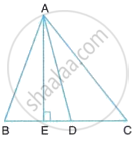
We have, D as the mid-point of BC
(i) AC2 = AE2 + EC2
b2 = AE2 + (ED + DC)2 [By pythagoras theorem]
b2 = AD2 + DC2 + 2DC × ED
`b^2=p^2+(a/2)^2+2(a/2)xxx` [BC = 2CD given]
`rArrb^2=p^2+a^2/4+ax` .........(i)
(ii) In ΔAEB, by pythagoras theorem
AB2 = AE2 + BE2
⇒ c2 = AD2 − ED2 + (BD − ED)2 [By pythagoras theorem]
⇒ c2 = p2 − ED2 + BD2 + ED2 − 2BD × ED
`rArrc^2=p^2+(a/2)^2-2(a/2)xx x`
`rArrc^2=p^2+a^2/4-ax` .........(ii)
(iii) Add equations (i) and (ii)
`b^2+c^2=p^2+a^2/4+ax + p^2+a^2/4-ax`
`b^2+c^2=2p^2+(2a^2)/4`
`b^2+c^2=2p^2+a^2/2`
In right-angled triangle ABC in which ∠C = 90°, if D is the mid-point of BC, prove that AB2 = 4AD2 – 3AC2.
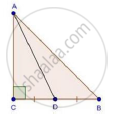
We have,
∠C = 90° and D is the mid-point of BC
In ΔACB, by Pythagoras theorem
AB2 = AC2 + BC2
⇒ AB2 = AC2 + (2CD)2 [D is the mid-point of BC]
AB2 = AC2 + 4CD2
⇒ AB2 = AC2 + 4(AD2 − AC2) [In ΔACD, by Pythagoras theorem]
⇒ AB2 = AC2 + 4AD2 − 4AC2
⇒ AB2 = 4AD2 − 3AC2
In an equilateral triangle with side a, prove that area = `sqrt(3)/4 a^2`.
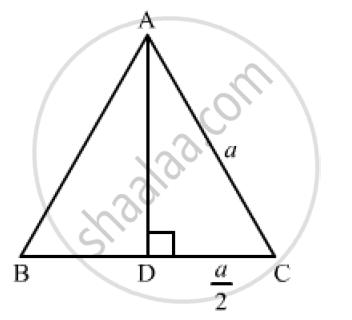
We know that the altitude of an equilateral triangle bisects the side on which it stands and forms right angled triangles with the remaining sides.
Suppose ABC is an equilateral triangle having AB =BC = CA = a.
Suppose AD is the altitude drawn from the vertex A to the side BC.
So, It will bisects the side BC
∴` DC=1/2 a `
Now, In right triangle ADC
By using Pythagoras theorem, we have
`AC^2=CD^2+DA^2`
⇒` a^2-(1/2 a)^2+DA^2`
⇒ `DA^2=a^2-1/4 a^2`
⇒` DA^2=3/4 a^2`
⇒`DA=sqrt3/2 a`
𝑁𝑜𝑤,𝑎𝑟𝑒𝑎 (Δ𝐴𝐵𝐶)=`1/2xxBCxxAD`
=` 1/2xxaxxsqrt3/2 a`
=`sqrt3/4 a^2`
In a quadrilateral ABCD, ∠B = 90°, AD2 = AB2 + BC2 + CD2, prove that ∠ACD = 90°.

We have, ∠B = 90° and AD2 = AB2 + BC2 + CD2
∴ AD2 = AB2 + BC2 + CD2 ...[Given]
But AB2 + BC2 = AC2 ...[By pythagoras theorem]
Then, AD2 = AC2 + CD2
By converse of pythagoras theorem
∠ACD = 90°
Statement:
In a right-angled triangle, if the altitude is drawn to the hypotenuse, then the two triangles formed are similar to the original triangle and to each other.
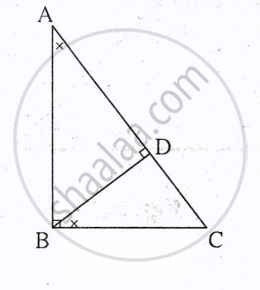
△ADB ~ △ АBС
△ BDC ~ △ ABC
△ ADB ~ △ BDC
Statement:
In a right-angled triangle, the square of the hypotenuse is equal to the sum of the squares of the other two sides.
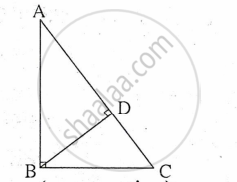
Hypotenuse2 = (base)2 + (perpendicular)2
Converse of Pythagoras Theorem:
In a triangle, if the square of one side is equal to the sum of the squares of the remaining two sides, then the triangle is a right-angled triangle
Statement:
In a right-angled triangle, the altitude drawn to the hypotenuse is the geometric mean of the two segments of the hypotenuse.
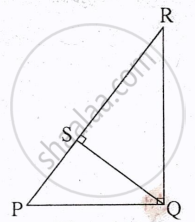
(Altitude)2 = (segment1) × (segment2)
Statement:
In a triangle, the sum of the squares of any two sides is equal to twice the square of the median to the third side plus twice the square of half the third side.
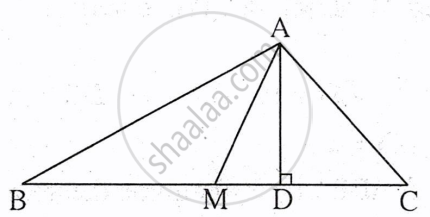
AB2 + AC2 = 2AM2 + 2BM2
(where M is the midpoint of BC)
Key Points
(I)Property of 30°-60°-90° triangle
- Side opposite 30° = \[\frac{1}{2}\] × hypotenuse
- Side opposite 60° = \[\frac{\sqrt{3}}{2}\] × hypotenuse.
(II) Property of 45°-45°-90°
- Each perpendicular side = \[\frac{1}{\sqrt{2}}\] × hypotenuse
Important Questions [25]
- If a and b are natural numbers and a > b If (a2 + b2), (a2 – b2) and 2ab are the sides of the triangle, then prove that the triangle is right-angled. Find out two Pythagorean triplets by taking
- Four alternative answers for the following question are given. Choose the correct alternative and write its alphabet: Out of the dates given below which date constitutes a Pythagorean triplet?
- In the following figure, in ΔABC, ∠B = 90°, ∠C = 60°, ∠A = 30°, AC = 18 cm. Find BC.
- Find the Height of an Equilateral Triangle Whose Side is 6 Units.
- In ∆RST, ∠S = 90°, ∠T = 30°, RT = 12 cm, then find RS.
- In right-angled triangle PQR, if ∠P = 60°, ∠R = 30° and PR = 12, then find the values of PQ and QR.
- In δDef, If ∠E = 90°, Then Find the Value of ∠D + ∠F.
- In ΔABC, ∠ABC = 90°, ∠BAC = ∠BCA = 45°. If AC = 92, then find the value of AB.
- Choose the correct alternative: ΔABC and ΔDEF are equilateral triangles. If ar(ΔABC): ar(ΔDEF) = 1 : 2 and AB = 4, then what is the length of DE?
- In the following figure, AE = EF = AF = BE = CF = a, AT ⊥ BC. Show that AB = AC = √3×a
- In the given figure, ∠MNP = 90°, seg NQ ⊥ seg MP, MQ = 9, QP = 4, find NQ.
- In right-angled ΔABC, BD ⊥ AC. If AD= 4, DC= 9, then find BD.
- Find the side of a square whose diagonal is 10sqrt2 cm.
- In the above figure □ABCD is a rectangle. If AB = 5, AC = 13, then complete the following activity to find BC. Activity: ΔABC is □ triangle. ∴ By Pythagoras theorem AB2 + BC2 = AC2 ∴ 25 + BC2 = □
- Construct two concentric circles with centre O with radii 3 cm and 5 cm. Construct a tangent to a smaller circle from any point A on the larger circle. Measure and write the length
- Find the Side and Perimeter of a Square Whose Diagonal is 13sqrt2 Cm.
- In ∆ABC, seg AP is a median. If BC = 18, AB2 + AC2 = 260, Find AP.
- In δAbc, Seg Ap is a Median. If Bc = 18, Ab2 + Ac2 = 260, Then Find the Length of Ap.
- In ∆RST, ∠S = 90°, ∠T = 30°, RT = 12 cm, then find RS and ST.
- Out of the following, which is the Pythagorean triplet? (A) (1, 5, 10) (B) (3, 4, 5) (C) (2, 2, 2) (D) (5, 5, 2)
- Find the perimeter of a square if its diagonal is 102 cm:
- Adjacent sides of a parallelogram are 11 cm and 17 cm. If the length of one of its diagonal is 26 cm, find the length of the other
- Choose the correct alternative: Out of the following which is a Pythagorean triplet?
- In δPqr, Seg Pm is the Median. If Pm = 9, Pq2 + Pr2 = 290, Find Qr.
- In ΔPQR, seg PM is a median, PM = 9 and PQ2 + PR2 = 290. Find the length of QR.
Concepts [9]
- Pythagorean Triplet
- Property of 30°- 60°- 90° Triangle Theorem
- Property of 45°- 45°- 90° Triangle Theorem
- Theorem of Similarity in Right Angled Triangle
- Theorem of Geometric Mean
- Pythagoras Theorem
- Application of Pythagoras Theorem
- Apollonius Theorem
- Overview of Pythagoras Theorem
