- AO is the incident ray, OB is the refracted ray, and BC is the emergent ray in the glass block experiment.
- The ratio sin i/sin r or DF / EG is a constant and gives the refractive index (μ) of glass.
- The first law of refraction is verified as AO, OB, and normal NOM lie in the same plane.
- The second law of refraction is verified as sin i / sin r remains constant for different angles of incidence.
- The alternative method uses a circle and the normals DF and EG to calculate μ = DF / EG.
Definitions [20]
Definition: Reflection of Light
The return of light in the same medium after striking a polished surface is called reflection of light.
Define the following terms used in the study of reflection of light by drawing a labelled ray-diagram:
- Incident ray
- Point of incidence
- Normal
- Reflected ray
- Angle of incidence
- Angle of reflection
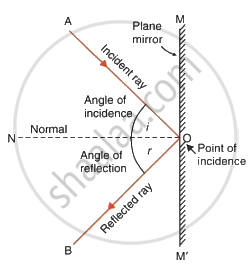
- Incident ray: The ray of light which falls on the mirror surface is called the incident ray.
- Point of incidence: The point at which the incident ray falls on the mirror is called the point of incidence.
- Normal: The normal is a line at right angles to the mirror surface at the point of incidence.
- Reflected ray: The ray of light which is sent back by the mirror is called the reflected ray.
- Angle of incidence: The angle of incidence is the angle made by the incident ray with the normal at the point of incidence.
- Angle of reflection: The angle of reflection is the angle made by the reflected ray with the normal at the point of incidence.
Define the principal focus of a concave mirror.
Light rays that are parallel to the principal axis of a concave mirror converge at a specific point on its principal axis after reflecting from the mirror. This point is known as the principal focus of the concave mirror.
Definition: Refraction
The change in the direction of the path of light when it passes from one transparent medium to another transparent medium is called refraction. The refraction of light is essentially a surface phenomenon.
or
When light passes from one transparent medium to another, its speed and direction change. This is called refraction.
Definition: Refraction of Light
When travelling obliquely from one medium to another, the direction of propagation of light in the second medium changes. This phenomenon is known as refraction of light.
OR
Light changes its direction when going from one transparent medium to another transparent medium. This is called the refraction of light.
OR
The bending of the light ray from its path in passing from one medium to the other medium is called 'refraction' of light.
OR
When a ray of light impinges on a polished, smooth, shiny surface, the rebounding of light within the same medium is called reflection of light.
Definition: Normal
A normal is an imaginary line drawn perpendicular to the boundary at the point of incidence.
Definition: Refracted Ray
The ray that enters the second medium after crossing the boundary is called the refracted ray.
Definition: Refracted Light
Refracted light is the part of light enters into the other medium and travels in a straight path but in a direction different from its initial direction and is called the refracted light.
Define opaque material.
Materials that are not able to allow light to pass through, are called opaque material.
Definition: Refractive Index of a Medium
The refractive index of a medium is defined as the ratio of the speed of light in vacuum (or air) to the speed of light in that medium.
Define transparent materials.
Materials that allow light to pass through completely are known as transparent materials.
Define the absolute refractive index of a medium.
The absolute refractive index is the ratio of the velocity of light in a vacuum to that of the medium.
Define the term refractive index of a medium in terms of velocity of light.
It is defined as the ratio of the velocity of light in medium 1 to the velocity of light in medium 2.
Definition: Lateral Displacement
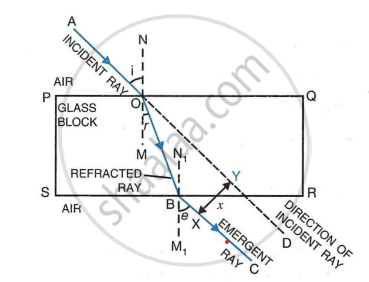
The perpendicular distance XY between the path of the emergent ray BC and the direction of the incident ray OD is called the lateral displacement.
Definition: Prism
A prism is a transparent medium bounded by five plane surfaces with a triangular cross-section.
Definition: Critical Angle
Critical angle is the angle of incidence in the denser medium corresponding to which the angle of refraction in the rarer medium is 90°.
Definition: Total Internal Reflection
Total internal reflection is the complete reflection of light back into an optically denser medium when light travels from a denser medium to a rarer medium and the angle of incidence exceeds the critical angle.
Define critical angle for a given medium.
When a ray of light propagates from a denser medium to a rarer medium, the angle of incidence for which the angle of refraction is 90° is called the critical angle.
Definition: Critical Angle
The critical angle is the angle of incidence in the denser medium for which the angle of refraction in the rarer medium is 90 degrees.
Definition: Total Reflecting Prism
A prism having an angle of 90° between its two refracting surfaces and the other two angles each equal to 45° is called a total reflecting prism.
Formulae [1]
Formula: Critical Angle
For light travelling from medium 1 to medium 2, where medium 1 is denser than medium 2:
sin C = \[\frac {n_1}{n_2}\]
where:
- C = critical angle
- n1 = refractive index of the denser medium
- n2 = refractive index of rarer medium
For a denser medium to air:
sin C = \[\frac {1}{μ}\]
where μ is the refractive index of the denser medium with respect to air.
Theorems and Laws [5]
Law: Laws of Refraction
The laws of refraction are fundamental for board examinations and objective tests.
First law
The incident ray, the refracted ray, and the normal at the point of incidence all lie in the same plane.
Second law
For a given pair of media, the ratio of the sine of the angle of incidence to the sine of the angle of refraction remains constant.
\[\frac {\text {sin i}}{\text {sin r}}\] = constant
This constant is called the refractive index of the second medium with respect to the first medium.
Law: Laws of Refraction
-
First Law: Incident ray, refracted ray, and normal to the interface at the point of incidence all lie in the same plane.
-
Second Law (Snell's Law): \[\frac{\sin i}{\sin r}=\mathrm{constant}=\frac{\mu_2}{\mu_1}\]
Extended Snell's Law: \[\frac{\sin i}{\sin r}=\frac{\mu_2}{\mu_1}=_1\mu_2=\frac{v_1}{v_2}=\frac{\lambda_1}{\lambda_2}\]
A ray of light moves from a rare medium to a dense medium as shown in the diagram below. Write down the number of the ray which represents the partially reflected ray.

Ray 2 shows partially reflected ray.
Law: Snell's Law
- The incident ray, the refracted ray and the normal to the interface of two transparent media at the point of incidence all lie in the same plane.
- The ratio of the sine of the angle of incidence to the sine of the angle of refraction is a constant, for the light of a given colour and for the given pair of media. This law is also known as Snell’s law of refraction. (This is true for angle 0 < i < 90°)
If i is the angle of incidence and r is the angle of refraction, then,
\[\frac {\text{sin i}}{\text{sin r}}\] = constant
This constant value is called the refractive index of the second medium with respect to the first.
Prove that Refractive index = `"Real depth"/"Apparent depth"`.

Consider a point object O kept at the bottom of a transparent medium (such as water or glass) separated from air by the surface PQ.
A ray of light OA, starting from the object O, is incident on the surface PQ normally, so it passes undeviated along the path AA'. Another ray, OB, starting along the object O, strikes the boundary surface PQ at B and suffers refraction.
Since the ray travels from a denser to a rarer medium, it bends away from the normal N'BN drawn at the point of incidence B on the surface PQ and travels along BC in air.
When viewed by the eye, the ray BC seems to originate from point I, which is the virtual image of O created by extending lines A'A and CB backwards.
Thus, any point seen from the air will appear to be at I, which is a lesser depth = AI than its actual depth AO.
Angle of incidence = ∠OBN'
Angle of refraction = ∠CBN
Since, AO and BN' are parallel and OB is transversal line, so
∠AOB = ∠OBN' = i
Similarly, IA' and BN are parallel and IC is the transversal line, so
∠BIA' = ∠CBN = r
In right-angle triangle BAO,
sin i = `(BA)/(OB)` and,
In right-angle triangle IAB,
sin r = `(BA)/(IB)`
For refraction from medium to air, by Snell’s law
`""_mμ_a = sin i/sin r = ((BA)/(OB))/((BA)/(IB))`
⇒ `""_mμ_a = (IB)/(OB)`
Hence, refractive index of medium with respect to air is,
`""_aμ_m = 1/(""_mμ_a) = (OB)/(IB)`
The object is viewed from a point vertically above the object O, since point B is very close to the point A.
∴ IB = IA and OB = OA
Hence,
`""_aμ_m = 1/(""_mμ_a) = (OA)/(IA)`
⇒ `"Real depth"/"Apparent depth"`
Key Points
Key Points: Speed of Light in Different Media
- Refractive index (µ) = c / V, where c is the speed of light in vacuum and V is the speed in the medium.
- The refractive index of a medium is always > 1 because the speed of light in any medium is less than in a vacuum.
- If µ₁ = µ₂ or the angle of incidence = 0°, the ray of light passes undeviated.
- Wavelength in medium A′ = A / µ; wavelength decreases in denser medium and increases in rarer medium.
- Refractive index decreases with decreasing speed of light, and is maximum for violet light and minimum for red light.
Key Points: Refraction Laws & Glass Index
Key Points: Refraction of Light Through a Rectangular Glass Block
Key Points: Multiple Images in a Thick Mirror
- A thick glass plate produces multiple virtual images due to repeated partial reflections and refractions inside the glass.
- The second image (A₂) is the brightest because it is formed by strong reflection at the silvered back surface.
- Later images (A₃, A₄, A₅...) are dimmer due to multiple internal reflections and light loss at each stage.
Key Points: Real and Apparent Depth
- An object in a denser medium (such as water or glass) appears shallower when viewed from a rarer medium (such as air) due to refraction.
- Apparent depth < Real depth, and the ratio is given by:
μ = \[\frac {\text{Real depth}}{\text{Apparent depth}}\] - Shift in position = Real depth – Apparent depth =
Real depth × (1 − \[\frac {1}{μ}\]) - The shift is greater when:
The refractive index of the medium is higher,
The medium is thicker, or
The wavelength is shorter (more for violet, less for red). - These formulas are valid only when the object is viewed vertically from above.
Key Points: Consequences of Refraction of Light
- Stars twinkle due to changes in the air’s refractive index caused by temperature variations.
- The Sun appears higher in the sky at sunrise and lower at sunset due to atmospheric refraction, which bends its rays.
- A hidden coin becomes visible when water is added, as refraction bends light from the coin toward the eye.
- Objects under a glass slab or in water appear raised because light bends as it passes from a denser to a rarer medium.
- Water tanks appear shallow, and legs appear shorter in water because light bends away from the normal.
Key Points: Transmission of Light From a Denser Medium to a Rarer Medium
Key Points: Relationship between Critical Angle and Refractive Index
Key Points: Total Internal Reflection Through a Right-Angled Isosceles Prism
- A total-reflecting prism has angles of 90°, 45°, and 45° and is used to produce total internal reflection within the prism.
- A total-reflecting prism deviates a light ray by 90° or 180° without loss of intensity and is used in periscopes, binoculars, and cameras.
- A total reflecting prism can erect an inverted image without deviation and is used as an erecting prism in slide projectors.
Key Points: Total Internal Reflection Through Right-angled prism
- A 30°, 90°, 60° prism can deviate a light ray through an angle less than 60° using total internal reflection, when the incident ray enters normally on the face BC and strikes AC at 60°, which is greater than the critical angle (42°).
- A ray incident normally on the hypotenuse face below the foot of the perpendicular suffers total internal reflection at BC, and emerges bending away from the normal at AB, resulting in a deviation greater than 60°.
Key Points: Using Prisms Instead of Plane Mirrors
- A total internal reflecting prism is used instead of a plane mirror to deviate light by 90° in a periscope and 180° in a binocular or camera.
- A total reflecting prism gives 100% reflection, while a plane mirror reflects less due to refraction and absorption.
- The image formed by a total-reflecting prism is brighter and does not fade over time, unlike in a plane mirror, where silvering deteriorates.
Key Points: Consequences of Total Internal Refraction
- Mirage seen on hot roads or in deserts is a consequence of total internal reflection.
- An empty test tube in water shines like a mirror due to total internal reflection.
- A crack in a glass vessel often appears shiny because of total internal reflection.
- A diamond sparkles due to total internal reflection within its surfaces.
- Optical fibres use total internal reflection to transmit light signals without energy loss.
Important Questions [35]
- When a ray of light travels normal to the given surface, then the angle of refraction is ______.
- Light travels a distance of '10x' units in time 't1' in vacuum and it travels a distance of 'x' units in time 't2' in a denser medium. Using this information answer the question that follows:
- A boy uses the blue colour of light to find the refractive index of glass. He then repeats the experiment using the red colour of light. Will the refractive index be the same or different in the two
- Name a Prism Required for Obtaining a Spectrum of Ultraviolet Light.
- Draw a ray diagram to show the refraction of a monochromatic ray through a prism when it suffers minimum deviation.
- State the dependence of angle of deviation on the refractive index of the material of the prism.
- State the Dependence of Angle of Deviation On the Wavelength of Light
- Write a Relationship Between the Angle of Incidence and Angle of Refractions for a Given Pair of Media
- Name One Factor that Affects the Lateral Displacement of Light as It Passes Through a Rectangular Glass Slab.
- The Speed of Light in Glass is 2 × 10⁵ Km/S. What is the Refractive Index of Glass?
- Draw the Diagram Given Below and Clearly Show the Path Taken by the Emergent Ray.
- A Ray of Light Passes from Water to Air. How Does the Speed of Light Change?
- Which Colour of Light Travels Fastest in Any Medium Except Air?
- Light passes through a rectangular glass slab and through a triangular glass prism. In what way does the direction of the two emergent beams differ and why?
- Why is the Ratio of the Velocities of Light of Wavelengths 4000å and 8000å in Vacuum 1: 1?
- Which of the Above Wavelengths Has a Higher Frequency?
- The Following Diagram Shows a 60°, 30°, 90° Glass Prism of Critical Angle 42°, Copy the Diagram and Complete the Path of Incident Ray Ab Emerging Out of the Prism Marking the Angle of Incidence on Each Surface.
- How Does the Angle of Deviation Produced by a Prism Change with Increase in the Angle of Incidence. Draw a Curve Showing the Variation in the Angle of Deviation with
- (I) What is the Relation Between the Refractive Index of Water with Respect to Air ( a μ W ) and the Refractive Index of Air with Respect to Water ( W μ a ) .
- The diagram below shows two parallel rays A (Orange) and B (Blue) incident from air, on air-glass boundary. Copy and complete the path of the rays A and B.
- How is the refractive index of a material related to real and apparent depth?
- A coin kept inside water [µ = 4/3] when viewed from air in a vertical direction appears to be raised by 3.0 mm. Find the depth of the coin in water.
- Jatin puts a pencil into a glass container having water and is surprised to see the pencil in a different state. (i) What change is observed in the appearance of the pencil?
- Which colour of light has a higher critical angle? Red light or green light.
- Small air bubbles rising up a fish tank appear silvery when viewed from some particular angle is due to the ______.
- Draw the diagram of a right-angled isosceles prism which is used to make an invented image erect.
- State the conditions required for total internal reflection of light to take place.
- (I) Define Critical Angle. (Ii) State One Important Factor Which Affects the Critical Angle of a Given Medium.
- Name the factors affecting the critical angle for the pair of media.
- The diagram below shows a light source P embedded in a rectangular glass block ABCD of critical angle 42°. Complete the path of the ray PQ till it emerges out of the block. [Write necessary angles].
- A Ray of Light Travels from Water to Air as Shown in the Diagram Given Below :Copy the Diagram and Complete the Path of the Way. Given the Critical Angle for Water is 48 State the Condition So that Internal Reflection Occurs
- State the Relation Between the Critical Angle and the Absolute Refractive Index of a Medium.
- The diagram below shows a point source P inside a water container. Four rays A, B, C, D starting from the source P, are shown up to the water surface. (1) Show in the diagram the path of these
- Copy the diagram given below and complete the path of the light ray till it emerges out of the prism. The critical angle of glass is 42°. In your diagram mark the angles wherever necessary.
- A ray of light XY passes through a right-angled isosceles prism as shown below a. What is the angle through which the incident ray deviates and emerges out of the prism?
Concepts [24]
- Light: Reflection and Refraction
- Refraction of Light
- Laws of Refraction
- Speed of Light in Different Media
- Principle of Reversibility of the Path of Light
- Refraction Laws & Glass Index
- Refraction of Light Through a Rectangular Glass Block
- Multiple Images in a Thick Mirror
- Prism
- Refraction Through a Prism
- Real and Apparent Depth
- Apparent Bending of a Stick Under Water
- Consequences of Refraction of Light
- Transmission of Light From a Denser Medium to a Rarer Medium
- Critical Angle
- Relationship between Critical Angle and Refractive Index
- Total Internal Reflection
- Total Internal Reflection in a Prism
- Total Internal Reflection Through a Right-Angled Isosceles Prism
- Total Internal Reflection Through an Equilateral Prism
- Total Internal Reflection Through Right-angled prism
- Use of a Total Internal Reflecting Prism in Place of a Plane Mirror
- Total Internal Reflection vs Reflecting from a Plane Mirror
- Consequences of Total Internal Refraction
