Advertisements
Advertisements
प्रश्न
You will probably agree that this story does not have breathless adventure and exciting action. Then what in your opinion makes it interesting?
Advertisements
उत्तर
Pointers have been provided for students' reference.
It is strongly recommended that students prepare the answer on their own.
The various reasons which make this story mind-gripping and a real page turner, are:
-
The innocence of the language which keeps us in suspense about the belongingness of the horse.
-
The mystery behind riding horse;
The interesting feature which makes this story captivating is the way in which the relationship between the author and his cousin develops.
APPEARS IN
संबंधित प्रश्न
Give reasons for the following statement.
The author thought that his positive thinking strategy worked well after all.
The school system often curbs individual talents. Discuss.
The story revolves around characters who belong to a tribe in Armenia. Mourad and Aram are members of the Garoghlanian family. Now locate Armenia and Assyria on the atlas and prepare a write-up on the Garoghlanian tribes. You may write about people, their names, traits, geographical and economic features as suggested in the story.
If you were to write about these issues today what are some of the incidents, examples and problems that you would think of as relevant?
What does the line 'I never writ, nor no man ever loved' imply?
Comment on the contemporary concern that the poem echoes.
What quality of 'beauty' and 'love' does the poem highlight?
Read the extract and state whether the following statement is true or false. Correct the false statement.
Growing in abundance is more important than the quality of the crop.
Go through the text again and find the reasons that forced Peter to shoot down a person.
- The keepers spotted him.
- _________________________
- _________________________
Using a dictionary/internet note down the main difference between self-reliant and self-assured.
When we look at the sky, we find several objects. They stand for something or the other. Complete the following table by finding the significance of the given objects. One example is given to you.
| Celestial Bodies | Association |
| The Sun | Power, Heat, Energy, Commitment, etc. |
| The Moon | |
| The Rainbow | |
| The Stars |
Correct the following statement.
Sue ignored Johnsy completely.
Think and answer in your own words.
'Beauty' in stanza 5 to 6 can refer to a beautiful maiden as well as nature itself. Explain when and how nature ‘dances’ and also 'smiles'.
Have you ever given up on something good? Share your story with your friend.
What could have happened to the one who flew away? Who was she?
List the four elements of drama.
Form groups and hold debates on the following topics. Make bulleted lists of points in favour of the topic (pros) and those against it (cons). (3-6 points each)
You should admit your mistakes.
Read aloud/Enact the play.
Explain the meaning of the following phrase:
An eagle’s eye
Imagine you are visiting the Science Fair. What other stalls (apart from the ones mentioned here) are you likely to find there? Try to list at least five more stalls.
Read the passage and answer the following:
Where does the story take place?
List the various things that the Lethargarians do or want to do. Can you sum up all of it in one word or phrase?
Read the following sentence aloud. Write who said it and to whom.
“Why, the dress you go to the theatre in !”
Find out the following with the help of your teacher and the internet.
Rain in countries like the UK which experience spring-summer-autumn-winter.
Pick out words from the poem that describe the following. List them in Column ‘A’. Substitute each of those describing words with another word/phrase of the same meaning.
| A (Poetic words) | B (Your own words) | |
| the ‘Autumn’ | a maiden fair | |
| stars | ||
| moonlight | ||
| cooing of birds |
‘And calls our Best away’ is a gentle way of expressing the unpleasant idea of a loved one dying. It is an example of euphemism. Think and write down 3 or 4 ways in which we can express the idea of ‘death’ in a tactful and gentle manner.
- _________________
- _________________
- _________________
- _________________
Find the meaning of the following word.
starlets
Name the following.
Not comfortable with the wet ground.
Discuss the following in group.
What can we do to get rid of bad habits?
Discuss the following in group.
Do’s and Don’ts for young children.
What is meant by being ‘offline’?
Where is Rangoli usually drawn?
Read the following line from the poem and answer the question that follow.
Not hurrying to, nor turning from the goal; Not mourning for the things that disappear
- Why do you think the poet is not in a hurry?
- What should one not mourn for?
Identify the character or speaker.
I was Duke of Milan, and you were a princess.
Where was the author when he heard the noise?
What was the e-mail message sent to Somu by Dr.Krishnan?
Read the data below and answer the following question.
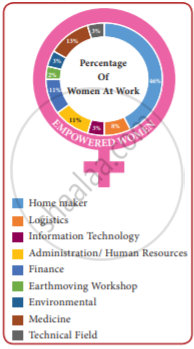
Choose the correct answer.
What is the difference between the percentage of women working in logistics and Medicine?
Why does Alice drink from the bottle that says ‘DRINK ME’ and why does she eat from the cake that says ‘EAT ME’?
Read these lines and answer the questions given below.
With lutes in our hands ever-singing we roam,
All men are our kindred, the world is our home.
- Who does ‘we’ refer to? What do they have in their hands? What is its name?
- How are the men in the world related to the singers?
Read the line and answer the question.
And the wheel’s kick and the winds song and the white sail’s shaking
What according to the poet are the pleasures of sailing?
Vasantha made a lot of noise because ______
What does the tamarind give?
Mithali’s mother tongue is Telugu.
We don’t use _________ in the soil.
Find the rhyming word from the poem.
Country - ______.
Read scene I of the play carefully and answer the question below.
Match the following.
| Sr.No. | CHARACTER | TRAIT |
| a. | Father Wolf | with a grey nose…feeds her four cubs |
| b. | Tabaqui | the big one from Waingunga River with a lame foot |
| c. | Mother Wolf | the chief of the Wolves |
| d. | Shere Khan | begs for meat and thanks for the meal/warns the wolves about the arrival of Shere Khan |
A man in ______ clothes stopped near him.
Write the rhyming word.
Nature - ______.
Who will be the fortunate?
What is the main idea of the story?
Name the character or speaker.
"Why does Nandhini look so sad?"
Where did the tanker man take the water from the village?
Why did the king want a leader who knows to grow a plant?
Why was his father unable to sleep?
Why did he rub the circle again and again?
Why did the headmaster give Megala a special prize?
What did Nasruddin boast about?
What did the boy make with the trunk of the tree?
Read the passage given below and answer the questions that follow
Humans have long been fascinated by fiction. We experience excitement in assigning supernatural power to imaginary characters in fictional stories – and so we have Spider man, Batman, He–man, Titans and many more. The ‘Cyborg’ was an offshoot of such wild imagination of humans to invest our species with superhuman powers. Today, the Cyborg is no more an imaginary organism. We are living in a world where a sizeable population of humans have merged their bodies with technological implants. The term ‘Cyborg’, short for ‘cybernetic organism’, was coined to describe a man, whose body is implanted with technological devices to supplement and substitute body functions.
Cyborgs include people with cardiac pacemakers, contact lenses, bionic ears and eyes, prosthetics and so on. In other words, a cyborg is partly human and partly machine. The technological innovations in the field of medicine and healthcare augment humans with machines, producing a beta version of the human body. The advent of brain machine interfaces is certain to blur the boundary between humans and machines. Scientists are working hard to find a technique for age reversal too. People do not want to die, so mankind is striving to get to the final frontier, which is development of machines and devices that would accord man immortality.
The needs of humans are not limited. As time passes, food habits change, thinking patterns change, and even appearances change. We are about to travel by driverless, fully automated vehicles. Computers and smart phones have become our masters. The more we depend and merge with technological advancements, the more the humanness in us slowly erodes. Intelligence is sought to be infused into machines and robotics are designed in such a way to give man a virtual human companion. The field of artificial intelligence is overtaking the human brain and many fear that it could even harm the human race. Despite certain limitations and potential threats, many believe that cyborgs will be the next step in the evolution of mankind. The amalgamation of man and machine is sure to add a new dimension to the life of mankind and this will prove to be the ‘biggest evolution in Biology’ since the emergence of life, four billion years ago.
Questions:
a) Account for the popularity of characters with supernatural powers.
b) Who is referred to as a ‘Cyborg’?
c) What is expected to happen with the advent of the brain machine interface?
d) The needs of humans are not limited. How is this statement elaborated in the passage?
e) How can a machine turn into a virtual companion for humans?
f) Explain the flipside of the rapid technological advancement.
g) Identify the word in para 1 which means ‘everlasting life’.
h) Which of the following words is synonymous with ‘amalgamation’?
- recreation
- integration
- exploration
- proposition
i) Which of the following options is the antonym of the word ‘advent’?
- drawback
- dispute
- departure
- danger
j) Find out the word which is the antonym of ‘natural’ in para 3.
Pick out word which mean the same as
not protected (para 2)
