Advertisements
Advertisements
प्रश्न
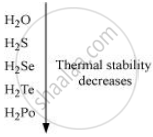
Write the order of thermal stability of the hydrides of Group 16 elements.
Advertisements
उत्तर १
The thermal stability of hydrides decreases on moving down the group. This is due to a decrease in the bond dissociation enthalpy (H−E) of hydrides on moving down the group.
Therefore,
उत्तर २
The thermal stability of hydrides of group 16 elements decreases down the group. This is because down the group, size of the element (M) increases, M-H bond length increases and thus, stability of M-H bond decreases so that it can be broken down easily. Hence, we have order of thermal stability as H2O > H2S > H2Se > H2Te > H2PQ
संबंधित प्रश्न
Give reasons: SO2 is reducing while TeO2 is an oxidising agent.
Account for the following : There is large difference between the melting and boiling points of oxygen and sulphur.
Give reasons for the following : H2Te is the strongest reducing agent amongst all the hydrides of Group 16 elements.
Why is H2O a liquid and H2S a gas?
Why does NH3 form hydrogen bond but PH3 does not?
Why are halogens strong oxidising agents?
Arrange the following in the order of property indicated for the given set:
F2, Cl2, Br2, I2 - increasing bond dissociation enthalpy.
Arrange the following in the order of the property indicated against set :
H2O, H2S, H2Se, H2Te − increasing acidic character.
Match the items of Columns I and II and mark the correct option.
| Column I | Column II |
| (A) \[\ce{H2SO4}\] | (1) Highest electron gain enthalpy |
| (B) \[\ce{CCl3NO2}\] | (2) Chalcogen |
| (C) \[\ce{Cl2}\] | (3) Tear gas |
| (D) Sulphur | (4) Storage batteries |
Given below are two statements labelled as Assertion (A) and Reason (R).
Assertion (A): Electron gain enthalpy of oxygen is less than that of Flourine but greater than Nitrogen.
Reason (R): Ionisation enthalpies of the elements follow the order Nitrogen > Oxygen > Fluorine.
Select the most appropriate answer from the options given below:
In forming (i) \[\ce{N2 -> N^{+}2}\] and (ii) \[\ce{O2 -> O^{+}2}\]; the electrons respectively are removed from:
The correct order of ΔiHs among the following elements is
These are physical properties of an elements.
- Sublimation enthalpy
- Ionisation enthalpy
- Hydration enthalpy
- Electron gain enthalpy
The total number of above properties that affect the reduction potential is ______. (Integer answer)
What is the basicity of \[\ce{H3PO4}\]?
______ is a gaseous element of group 16.
Given below are two statements:
Statement I: The boiling point of hydrides of Group 16 elements follows the order:
H2O > H2Te > H2Se > H2S
Statement II: On the basis of molecular mass, H2O is expected to have a lower boiling point than the other members of the group but due to the presence of extensive H-bonding in H2O, it has a higher boiling point.
In the light of the above statements, choose the correct answer from the options given below:
