Advertisements
Advertisements
प्रश्न
Write about the following memories or experiences. Share your views with the
class.
Advertisements
उत्तर
(i) A memorable holiday spent with my grandmother
Grandmothers are more than mothers. I still remember how I spent a holiday with my grandmother. It was quite a long time since I met her. I found her standing at the village bus-stand to receive me. She was really excited. She had prepared some of my favourite dishes only for me. She took me to the fields. We stopped at the canal. What a sight! Children were diving into it from a wooden bridge. I enjoyed fresh sugarcanes. It was evening. A herd of cattle was returning home. My grandmother would not let me sleep early. She had many interesting stories to tell. She talked of her youth, her good old times and her hobbies. She kissed me affectionately before I went to bed.
(ii) A Story told by my grandmother
It is difficult to imagine a grandmother without her fanciful stories. My grandmother is a great story-teller. Her narrative skill is very real and convincing. She will make you believe even the incredible. She has stored many stories in her memory. Her favourite story is of Savitri and Yama. Savitri’s husband was cutting wood in the forest. He fell down from a tree and died. The God of death, Yama came to take him to the other world. Savitri would not let him come near the dead body of her husband. She remained glued to the dead body for many days. She didn’t eat and sleep. The God of death was moved. He had never seen such a devoted and determined wife. He was pleased and restored Savitri’s husband to life.
(iii) The things I admire the most about my grandmother
My grandmother is my role-model. I am very much impressed with her personality. But there are certain things which I admire the most in her character. The first thing is her sense of discipline. She is very regular and punctual. She gets up at 5 a.m. in the morning. She is ready for her prayers before 6 a.m. She has always a fixed time for everything. I like her deep faith in God. Her sense of cleanliness is extremely praiseworthy. She looks noble and dignified in her spotless white clothes. All these things make her a very pleasing and dignified personality.
(iv) The difference between my mother and my grandmother
Human relations generally defy comparisons. But still there are certain basic differences between my mother and my grandmother. I am also different from my mother. So is my grandmother from her daughter-inlaw. Basically it is a generation gap. My grandmother is conservative. She is highly religious. She has deep faith in God and fate. But my mother is a working woman. She has a progressive outlook towards life and people. She is not so religious. She believes that everyone has a right to lead one’s own kind of life. My grandmother thinks that home and children are the most important things for any woman. My mother thinks of other things as well. She believes that a woman must have freedom to decide what is good or bad for her.
APPEARS IN
संबंधित प्रश्न
Answer the following question briefly:
Did Private Quelch’s day to day practices take him closer towards his goal? How can you make out?
Answer the following question:
Describe Mr. Bramble as he has been described in the story.
The sequence of events has been jumbled up. Rearrange them and complete the given flowchart.
(1) Major Percy and Bill come to the house.
(2) Harold comes to know that his father is a boxer.
(3) Bill tells his wife that he is doing it for Harold.
(4) Jerry Fisher tries to convince Bill to reconsider.
(5) Mrs. Bramble is amazed to think that she has brought such a prodigy as Harold into the world.
(6) Harold wants to know what will happen to the money he had bet on Murphy losing.(7) Mrs. Bramble is informed that Bill had decided not to fight.
(8) Mrs. Bramble resumes work of darning the sock.
(9) Harold is alone with his mother in their home.

Roads are fascinating as metaphors for life, change, journeys, partings,
adventure, etc. or simply as roads. This is probably why they, and all their
attendant images, have permeated art, literature and songs. In the poem, Frost
uses the fork in the road as a metaphor for the choices we make in life. Thus the
roads are, in fact, two alternative ways of life. What other nouns, according to
you could be used to represent life?
River
________________
________________
________________
________________
________________
On the basis of your understanding of the poem, answer the following question
by ticking the correct choice.
The speaker says that she has paved the way for cavities and decay by __________.
Answer the following question briefly.
Why does Jeanne want to buy a villa?
Answer the following question briefly.
Do you think the Bishop was right in selling the salt-cellars? Why/ Why not?
You are a member or 'Explorer', an adventure club. Write a paragraph about one of your experiences or adventure activity.
Here are some words and phrases you can use
| Curious | thrilled | terrified | relieved |
| felt euphoric | agonizing moments | insecurity | grateful |
| uncertainty | overwhelming experience | extraordinary | courage |
Present Perfect Continuous
“What have you been doing?”
Imagine what people have been doing or what are the things that have been happening.
| Ashok comes in wearing white shorts, a T-shirt and carrying a racquet. He is sweating. | ||
| I think | he has been playing | tennis |
| I imagine | badminton | |
| Perhaps | badminton | |
Now try to build your own similes for the following :
- The rock stood…
- The waves leapt…
- The sea shone …
- The sun set…
- The rain fell heavily …
- The birds soared …
- Dawn broke …
- The stars…
- The wind shook the trees …
Add other similes of your own and write them in your notebook.
Comparing Quantities
Study the following graph depicting major exports from Medland in the
current year.
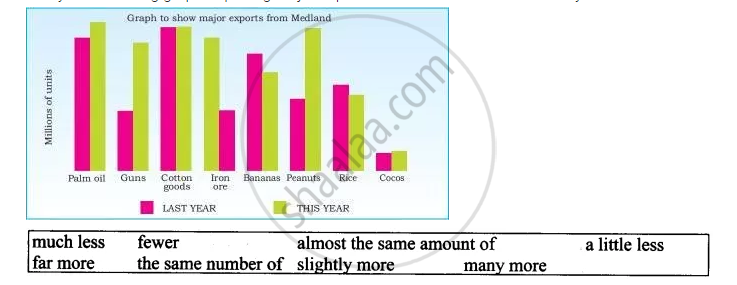
Write a short report on major exports from Medland this year compared with the last year. Use words from the box above. Divide your report into two paragraphs as indicated:
Medland’s Export Trends
On the whole, Medland exported slightly less this year than the last year. Concerning foodstuffs,
_________________________________________________________________
As regards non-edible goods,_____________________________________________
Work in pairs and recognise how many words belong to each set. Complete the sentences as in the example. Use words only from the box above:
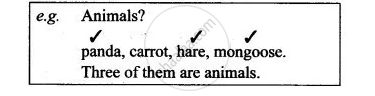
- Chemical elements?
Mercury, iron, ammonia__________ of___________ are chemical elements. - Countries in South America?
Brazil, Syria, Sumatra One____________ is a country in South America. - Rivers?
Hwang Ho, Mekong ____________ them are rivers. - Languages?
Telugu, Bengali, Punjabi, Holland____________are languages. - Capital cities?
Pokhara, Mandalay, New York, Melbourne___________of ____________a capital. - Grow on trees?
Pineapple, tomato_______________ of them grows on trees. - Religions?
Taoism, Democracy, Communism ____________of ____________ is a religion. - Units of currency?
rupee, kyat, yen, dollar, baht, rupiah ____________are units of currency.
Complete the following passage by choosing the correct option. The first one has been done as an example:
Martin Cooper, (a) _______ a Motorola researcher and executive, is widely (b) _______ to be the inventor (c)_______ the first mobile phone in 1973. There are (d) _______ categories of mobile phones (e)_______ from basic phones and feature phones (f)______ as music phones, camera phones to smart phones. The (g)_________commonly used data application on mobile phones (h)______ text messaging. Mobile phones generally (i)_______power from batteries which (j)_______ be recharged. The use of cellphones (k)_________ while driving as a safety measure.
| (a) (i) an (ii) the (iii) a (iv) X |
(b) (i) consider (ii) considered (iii) considering (iv) have considered |
(c) (i) for (ii) of (iii) as (iv) off |
(d) (i) many (ii) few (iii) much (iv) more |
| (e) (i) are ranging (ii) ranging (iii) range (iv) ranges |
(f) (i) some (ii) like (iii) such (iv) similar |
(g) (i) much (ii) more (iii) most (iv) many |
(h) (i) is (ii) are (iii) has been (iv) being |
| (i) (i) obtain (ii) is obtaining (iii) obtaining (iv) obtained |
(j) (i) would (ii) can (iii) may (iv) should |
(k) (i) ban (ii) was banned (iii) banning (iv) is banned |
Will and Shall
Look at this cartoon which shows the difference in the use of present continuous and will to express the future.
It’s Mike’s birthday on January 2nd.

Write the contracted forms. Practise saying these words.
e.g. ought not to – oughtn’t to.
- cannot _______
- need not _______
- should not _______
- must not _______
- do not _______
- did not _______
Write what each symbol means using can, can’t, must, mustn’t.

Can you make some guesses about the dead man? Give reasons for your answers.
a) Did the man die a natural death or was he murdered?
b) Was the dead man rich or poor?
c) Who is the man bending over him?
Complete the following passage on Dance by choosing the correct word from the given options. The first one has been done for you.
The fact that dance (a) is an art form is a well known fact. (b) ________ dance as a therapy is not known (c) ________ many. Dance therapy involves a synthesis of the grace and vigour (d) ________ Indian classical and folk dance movements into (e) ________ innovative and holistic therapy. It brings (f) ________ the inner feelings (g) ________ the participants and can help them (h) ________ develop a healthy personality.
| (a) (i) is (ii) been (iii) as (iv) being |
(b) (i) For (ii) Although (iii) But (iv) While |
(c) (i) by (ii) to (iii) in (iv) about |
(d) (i) on (ii) in (iii) of (iv) into |
| (e) (i) the (ii) a (iii) an (iv) as |
(f) (i) in (ii) of (iii) over (iv) out |
(g) (i) about (ii) for (iii) in (iv) of |
(h) (i) with (ii) in (iii) to (iv) into |
Choose the right word from the options given below and fill in the blanks.
(а) The weekly forecast says that I _________ an old friend this week.
(b) I have to catch the 5.00 am train tomorrow. So, I _________ go to bed late tonight.
(c) The casualties _________ to a nearby hospital.
(d) The majority of the news _________ about violence.
| (a) (i) will meet (ii) meet (iii) am meeting (iv) ought to meet |
(b) (i) have to (ii) needn’t (iii) may (iv) mustn’t |
| (c) (i) was taken (ii) were taken (iii) taken (iv) took |
(d) (i) are (ii) is (iii) has (iv) have |
20 years from now, one of your class-mates becomes a famous sport-star. You have been asked to write his/her biography. Collect the necessary biographical details. Use your imagination to create his / her achievements in the sport concerned, and write the biography. Remember to write it in chronological order of events, and use the simple past tense as far as possible.
