Advertisements
Advertisements
प्रश्न
Comparing Quantities
Study the following graph depicting major exports from Medland in the
current year.
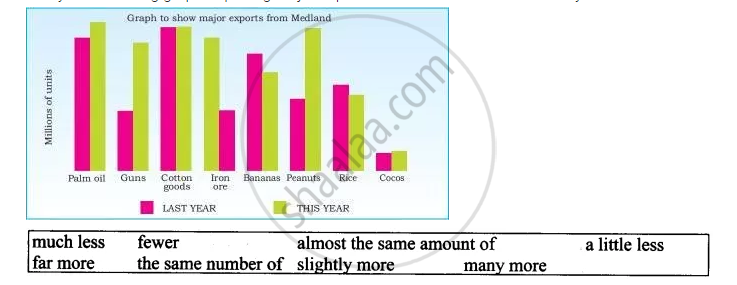
Write a short report on major exports from Medland this year compared with the last year. Use words from the box above. Divide your report into two paragraphs as indicated:
Medland’s Export Trends
On the whole, Medland exported slightly less this year than the last year. Concerning foodstuffs,
_________________________________________________________________
As regards non-edible goods,_____________________________________________
Advertisements
उत्तर
Medland’s Export Trends
On the whole, Medland exported slightly less this year than the last year. Concerning foodstuffs, it exported slightly more palm oil this year than the last year. It exported fewer bananas this year than the last year. It exported far more peanuts this year than the last year. It exported a little less rice this year than the last year. It exported slightly more cocos this year than die last year.
As regards non-edible goods, Medland exported far more guns this year than the last year. It exported almost the same amount of cotton goods this year than the last year. It exported much less iron ore this year than the last year.
APPEARS IN
संबंधित प्रश्न
Write about the following memories or experiences. Share your views with the
class.

a) This is the other word for trembling
(b) This is used for smile
(c) You call a person this if he/she has pale gold coloured hair.
(d) This is a quality which relates to high energy and noise
(e) This is related to dancing or moving in a way that involves shaking your hips and shoulders
(f) This is to express a tendency to show violent and wild behaviour often causing damage
(g) We use it for a condition which is serious, uncertain and dangerous
(h) This is a state in which one is forced to stay in a closed space
(i) This is a medical condition involving bleeding in the brain
(j) It is a loud, deep shout to show anger.
(k) This is a condition when the rope or leash is stretched tightly
Answer the following question briefly:
Private Quelch looked like a ‘Professor’ when the author first met him at the training depot. Why?
Answer the following question:
Describe Mr. Bramble as he has been described in the story.
Working in groups of four, write the article on the following :
The elderly seek attention and company from younger members of their family. They are eager to listen and long to share their life experiences. John A Pescud is not only respectful but also very patient with Colonel Allyn, Jessie’s father. As a reporter, write an article for a newspaper, on the importance of the elderly in our lives.
(a) Listen to a recording of the poem.
(b) What choice did the poet have to make?
(c) Did he regret his choice? Why/why not?
Answer the following question briefly.
Does the speaker seem happy about his decision?
Identify the rhyme scheme of the poem.
Answer the following question.
With reference to the poem, how can you look after your teeth?
Answer the following question briefly.
Do you think the punishment given to the convict was justified? Why/ Why not?
Why is the convict eager to reach Paris?
Answer the following question briefly.
Before leaving, the convict asks the Bishop to bless him. What brought about this
change in him?
Rearrange the following words and phrases to form meaningful sentences. The first one has been done as an example:
other species/ human species/the/of/ many/ the/ very existence/ is threatening.
The human species is threatening the very existence of many other species.
(a) of nature/biodiversity/the/is/variety of life forms/interact to support/ that/ and sustain/ balance/ the ____________________________________
(b) consumed/as/grows,/ more and more of / Earth’s/ the / resources/ are/ human population/the
____________________________________
(c) extinction/ crisis / explosive/ an/ consumption / had led / growth and / an ____________________________________
(d) that have/ Earth’s history/ mass extinctions / the/ threatens/ periodically during/ occurred/ the/and to surpass
(e) one everyday/ scientists/ that/ estimate/ rate off species are disappearing/ the / at
____________________________________
Before you listen for the second time, discuss the following with your partner.
- Why are there two presenters?
- What is the presenter’s role?
- What is the presenter’s style? Do you like their style? Why / Why not?
- Why do the presenters outline some of the contents right at the start of the programme?
The following note comes from an army booklet, “Advice to New Recruits.” Complete the instructions by filling in the blanks with suitable modals.
Welcome to Ranor Barracks!
Follow the rules, accept the advice and you will find your life in the army interesting and fulfilling.
You ________ have your hair cut very short in the first month. After that you ________
grow it longer but it ________ never touch your collar. Your uniform ________ be kept clean and tidy. Boots and buttons ________ be polished daily. You ________ use cell phones on the campus but you ________ switch them off during the training sessions. Before joining you ________ have a medical check-up. You ________ undergo medical examinations once a year during service.
In pairs, discuss the following aspects of the story, and then have a class discussion.
- Tom was not really ill but he pretended to be ill
- Usually, he made a lot of fuss to take Aunt Polly’s medicines, but this time he took the medicines quietly.
- His aunt was worried because he was not his usual self: instead, he showed an unusual interest in the medicine.
- Aunt Polly could read Tom’s thoughts.
- Aunt Polly loved Tom Sawyer.
Here are the stories of the two boys. One student reads the story of Shravan Kumar and the second student reads the story of Narendra Kumar. After reading the story, each student completes bis or her half of the table in Question 3.
SHRAVAN KUMAR
His day begins when most other people's day ends. Thirteen-year old Shravan Kumar works in a tea shop on Delhi's Bahadur Shah Zafar Marg, where several newspaper offices are situated. His work begins around seven in the evening when he starts preparing samosas, coffee and tea. He carries them to several offices, does the dishes, and goes around collecting his money well into the night. Around six in the morning, when all the newspapers are despatched for distribution and the press employees return home, he prepares his food, takes a bath and goes to bed.
Shravan is an orphan who crune to Delhi from his village in search of work. His father kept a shop, but was tricked out of it by a deceitful uncle. Despair drove him to alcohol and grunbling, and he died of a stroke soon after.
Shravan worked in a tea shop in his village for a while. "When I first began washing other people's cups and glasses", he recalls, "I used to feel very bad, I would cry."
Shravan moved to the more lucrative environs of Delhi, where his elder brother Shatrughan had preceded him. Ajob in a shop selling ice was his first taste of big city life. His mother crune to visit him in Delhi, but she fell ill and died soon after. "That was two or three years ago. I don't remember exactly when," the little boy says. Soon, Shravan lost his first job. His employer still owes him Rs 500.
Following a brief spell of unemployment and a short spell as an assistant at a car park, he joined the tea shop where he is presently employed. The ruthlessness and loneliness of the world has left him shattered. "I think I run all alone in this world," he says despondently.
Of the Rs 300 that he earns every month, he deposits Rs 200 in the bank. His bank balance stands at Rs 2000, he says proudly. Survival is his immediate aim but there is a larger objective towards which Shravan is working. He intends to retrieve the land that was mortgaged by his father. Already Shravan and Shatrughan have paid back the loan of Rs 8000 - only the interest remains to be paid.
Shravan was a dedicated lotte:ry buyer at one time; until he realized that it was adding nothing to his income. The cinema remains a favourite form of entertainment - he even wakes up early to see the noon show. "I have no friends here. Who keeps awake late at night and sleeps during the day? I miss my village. There, I used to play gully danda and marbles and I had a lot of friends. When I went to the village last year, I met them. They are still studying and playing games. I want to join them, but it is a question of survival for me."
Sharvan's mother wanted him to own a big shop - "like the one his father had owned," he says wistfully. He dreams of fulfilling her wish. He dreams of getting back their mortgaged land, and returning to the village for good, "I like being in my village. I like the films and the glitter of Delhi, but I prefer the greene:ry, the trees, and the fields of my village." Maybe the grit and intelligence he has shown, alone and friendless, in facing a hostile world, will also win for him his heart's desire.
NARENDRA KUMAR
Narendra Kumar, a thirteen year old Kendriya Vidyalaya student, was interviewed by The Illustrated Weekly of India. Read what he says about himself.
Interviewer : Hello, Narendra!
Narendra : Hello!
Interviewer : Congratulations! Narendra. I saw your photograph in the newspaper last week, when you won the Soviet Land Nehru Award for drawing and painting. Our readers are anxious to know more about you.
Narendra : Thank you, Sir. I think I was just lucky to get the award. The competition is held every year in my school and a large number of students take part in it.
Interviewer : That's good, very good. It's evident that your school encourages students to take part in various activities.
Narendra : Oh yes. Our teachers -especially my Art teacher, Mr. V. Sinha - gives us a lot of encouragement. My parents have encouraged me a lot, too.
Interviewer : When did you start painting?
Narendra : When I was three, I was attending the Shishu Vihar Nursery School. My teacher gave me a picture of a big kite one day. The picture was beautiful and that very day I asked my father to buy me some crayons and drawing paper... Soon my room was full of crayons and paper! I kept drawing whenever I found time. I now have a mini art room of my own at home!
Interviewer : That's great, really great! Do you want to become an artist when you grow up?
Narendra : No. Drawing and painting are just hobbies, which give me a great deal of pleasure. I want to become a police officer when I grow up. That's the only thing I've ever wanted to be.
Interviewer : Is that because your father is a police officer?
Narendra : Yes, maybe. I've been watching my father and other policemen for a very long time. I suppose I want to be like him!
Interviewer : Do you feel you have the qualities that a good police officer needs?
Narendra : Yes, I think so. A good police officer needs to be physically fit and mentally alert. I'm trying my best to grow into a healthy young man. I'm a member of the local sports club. I play tennis in the evenings and I also swim regularly.
Interviewer : How do you find time for all these activities?
Narendra : Well, I suppose I'm busy the whole day. Immediately after school I like to paint or play. I study before dinner and usually get to bed at about 10 o'clock.
Interviewer : Thank you, Narendra. It's been good talking to you. We wish you success.
Narendra : It's been a pleasure
Now prepare a graph based on the students' response to the survey you conducted in Question 2. Then write a report for the newspaper taking the help of Question 5, Question 3 and Question 6. You may follow this pattern:
Paragraph 1 : A suitable introduction as in B.4.
Paragraph 2 : Hours per week spent on different activities - classes VI, IX and XI compared.
Paragraph 3 : How extra time would be used - Classes VI, IX and XI compared.
Paragraph 4 : Boys and girls compared - Classes VI, IX and XI
The following words and phrases will be useful to you:
To express proportion
Most __
Many __
The majority of ___
A large number of ___
A small number of ___
Very few ____
Only a few ___
To express frequency
Most of the time ___
Frequently ___
Occasionally ___
Often ____
At times ___
To express comparison and contrast
__ compared with __
On the other hand, ___
In contrast, ___
By comparison, ___
___ however, ___
____ in comparison with ___
You may also find some of the phrases from B.5 useful.
Copy the worksheet in your notebooks and work in pairs to complete the worksheet to know all about yourself. This will enable you to discover your hidden strengths, work on your weaknesses, and develop your personality.
Johari Window Work Sheet
| A | B | C |
| How I describe myself? | How I describe my friend ? | How my friend describes me? (Fill this part from what the friend says about you) |
|
|
____________ ____________ _____________ ___________ _____________ ______________ ______________ ______________ |
You have recently been to a wedding. A British pen friend asks you to describe it. Using the words in the box, describe the different stages. Write only the body of the letter below.
Think of a person in your class, and use adjective + prepositions to describe him/her in about two or three sentences. Don't give a name.
(a) e.g. She’s good at Maths.
She’s keen on hiking.
Show your description to your partner. Let her or him guess who it is.
(b) The following diagram explains the use of some of these prepositions.
| Destination | Position | Destination | Position | Reference |
| to •X | at •X | away from x ⇒ |
away from x • |
Referring to a |
| on (to) | on | off | off | Referring to a line or surface. |
| into | in | out of | out of | Referring to an enclosed area |
Notice the following peculiarities in the use of Prepositions.
1) at relates to a small extent of space or time while in relates to a wider extent.
2) with relates to the instrument used for doing something.
by relates to the doer
e.g. (1) This poem was composed~me
(2) I wrote with a Shaffer's pen.
3) between, among: between is used when there are two things or persons or
ideas, among is used for more than two.
e.g. ( 1) The property was divided between the twins.
(2) The gossip spread among the villagers.
4) beside, besides : beside means by the side of, besides means in addition to
e.g. (1) Ram sat beside his grandmother.
(2) Besides music, he is interested in painting.
5) in and within : in denotes at the close of some future period, within denotes
sometime short of the close
e.g. (1) The project will be implemented in a week's time.(= at the close)
(2) The plan will be sanctioned within a fort night(= less than)
