मराठी

Work in Pairs and Recognise How Many Words Belong to Each Set. Complete the Sentences as in the Example. Use Words Only from the Box Above: - English - Communicative

Advertisements
Advertisements

प्रश्न

Work in pairs and recognise how many words belong to each set. Complete the sentences as in the example. Use words only from the box above:
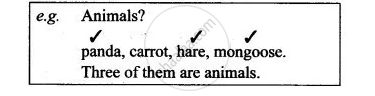
  1. Chemical elements?
    Mercury, iron, ammonia__________ of___________ are chemical elements.
  2. Countries in South America?
    Brazil, Syria, Sumatra One____________ is a country in South America.
  3. Rivers?
    Hwang Ho, Mekong ____________ them are rivers.
  4. Languages?
    Telugu, Bengali, Punjabi, Holland____________are languages.
  5. Capital cities?
    Pokhara, Mandalay, New York, Melbourne___________of ____________a capital.
  6. Grow on trees?
    Pineapple, tomato_______________ of them grows on trees.
  7. Religions?
    Taoism, Democracy, Communism ____________of ____________ is a religion.
  8. Units of currency?
    rupee, kyat, yen, dollar, baht, rupiah ____________are units of currency.
थोडक्यात उत्तर
Advertisements

उत्तर

  1. Mercury, iron—Two of them are chemical elements.
  2. Brazil—One of them is a country in South America.
  3. Hwang Ho, Mekong—Both of them are rivers.
  4. Telugu, Bengali, Punjabi—Three of them are languages.
  5. Mandalay—One of them is a capital city.
  6. Pineapple—Neither of them grows on trees.
  7. Taoism—One of them is a religion.
  8. rupee, kyat, yean dolloar, baht, rupiah—All of them are units of currency.
shaalaa.com
Writing and Grammar
  या प्रश्नात किंवा उत्तरात काही त्रुटी आहे का?
पाठ 2.1: Determiners - Exercises [पृष्ठ २९]

APPEARS IN

सीबीएसई English Communicative Workbook Interact in English [English] Class 9
पाठ 2.1 Determiners
Exercises | Q 9.1 | पृष्ठ २९

संबंधित प्रश्‍न

At first, Private Quelch was a hero in the eyes of his fellow soldiers. Support this observation with suitable examples from the story in about 100 words.


Answer the following questions:

Name the different things that can be found floating in the brook.


Have you made choices that are acceptable and less ‘risky’ or have you followed the beaten track? Why?


On the basis of your understanding of the poem, answer the following questions
by ticking the correct choice.

The poet writes, 'Two roads diverged in a yellow wood.' The word diverged means
_______________.


Fill in the blanks to complete the following paragraph that highlights the theme of
the poem. Use the words given in the box below.

decision             sorry             foresee            choices             pleasant            direction
fork                    trail               rewarding       chance              wonder              both

The poem "The Road Not Taken" by Robert Frost is about the __________ that one
makes in life. It tells about a man who comes to a ___________ in the road he is
travelling upon. He feels ___________ that he can not travel___________ paths as he
must choose one. Frost uses this fork in the road to represent a point in the man's life
where he has to choose the ___________ he wishes to take in life. As he thinks about
his ___________ he looks down one path, as far as he can see trying to ___________
what life will be like if he walks that path. He then gazes at the other and decides that the
outcome of going down that path would be just as ________________. At this point he
concludes that the ________that has been less travelled on would be more
___________ when he reaches the end of it. The man then decides that he will save the
other path for another day, even though he knows that one path leads to another and
that he won't get a ___________ to go back. The man then says that he will be telling
this story with a sigh, someday in the future suggesting that he will ___________ what
life would have been like if he had chosen the more walked path even though the path
he chose has made all the difference.


Simple Past and Past Perfect
Complete this story by Julius Lester. Choose the correct forms of the words
given in the brackets.

Brer Rabbit (a) ________ (decidedI had decided) gardening was too much hard work. So he (b) ________ (had gone/went) back to his old ways of eating from everybody else’s garden. Earlier, he (c)________ (made/had made) a tour through the community to see what everybody (d)________ (had been/was) planting that summer and his eye (e) ________ (was/had been) caught by Brer Fox’s peanut patch.

Soon as the peanuts (f) ________ (had been/were) ready, Brer Rabbit (g) ________ (decided/had decided) to make his acquaintance with them. Every night he (h) ________ (had eaten/ate) his fill and even started bringing his family. Brer Fox (i) _______ (had/had had) a good idea who was eating his peanuts, but he couldn’t catch him. He inspected his fence and finally (j) ________ (had found/found) a small hole on the north side. He tied a rope with a loop knot and put it inside the hole. If anybody (k) ________ (stepped/had stepped) in it, the rope would grab his leg and hoist him up in the air.

That night Brer Rabbit (l) _______ (came/had come) down to the peanut patch. He climbed through the hole and WHOOSH ! Next thing he (m) _______ (had known/knew), he was hanging in the air upside down. There (n) ________ (wasn’t/hadn’t been) a thing he could do, so he made himself comfortable to catch a little sleep!

Answer the following questions based on the story you have read.
(a) What had Brer Rabbit found out?
(b) What did he do when the plants grew?
(c) How did he enter Brer Fox's peanut patch?
(d) Brer Fox had an idea of who was stealing from his patch. What did he do to trap
Brer Rabbit?

You must have used the simple past tense and past perfect tense in your
answer. Do you know most often, when you use the past perfect, you use it with
the (simple) past?
Study the sentences from the story and write whether (a) the action happened
before the action mentioned in the simple past tense, or (b) an action happened
after the action mentioned in the past perfect tense.
(e.g.) Brer Rabbit had decided _(a)_ gardening was _(b)_too much for him. So,
he went __ back to his old ways. Earlier, he had made __ a tour through
the community to see what everybody had been __ planting that summer
and his eye was __ caught by Brer Fox's peanut patch.


Imagine that you are on an uninhabited island with a group of children of your age. In groups of four, discuss and enumerate the strategies that will be adopted by you to survive. You can think on the following lines : 

food  protection against animals 
shelter  life-skills (problem-solving, decision-making) 
means of escape  protection against harsh weather conditions 

Imagine that you have just returned from Topo Island. The Editor of a local newspaper has asked you to write about your adventure. Write the article. 
Some hints : 
1) Very briefly, describe how you landed on the island, and the main features of the island. 
2) Write about where you set up camp, describe one main adventure, and how you were eventually rescued. 
3) Make the adventure part of your story exciting, with lots of action. 
4) Include dialogue in the adventure part. 
5) Try to create mystery and suspense, as in B.3. 
6) Finally, give your adventure story a suitable heading. 
7) Your story must be written in paragraphs and should carry your By line. 


(a) Answer the following questions:

  1.  Where were the characters at the time of narration?
  2. Who was travelling with the aunt?
  3. How did the children pass their time?
  4. How long would they take to reach Templecombe?
  5. How does the aunt respond to the children’s antics? Why do you say so?

(b) You must have used a variety of articles in your answer. Why did you use them? Discuss the reasons with your teacher.

Study the following pair of sentences from the description. Notice the use of
articles-a, an or the or no article (X).
e.g. The next stop was at X Templecombe.
An aunt belonging to the children sat in one corner.
In the corner sat a stranger.
Hence we conclude
1. No article is used before a proper noun.
2. 'The' is used to refer to a specific place/person/ object.
3. 'A' is used when the person/place is referred to for the first time.
4. 'An' is used before a vowel sound.


In groups, work on one of the topics mentioned in 8(a)-(g). Research your topic by collecting relevant articles from the print and electronic media (like the National Geographic). Make a power point presentation of 10-12 minutes. You can also use film clippings to enrich your presentation. 

(a) SOLAR MISSION 
1) To promote the use of solar energy through solar photovoltaic and thermal systems for power generation .
2) To integrate other renewable energy technologies like biomass and wind. 

(b) ENERGY EFFICIENCY 
1) To mitigate GHG through sector-specific and cross-cutting technology and fuel switch options. 
2) To use more LNG and biomass fuels besides seeking tech transfer. 

(c) SUSTAINABLE HABITAT 
1) To promote energy efficiency in the residential and commercial sectors through LPG use. 
2) To manage municipal solid waste and urban public transport in a better way. 

(d) WATER MISSION 
1) To promote efficient water use, augment supply in critical areas and ensure effective management of water resources. 
2) To have better management of surface and groundwater,and conserve wetlands. 

(e) SUSTAINING HIMALAYAS 
1) To enhance monitoring and conservation of the Himalayan ecosystems, empower local communities for management of ecological resources and promote sustainable tourism. 

(f) GREEN INDIA 
1) To reduce fragmentation of forests, enhance public and private investments for plantation, upscale joint forestry management and promote conservation of biodiversity. Need to afforest degraded lands. 


(g) SUSTAINABLE AGRICULTURE : 
1) To focus on four crucial areas - dry land agriculture, risk management, access to information and promoting the use of biotechnology. 
2) To develop drought and pest resistant varieties. 


First, you will hear a local radio programme, read out by teacher / student which is given below which will give you ideas for your own programme. First, listen without writing anything. 

Presenter 1: A very good day to all our listeners. This is your local radio station, Class IX Local Radio - bringing you up-to-the - minute news, current affairs, music, interviews, round-ups - and much much more. 
Presenter2: Yes, and in today's programme we have a special report from Ketaki Lahiri on "Safety at School". 
Presenter 1: Nikhil Gomes brings you his regular weekly review of "Beyond the Timetable", 
Presenter 2: And Leena invites you to "Meet the Teacher". 
Presenter 1: And lots more - jokes, news -you name it and we have it. We start with the round-up of School News by our roving correspondent - Anant Singh. Anant, over to you. 
Anant: Good morning, everybody! The highlight of this weeks' School News is that our school football team lost every single match it played in the YMCA football tournament at league level. The physical education teacher is so livid that he has threatened to make the school team practice on a doubletime schedule from tomorrow. So, friends, it's "wake-up" at 4 a.m for all footballers henceforth. 

In another school news, the tiny tots were taken on a visit to the zoo. Some, it is said, did not wish to return. One accompanying teacher, we are told, had a tough time convincing them that life outside is better! 

Class XII put on a one-act play "Examination Fever" which was written, directed and produced by them. The proceeds from this show are being sent to "Prathyasha" - an organisation that helps handicapped children. 
Look out next week for new faces around the school. A group of 20 students from Japan are arriving on a cultural exchange programme, We might even get one of them on our next edition ofThe Class IX Radio Show! 

Presenter 1: So ... Lots happening at school, it seems,-and lots more on your Local Radio. It's time for jokes now. Over to you, Hafeez and Aarohi. 
Aarohi: Waiter , Waiter , what's wrong with these eggs ?
Hafeez: I don't know. I only laid the table; 
Aarohi: Waiter, waiter, what's this fly doing in my soup? 
Hafeez: Breaststroke, I think, Sir, 
Teacher: I wish-you would pay a little more attention.
Pupil: I'm paying as little as I can. 
Teacher: You should have been here at 9 o'clock. 
Pupil: Why, what happened? 
Presenter 2: Thank you, Hafeez and Aarohi. And don't forget, listeners, to send in your jokes. Every original joke will win you a reward of RslO/- for each one played on your favourite radio programme - Class IX Local Radio - the station just for you. 
Presenter 1 : And now to your regular spot "Meet the Teacher", in which Leena interviews one of your favourite teachers to discover the real person "behind the chalk dust". 
So it's all yours, Leena. 
Leena: Thank you ! I'm delighted today to be able to interview the Head of the Science Department, Mr Chirag Sharma. Mr Sharma, what all our listeners are dying to know is - are you as strict at home as you are at school? 
Mr Sharma: (Laughs heartily). I don't have a bunch of forty naughty children at home. 
Leena: Did you ever get into trouble when you were at school? 
Mr Sharma : Have you ever thought about how I am able to catch you in your tricks? I was usually up to the same tricks at school! No, I'm afraid my teachers were not very happy with me. 
Leena: How good were you in your studies, Sir? 
Mr Sharma: Ah, that was my strong point. My work was always up-to-date and fairly good. I was naughty, but I was also keen to learn more. 
Leena: How do you spend your evenings and holidays, Sir? 
Mr Sharma: I like to spend time at home with my teenage children. We have common tastes in music. 
Leena: Any message for our listeners Sir? 
Mr Sharma: Yes. Fun and-play have their place in our lives. We must enjoy our play. At the same time, we must work with enthusiasm and sincerity. 
Leena: Thank you, sir !
Presenter 2 : Thank you Leena for that fascinating interview. I'm sure we all know, now what makes Mr Sharma 1tick1• And now it's time for a break. It's "advert time". 
"Buy two but pay for one!" 
Ruchita of VIIC has a fabulous offer. Two pencil boxes for the price of one. Pay Rs 5 / for the bargain. 
Lost - A Keltron calculator. Krishna of Class XIIA has offered a treat in the school canteen to the finder. 
Presenter 1: And now, a very serious subject. Ketaki has been researching the topic 'Safety at School'. She has come up with some very disturbing findings. This is the report. Ketaki? 
Ketaki: As I went around the senior school I was alarmed to find a number of broken electric sockets with exposed wires. Beware of this hidden danger, senior students. That brings me to another danger - this time in the primary block. The lid of the ground level water tank is broken. Till it is repaired, students are warned not to go anywhere near it. 
Presenter 2 : Well, time1s up boys and girls of Class IX Local Radio - bringing you news and entertainment of interest to you, in your school and locality. Until next week ... 


Read an extract from the poem New Year Resolution
The priest asked "Son, any new resolution this year"
I said "Father, driving with the
helmet and in first gear",
"That's good, my son, but have you any more?"
"Sure, there are ten, but I shall keep only four".

The first will be never to wipe
the shoe behind my pant
The second will be to say without hesitation "I can't",
The third is to always keep the toothpaste cap on
It's something which I never did since I was born.
The fourth, never to look at your neighbour's hedge
It's that what has brought the envy and the wedge,
The fifth is easy and you can have a ball
Never take from Peter what you have to pay Paul.
The sixth is to hold my head high even under water
Learn simple things of life from the potter,
He moulds wonders out of his two hands
Leaving impression forever on the sands.
Try and compose a poem conveying your resolutions. Let the first stanza be the
same.
e.g.
The first will be never to yawn
in public be it noon, dusk or dawn.
The second .................. .


Answer the following question by ticking the correct option. 

Cecil Barker's first reaction at the sight of the dead Douglas was to _____ 


The Passive in Tentative Statements
The passive is often used in tentative statements where the writer tries to be as neutral as possible.

    considered to be…
It is said    
    known to have been…
They are acknowledged
believed
regarded as…

 8.1
Look at the box below. Write tentative statements following the pattern in the table above.


Report the following questions. (Use if/whether or why, as appropriate.)

  1. Have you met my sister?
    She asked _________________ (use you and her)
  2. Do you want a drink?
    He asked _________________ (use you)
  3. Why didn’t you study for the Unit test?
    She asked _________________ (use he)
  4. Can you help me with my homework this evening?
    He asked _________________ (use she)
  5. Have you had lunch yet?
    They asked _________________ (use he)

Reported speech in Extended practice.

Read the dialogue between Mr Coomer (Mr C), the British Scholarship Officer, and an applicant, Miss Reena Banerjee (R).

Mr C : Come in, Miss Banerjee.
R : Thank you.
Mr C : Please sit down. Can I get you a cup of coffee or a cold drink?
R : Yes thank you. A cold drink, please.
Mr C : I’m just going to ask you a few questions. How long have you been studying English?
R : I’ve had private as well as school lessons for 14 years.
Mr C : Just as background information, what do you do in your spare time?
R : I’ve always enjoyed drama, and also debating.
Mr C : Why do you wish to obtain a scholarship to study in Britain?
R : Well, I’m interested in studying Immigration Law, and there are several good colleges in Britain dealing with his.
Mr C : Very interesting. Finally, do you know that the grant only covers teaching fees?
What about your living expenses?
R : My sister will pay for my personal expenses.
Mr C : Well, Miss Banerjee, we’ll be writing to you next week. Thank you for coming.

Reena meets her friend, Latha, after the interview. She is very excited and tells Latha exactly what happened. Fill in the spaces using reported speech.
Fill in the [boxes] with reporting verbs.


The song 'We Are the World' has been sung by many famous singers of the West. Do you know why it is called 'We Are the World'? Why was it recorded? What were the singers trying to do? Did they succeed? 

Student/ teacher can sing the song.

Listen to the song and check whether you have guessed right in Question 1.  Listen again until you are ready to sing along with it. 


Listen to the song and check whether you have guessed right in Question 1.  Listen again until you are ready to sing along with it. 


You have recently been to a wedding. A British pen friend asks you to describe it. Using the words in the box, describe the different stages. Write only the body of the letter below.


Adjectives and Prepositions
Look at the table below. Decide which of the adjectives in Column A commonly go with which preposition. Tick the table as shown. (There may be more then one tick for each adjective).

A at to about for
worried    
good        
bad        
surprised        
happy        
sensitive        
puzzled        
married        
clever        
suitable        
curious        
due        
qualified        
famous        

Share
Notifications

Englishहिंदीमराठी


      Forgot password?
Use app×