Advertisements
Advertisements
प्रश्न
Work in pairs and recognise how many words belong to each set. Complete the sentences as in the example. Use words only from the box above:
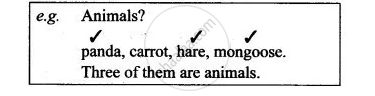
- Chemical elements?
Mercury, iron, ammonia__________ of___________ are chemical elements. - Countries in South America?
Brazil, Syria, Sumatra One____________ is a country in South America. - Rivers?
Hwang Ho, Mekong ____________ them are rivers. - Languages?
Telugu, Bengali, Punjabi, Holland____________are languages. - Capital cities?
Pokhara, Mandalay, New York, Melbourne___________of ____________a capital. - Grow on trees?
Pineapple, tomato_______________ of them grows on trees. - Religions?
Taoism, Democracy, Communism ____________of ____________ is a religion. - Units of currency?
rupee, kyat, yen, dollar, baht, rupiah ____________are units of currency.
Advertisements
उत्तर
- Mercury, iron—Two of them are chemical elements.
- Brazil—One of them is a country in South America.
- Hwang Ho, Mekong—Both of them are rivers.
- Telugu, Bengali, Punjabi—Three of them are languages.
- Mandalay—One of them is a capital city.
- Pineapple—Neither of them grows on trees.
- Taoism—One of them is a religion.
- rupee, kyat, yean dolloar, baht, rupiah—All of them are units of currency.
APPEARS IN
संबंधित प्रश्न
Write about the following memories or experiences. Share your views with the
class.
Answer the following question briefly.
Pick out two sentences showing that the grandmother was desperate to know what happened next in the story.
Answer the following question briefly:
How was Private Quelch’s knowledge exposed even further as the Sergeant’s classes went on?
Irony refers to the use of words to convey a meaning that is the opposite of their literal meaning. Working in pairs bring out the irony in the following:
(a) The title of the story, “The Best Seller”.
(b) Pescud’s claim, “When people in real life marry, they generally hunt up somebody in their own station. A fellow usually picks out a girl who went to the same high school and belonged to the same singing-society that he did.”
(c) The name Trevelyan.
Here is a list of a few things. Can you tell how long each of them can live /exist?
(a) a dog
(b) an elephant
(c) a tree
(d) a human being
(e) a star
(f) a mountain
(g) a river
On the basis of your understanding of the poem, answer the following question
by ticking the correct choice.
The tone of the speaker in the first stanza is that of ______________.
On the basis of your understanding of the poem, answer the following question
by ticking the correct choice.
The seven roles that a man plays correspond to his __
Explain the meaning of the following.
a) ... all the men and women merely players:
They have their exits and their entrances...
b) And then the lover,
Sighing like furnace...
c) a soldier,
... Seeking the bubble reputation
Even in the cannon's mouth.
You already know the two literary devices generally used by writers and poets for comparison, i.e. metaphor and simile.
e.g. a) He was a lion in the battle, (metaphor)
b) He fought like a lion, (simile)
In (a) the writer talks of the soldier in terms of a lion. The comparison is implied.
In (b) the writer compares the soldier to a lion with the use of the word like, (as may also be used for such comparisons.)
Read the poem again and note down the metaphors and similes. Complete the following chart.
| Reference | Metaphor | Simile |
| world | all the world's a stage | |
| men, women | ||
| school-boy | ||
| lover | ||
| soldier | ||
| reputation | ||
| voice |
Which comparison(s) do you find most interesting? Why?
In this poem, life is being compared to a play. Just as in a play, a man acts many
parts, so also in life, a man plays many roles. Can you think of some other
comparison for life? (For example, life could be compared with the seasons in
nature, the days of the week, the lessons in a school day.) Select one of these
comparisons (or choose one of your own), and write about the similarities that
life has with it. (80-100 words)
On the basis of your understanding of the poem, answer the following question
by ticking the correct choice.
The conscience of the speaker pricks her as she has__________.
Answer the following question briefly.
Who was Jeanette? What was the cause of her death?
Simple Past and Past Continuous
There was a burglary in your neighbourhood. You saw something suspicious.
Tell the police officer all about it by filling in the blanks choosing the correct
forms of the words from the options given below.
It (a) was raining last night. I (b) _________ TV. I (c) _________ a little restless. I (d) _________ to the window and was looking out when I (e) _________ that Mr Sharma, my neighbour (f) _________ near the door. I thought he had gone to shut it. I also (g) _________ Mrs Sharma walking up and down in her garden. Then I heard Mr Sharma calling his wife to come in. I (h) _________ back to my table and opened my book. I (i) _________ when I heard a thud and a scream. I (j) _________ out of the house and saw a man in a black coat and hat running towards the gate. Mr and Mrs Sharma (k) _________ in the street. I saw a car speeding away with the burglar.
(a) (i) raining (ii) was raining (iii) were raining (iv) rained
(b) (i) were watching (ii) watched (iii) was watching (iv) watching
(c) (i) has felt (ii) felt (iii) was feeling (iv) feel
(d) (i) had gone (ii) went (iii) was going (iv) gone
(e) (i) noticing (ii) was noticing (iii) were noticing (iv) noticed
(f) (i) stood (ii) were standing (iii) was standing (iv) were stood
(g) (i) seeing (ii) saw (iii) was seeing (iv) seen
(h) (i) had come (ii) was coming (iii) came (iv) were came
(i) (i) hadread (ii) was reading (iii) were reading (iv) read
m (i) rushed (ii) was rushing (iii) were rushed (iv) rushing
(k) (i) had screamed (ii) was screaming (iii) screamed (iv) were screaming
During your discussions in groups, and in your individual written report, you will find the following language useful :
GROUP DISCUSSION
When recommending
| I | Propose suggest recommend |
that..... |
| what about ? why don't we....... |
| we could think |
consider...... about......... |
WRITTEN REPORT
When recommending
| I |
propose |
that..... |
| I strongly recommend that ........ |
| I urge the commision to ....... |
| It is | recommended proposed |
that.... |
| My | recommendation proposal |
is that...... |
When giving reasons
| ................. as .............. ................because ......... ..............since ............... |
| My reason is that .................... |
When giving reasons
| ................. as .............. ................because ......... ..............since ............... |
| My reason is that....................... In view of the fact that.............. |
As a Conservationist, write a report to the World Wildlife Federation, based on 5. Remember 'CODER'
| From: (your name), Conservationist. To: The Chairman WWF (Date) (Suitable Heading) (Suitable introduction) e.g. You recently asked me to submit a report on my study of YAK - in particular, their future. The following are my findings and recommendations. 1. The current problem. 2. Reasons why this problem has arisen. 3. Effects of the problem 4. Recommendation 5. Conclusion (Suitable ending, including other ideas for increasing YAK population) Your name (Conservationist) |
Will and Shall
Look at this cartoon which shows the difference in the use of present continuous and will to express the future.
It’s Mike’s birthday on January 2nd.

Discuss in groups.
- Have you heard a story, seen a film, or read about someone becoming invisible?
- Did he/she use his/her power for good or for evil?
The following are the lyrics of a famous song. Complete it by filling in the missing letters (mostly vowels).
There c_m_s a time.
When we h __ d a certain call
When the w __ ld must come t_g_th_r
As one
There are p _ _ple d_ing
Oh and it's time
To l_nd a h_nd to l_fe
The gr __ test gift of all
Wec_n't go on 
Pr_t_nding day by day
Th_t s_me_ne, somewhere
Will s __ n make a change
We are all a p __ t of
God's gr __ t big f_m_ly
And thetr_th,youknow
L_ ve is all we n __ d
W_ are the world
We are the ch_ldr_n
We are the _nes
To m __ e a br ___ ter day
So l_t's st __ t g_ving
There's a ch __ ce we're m_king
We're s_ving our own l_ves
It's tr __ wemake a b_tterday
J_st y __ andme
W _11, send them your h __ rt
So they kn__ that s_me_ne cares
And th __ r lives wll be str_nger
And fr __
As G_d has sh_wn us
By t __ ning stone to br __ d
And so we _11 must
L-nd a h_lping h_nd
We are the world ...
We're d_wn and __ t
And there s __ ms no h_pe at all
Butify __ justbel __ ve
There's no w_y we can f_ll
Ohyes, let's r __ lise
That ch_nge can only c_me
When we st_nd t_g_ther
As one
We are the world ...
Listen to the song and check whether you have guessed right in Question 1. Listen again until you are ready to sing along with it.
Read the following dialogue
Raghu : I think one of my snakes has escaped.
Sheela : Isn’t it dangerous? You really must stop collecting snakes, Raghu.
Raghu : But I like snakes – they are unusual pets.
Sheela : But I think it’s a dangerous thing to keep such pets.
Raghu : No, they’re not dangerous; they are really… .er… .quite friendly.
Sheela : Huh, snakes require a great deal of careful handling and are still a risk.
Raghu : i don’t mind. What matters is that I like them.
Sheela : Well, quite frankly, I hate them. They are awfully frightening to look at.
Raghu : Look, I am very careful and I handle them very gently. In fact, I don’t have many.
Sheela : Have you ever been bitten?
Raghu : Well, it’s true I’ve been bitten once or twice, but…
You are a friend who has overheard this conversation between Raghu and Sheela. Write to your sister reporting it. Give the conversation an interesting, unexpected or humorous ending. (The first part has been done for you.)
Janpath
5 January 2016
Dear Varsha
As you’re very interested in Raghu and his snakes, I thought I’d tell you about a conversation I heard between him and Sheela.
He told her he thought one of his snakes had escaped and, as usual, she told him to stop collecting them because they were dangerous. (Typical of Sheela, don’t you think?)
Pronouns
Direct speech indirect speech
| masculine | feminine | plural | |
| i | he | she | they |
| you | he | she | they |
| you | him | her | them |
| your | his | her | their |
| me | him | her | them |
| my | his | her | their |
| myself | himself | herself | themselves |
| we | they | ||
| use | them, their |
WORDS DENOTING TIME AND POSITION
When the reporting verb is in the past tense, certain words denoting nearness of
time and place are changed into words denoting distance.
It is treated necessary to change the words denoting nearness to words denoting
distance because, when we report the words of a person to somebody, the place
and time of the reporting is changed.
So the reported speech must be in line with the modified time and place.
| DIRECT SPEECH | INDIRECT SPEECH |
| this | that |
| these | those |
| now | then |
| ago | before |
| last night |
the previous night the night before |
| next day |
the following day the day after |
| today | the day |
| tonight | that night |
| yesterday |
the previous day the day before |
| tomorrow |
the next day the following day the day after |
| day before yesterday | the day before the previous day or two days before |
| day after tomorrow | the day after the next day ot in two days |
| week | the following week |
| now | then |
| here | there |
