The police interview Chetan to get an eyewitness account of the kidnapping. In pairs conduct the interview. One of you can play the role of Chetan and tell your partner, who plays the role of the police officer, what happened when the kidnapping occurred.
Advertisements
Advertisements
Question
Work in pairs and recognise how many words belong to each set. Complete the sentences as in the example. Use words only from the box above:
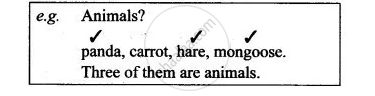
- Chemical elements?
Mercury, iron, ammonia__________ of___________ are chemical elements. - Countries in South America?
Brazil, Syria, Sumatra One____________ is a country in South America. - Rivers?
Hwang Ho, Mekong ____________ them are rivers. - Languages?
Telugu, Bengali, Punjabi, Holland____________are languages. - Capital cities?
Pokhara, Mandalay, New York, Melbourne___________of ____________a capital. - Grow on trees?
Pineapple, tomato_______________ of them grows on trees. - Religions?
Taoism, Democracy, Communism ____________of ____________ is a religion. - Units of currency?
rupee, kyat, yen, dollar, baht, rupiah ____________are units of currency.
Advertisements
Solution
- Mercury, iron—Two of them are chemical elements.
- Brazil—One of them is a country in South America.
- Hwang Ho, Mekong—Both of them are rivers.
- Telugu, Bengali, Punjabi—Three of them are languages.
- Mandalay—One of them is a capital city.
- Pineapple—Neither of them grows on trees.
- Taoism—One of them is a religion.
- rupee, kyat, yean dolloar, baht, rupiah—All of them are units of currency.
APPEARS IN
RELATED QUESTIONS
Now that you have enjoyed reading the story, answer the following question by choosing the correct option
Why did the grandmother touch her granddaughter's feet?
Answer the following question briefly:
What were the Professor’s ambitions in the army?
You are the ‘ProfessorWrite a diary entry after your first day at the cookhouse, describing the events that led to this assignment, also express your thoughts and feelings about the events of the day in about 175 words.
Answer the following questions:
The poem has many examples of alliteration. List any five examples.
c
I chatter, chatter, as I flow
To join the brimming river,
For men may come and men may go,
But I go on for ever
(a) Who does ‘I’ refer to in the given lines?
(b) How does it ‘chatter’?
(c) Why has the poet used the word ‘brimming’? What kind of a picture does it create?
(d) Explain the last two lines of the stanza.
Roads are fascinating as metaphors for life, change, journeys, partings,
adventure, etc. or simply as roads. This is probably why they, and all their
attendant images, have permeated art, literature and songs. In the poem, Frost
uses the fork in the road as a metaphor for the choices we make in life. Thus the
roads are, in fact, two alternative ways of life. What other nouns, according to
you could be used to represent life?
River
________________
________________
________________
________________
________________
Answer the following question.
"When I cry the hills laugh;
When I humble myself the flowers rejoice;
When I bow, all things are elated."
Cry, humble and bow indicate different intensity with which the rain falls. Explain the
three in the context of the poem.
Answer the following question.
"I am like earthly life … "
Why does the poet compare rain to earthly life?
You already know the two literary devices generally used by writers and poets for comparison, i.e. metaphor and simile.
e.g. a) He was a lion in the battle, (metaphor)
b) He fought like a lion, (simile)
In (a) the writer talks of the soldier in terms of a lion. The comparison is implied.
In (b) the writer compares the soldier to a lion with the use of the word like, (as may also be used for such comparisons.)
Read the poem again and note down the metaphors and similes. Complete the following chart.
| Reference | Metaphor | Simile |
| world | all the world's a stage | |
| men, women | ||
| school-boy | ||
| lover | ||
| soldier | ||
| reputation | ||
| voice |
Which comparison(s) do you find most interesting? Why?
Past Continuous
A young girl was kidnapped from the main street of Srutipur at 3 o’clock yesterday afternoon. Chetan was there at that time.

The residents of Kanpur decide to approach the Chairman of the Municipal Steps which can be taken problem of pollution in their city. In groups of six, play the role of the following : (Cue cards may be given by the teacher)
• A farmer
• An environmentalist
• Chairman of the Municipal Corporation
• President of 'Save the Ganga Project'
• A Human rights activist
As a resident of Kanpur, write a formal letter to the Editor of a prominent newspaper highlighting the problem discussed in Question 2. Also give some suggestions on how this problem can be reduced.
|
FORMAL LETTER A-43 Civil lines |
Carbon Footprint - Project Work
A carbon footprint is a representation of the effect human activities have on the climate in terms of the total amount of greenhouse gases produced (measured in units of carbon dioxide). So, it is a measure of the impact we make individually on the earth; by the choices we make regarding our lifestyle. Many activities generate carbon emissions, which contribute towards accelerating global warming and climate change.
Total carbon footprint/ emission quantification would include energy emissions from human activities - such as, from heat, light, power and refrigeration and all transport related emissions from cars, freight and distribution.
By measuring the carbon footprint through such tools as carbon calculators, we can get a better sense of what the individual impact is and which parts of our lifestyle deserve strict regulation.
In groups, choose and research any one aspect of how we are leaving carbon footprints and how can we modify our lifestyle. Each group will then make a project on the various aspects.
Discuss in groups.
- Have you heard a story, seen a film, or read about someone becoming invisible?
- Did he/she use his/her power for good or for evil?
Look at the following pair of sentences. Underline the modals and discuss why each one is used in that sentence.
e.g.
I must not take those pills. (I’m not allowed.)
I need not take those pills. (It is not compulsory but I may if I wish.)
(b) I needn’t go to the meeting if I don’t wish to.
2. (a) I can swim a length of the pool.
(b) I can swim in the pool on Saturdays.
3. (a) You ought to get a nice present for her.
(b) You have to get a nice present for her.
4. (a) Can I go to the toilet?
(b) May I be excused?
5. (a) I may come tomorrow if I have the time.
(b) I might come tomorrow but it’s going to be difficult.
Did you know?
Modals are a small group of verbs that are used to express possibility,
probability, capability, capacity, ability, obligation and predictions.
Some of the modals you learnt in this unit are
can
may
shall
could
might
should
Need, dare, had better are also modals.
Understanding Modals:
Modal Auxiliaries
A modal verb or auxiliary verb is a verb, which modifies another verb, so that
the modified verb has more intention in its expression. In essence the modal
verb expresses modality, the way in which something is being said.
The main modals are
Can: could; may: might; shall: should; will: would: must; ought to; need to;
have to.
The negative modals are
Couldn't; wouldn't; shouldn't; mustn't; needn't; oughtn't/ ought not to
| Modal | Examples | Uses |
| Can/ can't |
She can read and write It can rain today Can I borrow your pen? Can you lend me your notes? Can I carry your books? |
ability possibility /probability seeking permission request offer |
| Could/ couldn't |
Could I borrow your book? Could you please help me with this sum? We could go for a picnic on Sunday I think you could come first this time There was a time when I could work round the clock. |
seeking permission request suggestion possibility/ probability past ability |
| May |
May I have some water? May I help you? May I shut the door? India may become a super power by 2020. May God bless you |
request offer permission possibility/ probability wish/ desire |
| Might | They might sell their house as they need the money. | future possibility/ probability |
| Will /Won't |
It is very cold so I will stay at home. I will help you if you wish. Will you look after my dog for a day? It will rain tonight. I will get you a shawl from Srinagar. |
intention offer request prediction promise |
| Would/Wouldn't |
Would you mind if I come over tonight? Would five o'clock suit you? Yes it would. Would you pass the salt? Would you come to my party? Would you prefer tea or coffee? |
permission making arrangements request invitation preference
|
| Shall |
Shall I help you? Shall we meet at 3.00 pm outside Bakshi Stadium? |
offer making arrangements |
| Should |
We should check the timings of the train. You should listen to the advice of your elders. |
recommended action advice |
| Ought to |
You ought to do your duty. The bus ought to be here any minute |
advice probability |
| Must/mustn't |
We must make a move now. You mustn't tell lies. |
obligation necessity |
| Need |
He need not go to the market. You need to lose weight. I need to get the groceries. |
necessity compulsion insistence |
Can you make some guesses about the dead man? Give reasons for your answers.
a) Did the man die a natural death or was he murdered?
b) Was the dead man rich or poor?
c) Who is the man bending over him?
Answer the following question by ticking the correct option.
John Douglas had won quite a reputation for himself in Birlstone because of his __________________
On the basis of your reading of the extract, tick the most appropriate answer :
a. Tom's mind had drifted away because
• Becky Thatcher had stopped coming to school
• he no longer took an interest in war.
• the charm oflife was gone.
• he had put his hoop and his bat away.
b. Aunt Polly was concerned because:
• Tom was hanging around Becky Thatcher's father's house all night
• Tom no longer took an interest in anything
• she was infatuated with patent medicines
• she had a fever
c. She was filled with gratitude when she tested the new medicine as
• it was simply fire in a liquid form.
• her troubles were instantly at rest
• Tom's indifference was broken.
• Tom was responding well
d. 'Mending the health of a crack' means
• repairing a crack in the sitting-room floor
• looking after his health
• pouring the medicine into a crack in the sitting-room floor
• giving the medicine to the cat
You will now hold an actual class debate on the topic 'Computers and Children: A Boon or a Bane'.
In groups of four decide whether your group is FOR or AGAINST the motion. Then draft your debate. Each member of the group must participate in the written as well as the spoken matter. The spoken matter can be divided thus
• One introduces the topic
• One discusses points favouring the motion
• One argues the opponent's points
• One concludes
Now complete the Bio-data of Koneru Humpy :
|
KOKERU HUMPY Name : _____________ Father's Name : __________ Born on : _________________ Place of Birth : ______________ Trained by : _______________ Fint achievements :
Recent achievements :
|
