Advertisements
Advertisements
प्रश्न
What was the daily routine of the grandmother at home?
Advertisements
उत्तर
Grandma started the mornings with a sing-song prayer. She woke up the author bathed and dressed him up and wanted him to learn the prayers by heart. Both would march to the school which was attached to a temple. She would stay inside chanting prayers and telling beads. In the evening, she would throw the stale chapattis to village dogs as they returned home.
APPEARS IN
संबंधित प्रश्न
Why has the red colour of bangles been compared to the flame of the bride’s marriage fire?
Why does the poet use repetition in the poem?
The poet uses the word lonely in reference to a cloud. Explain.
In how many ways was this Olympic special? Explain?
Fill in the blank with an appropriate word:
I don't know what they were arguing __________ but I could hear angry voices.
Wilfred Owen paints a horrific picture of a nightmarish memory on the battlefield. How does Duke et Decorum Est become Owen's condemnation and bitter response to war?
Give an account of the incidents of racial discrimination that Braithwaite has described in the novel ‘To Sir With Love’.
We have come across words like 'gale' and 'storm' in the account. Here are two more words for 'storm': typhoon, cyclone. How many words does your language have for 'storm'?
There is a parallel drawn between rain and music. Which words indicate this? Explain the similarity between the two.
Maintain a record of the trees cut down and the parks demolished in your area or any other act that violates the environment. Write to newspapers reporting on any such acts that disturb you.
Discuss with your partners
Talking about teachers among friends.
Look at the highlighted expressions in the following sentences from the text and explain their figurative meaning.
- 'I went through it, sir, with a fine-toothed comb and never a Garrideb could I catch.'
-
'They are my favourite covert for putting up a bird, and I would never have overlooked a cock pheasant as that.'
-
'There is no bolt-hole for you in this country.'
-
'When his castle in the air fell down, it burred him beneath the ruins.'
Give reasons for the following.
Srinath’s disappointment with Satyajit.
Pillars form support for concrete buildings. Metaphorically speaking a strong nation too depends on strong pillars. Discuss with your partner and explain the pillars of a democratic nation. Make a list of obstacles that are a threat to the progress of a nation.
The cherry tree is a narrative poem. Features that make it a narrative poem are given below. Justify them with proper examples.
Different places are mentioned.
Write down the consequences of the following occurrences with the help of the play.
Dr. Thomas Stockmann wants an article exposing social evils to be printed in the newspaper.
Hold a debate on - 'Pets or Pests?'
Write the reason in your own words.
After the song, Ostad had vanished.
Write a speech for your school Literary Association celebration with the given lead.
| 1) Opening | |
| 2) Purpose | |
| 3) Audience | |
| 4) Language – Some Good Describing Words (Adverbs And Adjectives), Emotive Words, Imagery etc. | |
| 5) Ending |
Draft Letter for the following.
You are Raja. The street lights of your area do not work properly. As a responsible citizen, write a letter to the newspaper enlightening them about the problem and also suggest ways to brighten the area.
Have a conversation with your partner based on the picture below. You can start as -
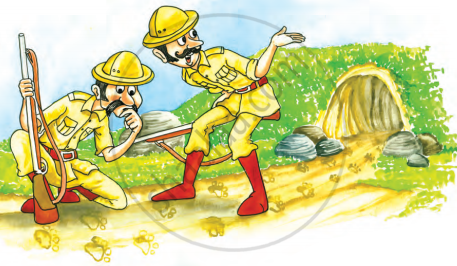
| Hunter 1 | “Look at the footprints in the mud!” |
| Hunter 2 | |
| Hunter 1 | |
| Hunter 2 |
Write a few lines on Mithoo and his little dog named Shadow.
Find out stories about other great people’s lives and their childhood and write these in your notebook. Collect at least two such stories and share them with your friends.
You could think of famous
- scientists
- religious people
- freedom fighters
- brave children
- astronauts
- artists
Find one story of bravery about a child. You can search for the story by talking to older people or watching a TV programme or from a film.
- Write down the story. Also, mention its source.
- Narrate the story to the class.
- Which story did you like the best? Write down your reasons.
What would make Jack the owner instead of being the tenant?
How did Jack manage to pay seven pounds eighty and eighty pence out of six pounds?
Observe the following picture and write a paragraph in about 150 word about each one of them.

School examinations do not test intelligence. Express your views either for or against this statement
Write a composition (in approximately 400-450 words) of the following subject:
Recently you attended the wedding of a close relative. It was the first family gathering after the pandemic. Describe the excitement of meeting all the family members, the venue of the wedding, the food that was served and the celebrations that followed.
Read the passage given below and answer the questions (i), (ii) and (iii) that follow.
| (1) | “Can I see the Manager?” I said, and added solemnly, “Alone.” I don't know why I said “Alone.” “Certainly,” said the accountant and fetched him. | |
| (2) | The Manager was a grave, calm man. I held my fifty-six dollars clutched in a crumpled ball in my pocket. “Are you the Manager?” I asked. God knows I did not doubt it. “Yes,” he said. “Can I see you …. alone?” I asked. |
5 |
| (3) | The Manager looked at me in some alarm. He felt that I had an awful secret to reveal. “Come in here,” he said, and led the way to a private room. He turned the key in the lock. “We are safe from interruption here,” he said; “Sit down.” We both sat down and looked at each other. I found no voice to speak. “You are one of Pinkerton’s men, I presume,” he said. |
10 |
| (4) |
He had gathered from my mysterious manner that I was a detective. I knew what he was thinking, and it made me worse. |
15
20
|
| (5) | The Manager got up and opened the door. He called to the accountant. “Mr. Montgomery,” he said unkindly loud, “this gentleman is opening an account, he will deposit fifty-six dollars. Good morning.” I rose. A big iron door stood open at the side of the room. “Good morning,” I said, and stepped into the safe. “Come out,” said the Manager coldly and showed me the other way. |
30 |
| (6) | I went up to the accountant’s wicket and poked the ball of money at him with a quick convulsive movement as if I were doing a conjuring trick. My face was ghastly pale. “Here,” I said, “deposit it.” The tone of the words seemed to mean, “Let us do this painful thing while the fit is on us.” He took the money and gave it to another clerk. |
35 |
| (7) | He made me write the sum on a slip and sign my name in a book. I no longer knew what I was doing. The bank swam before my eyes. “Is it deposited?” I asked in a hollow, vibrating voice. “It is,” said the accountant. “Then I want to draw a cheque.” My idea was to draw out six dollars of it for present use. Someone gave me a chequebook through a wicket and someone else began telling me how to write it out. The people in the bank had the impression that I was an invalid millionaire. I wrote something on the cheque and thrust it in at the clerk. He looked at it. |
40
45 |
| (8) | “What! Are you drawing it all out again?” he asked in surprise. Then I realised that I had written fifty-six instead of six. I was too far gone to reason now. I had a feeling that it was impossible to explain the thing. I had burned my boats. All the clerks had stopped writing to look at me. Reckless with misery, I made a plunge. “Yes, the whole thing.” “You withdraw all your money from the bank?” “Every cent of it.” “Are you not going to deposit anymore?” said the clerk, astonished. “Never.” |
50
55 |
| (9) | An idiot hope struck me that they might think something had insulted me while I was writing the cheque and that I had changed my mind. I made a wretched attempt to look like a man with a fearfully quick temper. | |
| (10) | The clerk prepared to pay the money. “How will you have it?” he said. This question came as a bolt from the blue. “What?” “How will you have it?” “Oh!”— I caught his meaning and answered without even trying to think— “in fifties.” He gave me a fifty-dollar bill. “And the six?” he asked dryly. “In sixes,” I said. He gave it to me and I rushed out. As the big door swung behind me. I caught the echo of a roar of laughter that went up to the ceiling of the bank. Since then, I bank no more. I keep my money in cash in my trousers pocket and my savings in silver dollars in a sock. |
60
65
70 |
| Adapted from: My Financial Career By Stephen Leacock |
||
-
- Find a single word from the passage that will exactly replace the underlined word or words in the following sentences. [3]
- The kind stranger went and got back the ball from where it had rolled into the bush.
- I took offence at the expression on his face that was clearly meant to insinuate I was a liar.
- The firm experienced a financial loss when the contract went to a contender who had just entered the business.
- For each of the words given below, choose the correct sentence that uses the same word unchanged in spelling, but with a different meaning from that which it carries in the passage. [3]
- alarm (line 8)
- The silence from the other end set off alarm bells in her head.
- The pallor of his skin alarmed those standing around.
- I set my alarm for six o’clock but slept through it.
- The sound of the approaching jets caused some alarm in the war room.
- wicket (line 44)
- The wicketkeeper was the true saviour of the day for that one match.
- The team wanted to bat while the wicket was still dry.
- The man at the window handed us our tickets through the wicket.
- The quick loss of wickets demoralised the team.
- reason (line 48)
- After the tragedy, his ability to reason is severely diminished.
- They reasoned they could get better seats if they arrived early.
- Recipients of funds were selected without rhyme or reason.
- We have every reason to celebrate.
- alarm (line 8)
- Find a single word from the passage that will exactly replace the underlined word or words in the following sentences. [3]
- Answer the following questions as briefly as possible in your own words.
- With reference to the passage, explain the meaning of the expression of the ‘I had burned my boats?’ [2]
- Cite any two instances of the behaviour of the bank employees that indicate the insignificance of a deposit of fifty-six dollars. [2]
- Why do you think the people in the bank thought of the narrator as an “invalid millionaire?” [2]
- Summarise why the narrator decided ‘to bank no more’ (paragraphs 6 to 10). You are required to write the summary in the form of a connected passage in about 100 words. Failure to keep within the word limit will be penalised. [8]
