Advertisements
Advertisements
प्रश्न
What is the relation between the focal length and radius of curvature of a spherical mirror (concave mirror of convex mirror)? Calculate the focal length of a spherical mirror whose radius of curvature is 25 cm.
Advertisements
उत्तर
The relation between the focal length and radius of curvature of a spherical mirror is as follows:
Radius of curvature = 2 x focal length
R = 2f
Given, the radius of curvature 'R' = 25 cm
Then, the focal length `f``=25/2 =12.5cm`
APPEARS IN
संबंधित प्रश्न
What type of image is formed:
in a plane mirror?
Name the spherical mirror which can produce a real and diminished image of an object.
The shiny outer surface of a hollow sphere of aluminium of radius 50 cm is to be used as a mirror:
Which type of spherical mirror will it provide?
What do you mean by the term dispersion?
Draw separate diagram for the formation of virtual image of an object by a concave mirror.
State the types of mirrors used for (i) headlights and (ii) rear view mirror, in cars and motorcycles. Give to justify your answer in each case.
Name the two kinds of spherical mirrors and distinguish between them.
Write two more characteristics of the image.
State the kind of mirror used
(a) By a dentist,
(b) As a search-light reflector.
How will you distinguish between a plane mirror, a concave mirror and a convex mirror, without touching them?
An object 5 cm high is placed at a distance 60 cm in front of a concave mirror of focal length 10 cm. Find the position and size of the image.
Select the correct option:
Looking into a mirror one finds her image diminished, the mirror is:
Define the following term in relation to concave mirror.
Center of curvature
What is a mirror formula?
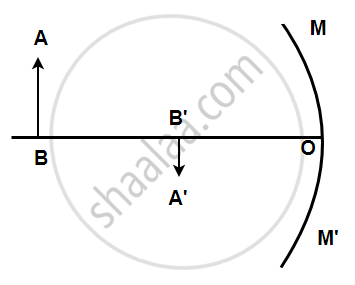
AB is the object, A'B' is the image, and MM' is the position of the mirror. Complete the ray diagram showing the formation of the image and find the focal length of the mirror.
A concave mirror can be used to produce a parallel beam of light. Draw a ray to illustrate this.
If the focal length of a spherical mirror is 10 cm, what is the value of its radius of curvature?
Geometric centre of the spherical mirror is ______.
