Advertisements
Advertisements
प्रश्न
Name the two types of spherical mirrors. What type of mirror is represented by the:
front side of a shining steel spoon?
Advertisements
उत्तर
The types of spherical mirrors represented by the
front side of a shining steel spoon is concave mirror
संबंधित प्रश्न
Explain the following term related to spherical lenses:- aperture
Give one use each of a concave and a convex mirror.
A virtual image larger than the object can be produced by a ______.
Define the Focal length of a spherical mirror
When a spherical mirror is held towards the sun and its sharp image is formed on a piece of carbon paper for some time, a hole is burnt in the carbon paper.
- What is the nature of spherical mirror?
- Why is a hole burnt in the carbon paper?
- At which point of the spherical mirror the carbon paper is placed?
- What name is given to the distance between spherical mirror and carbon paper?
- What is the advantage of using a carbon paper rather than a white paper?
A diverging lens is used in ______.
A 2.0 cm tall object is placed 40 cm from a diverging lens of focal length 15 cm. Find the position and size of the image.
What do you understand by the focus and focal length of a spherical mirror? Show them on the separate diagrams for each of a concave mirror and a convex mirror.
Figure shows a concave mirror with its pole at P, focus F and centre of curvature C. Draw ray diagram to show the formation of image of an object OA.
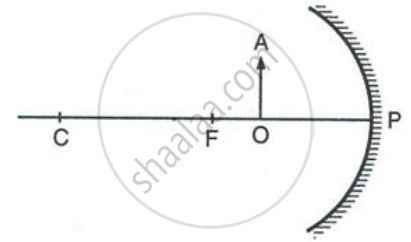
Upto what maximum distance from a concave mirror, the image can be obtained? What will be the location of object for it?
The radius of curvature of a convex mirror is 40 cm. Find its focal length.
Draw a ray diagram to show the formation of the image, when the object is placed between optical centre and principal focus of a convex lens.
State the signs and values of magnifications in the above mentioned case.
Select the correct option:
A concave mirror is made by cutting a portion of a hollow glass sphere of radius 30 cm. The focal length of the concave mirror is:
What do you understand by the term real image?
The spherical mirror used in a beauty parlour as make-up mirror is _______.
If the real image of a candle flame formed by a lens is three times the size of the flame and the distance between lens and image is 80 cm, at what distance should the candle be placed from the lens?
A ray of light is incident towards a plane mirror at an angle of 30° with the mirror surface. What will be the angle of reflection?
