Advertisements
Advertisements
प्रश्न
Name the spherical mirror which can produce a real and diminished image of an object.
Advertisements
उत्तर
Only a concave mirror can produce a real and diminished image of an object.
संबंधित प्रश्न
Define the following term in the context of spherical mirrors:- Principal focus
When a spherical mirror is held towards the sun and its sharp image is formed on a piece of a carbon paper for some time, a hole is burnt in the carbon paper.
Why is a hole burnt in the carbon paper?
When a spherical mirror is held towards the sun and its sharp image is formed on a piece of a carbon paper for some time, a hole is burnt in the carbon paper.
What is the advantage of using a carbon paper rather than a white paper?
Write the formula for a lens connecting image distance (v), object distance (u) and the focal length (f). How does the lens formula differ from the mirror formula?
Explain the following terms :
Pole, Centre of curvature, Radius of curvature, Principal axis. Show them on separate diagrams for each of the concave and convex mirrors.
What do you understand by the focus and focal length of a spherical mirror? Show them on the separate diagrams for each of a concave mirror and a convex mirror.
How is a spherical mirror used to converge a beam of light at a point? Name the type of mirror used.
Mention the types of mirrors used as (i) rear view mirrors, (ii) shaving mirrors. List two reasons to justify your answers in each case.
A student obtained a sharp image of a burning candle, placed at the farther end of a laboratory table, on a screen using a concave mirror. For getting better value of focal length of the mirror, the subject teacher suggested him for focusing a well illuminated distant object. What should the student do?
(A) He should move the mirror away from the screen.
(B) He should move the mirror slightly towards the screen.
(C) He should move the mirror as well as the screen towards the newly selected object.
(D) He should move only the screen towards the newly selected object.
Name the spherical mirror which (i) diverges (ii) converges the beam of light incident on it. Justify your answer by drawing a ray diagram in each case.
Name the mirrors shown in Figure (a) and (b).
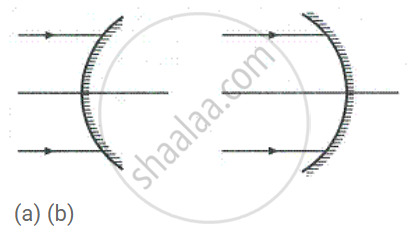
Name the mirror which always produces an erect and virtual image. How is the size of image related to the size of object?
For what position of object, the image formed by a concave mirror is magnified and erect?
Write the spherical mirror's formula and explain the meaning of each symbol used in it.
(a) When a concave mirror is used as a shaving mirror, where is the person's face in relation to the focus of mirror?
(b) State three characteristics of the image seen in part (a).
An object 5 cm high is placed at a distance 60 cm in front of a concave mirror of focal length 10 cm. Find the position and size of the image.
The sun is seen before the sunrise and after the sunset.
An object 5 cm high forms a virtual image of 1.25 cm high, when placed in front of a convex mirror at a distance of 24 cm. Calculate:
- the position of the image
- the focal length of the convex mirror.
Is real image always inverted?
What is the relationship between the focal length and radius of curvature?
Define the term Focus of a concave mirror.
Complete the following diagrams shown in the below figure by drawing the reflected ray for each incident ray.
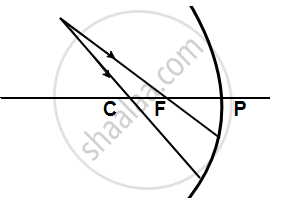
In torches, search lights and headlights of vehicles the bulb is placed ______.
The radius of curvature of a spherical mirror is 18 cm. What is the focal length of this mirror?
