Advertisements
Advertisements
प्रश्न
What is the photoelectric effect? Define stopping potential and photoelectric work function.
Advertisements
उत्तर
- The phenomenon of emission of electrons from a metal surface, when radiation of appropriate frequency is incident on it, is known as the photoelectric effect.
- If increasingly negative potentials were applied to the collector in the experiment of the photoelectric effect, the photocurrent decreases and for some typical value (– V0), photocurrent becomes zero. This value of V0 is termed as cut-off or stopping potential.
- The minimum amount of energy required to be provided to an electron to pull it out of the metal from the surface is called the work function of the metal.
संबंधित प्रश्न
If the frequency of incident light falling on a photosensitive material is doubled, then the kinetic energy of the emitted photoelectron will be ______.
The threshold wavelength of tungsten is 2.76 x 10⁻⁵ cm.
(a) Explain why no photoelectrons are emitted when the wavelength is more than 2.76 x 10⁻⁵ cm.
(b) What will be the maximum kinetic energy of electrons ejected in each of the following cases
(i) if ultraviolet radiation of wavelength λ = 1.80 × 10⁻⁵ cm and
(ii) radiation of frequency 4 x 10¹⁵ Hz is made incident on the tungsten surface?
The electrons are emitted in the photoelectric effect from a metal surface.
The maximum kinetic energy of the photoelectrons depends only on ______
Find the kinetic energy of the emitted electron, if in photoelectric effect energy of incident Photon is 4 eV and work function is 2.4 eV.
Draw a neat labelled diagram of a schematic of the experimental setup for the photoelectric effect.
State Einstein photoelectric equation.
With the help of a circuit diagram describing an experiment to study the photoelectric effect.
The work function of a surface is 3.1 eV. A photon of frequency 1 × 10¹⁵ Hz. Is an incident on it. Calculate the incident wavelength is photoelectric emission occurs or not.
State Einstein’s photoelectric equation. Explain all characteristics of the photoelectric effect, on the basis of Einstein’s photoelectric equation.
The ratio of energies of photons produced due to transition of electron of hydrogen atom from its (i) second to first energy level and (ii) highest energy level to second level is respectively.
When a photon enters glass from air, which one of the following quantity does not change?
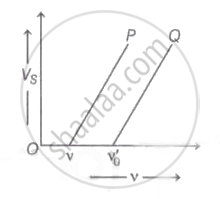
The graph of stopping potential `"V"_"s"` against frequency v of incident radiation is plotted for two different metals P and Q as shown in the graph. ΦP and ΦQ are work-functions of P and Q respectively, then
When a light of wavelength 4000 Å falls on a photoelectric emitter, photoelectrons are liberated. For another emitter, light of wavelength 6000 Å is sufficient for photo emission. The work functions of the two emitters are in the ratio of ____________.
An important spectral emission line has a wavelength of 21 cm. The corresponding photon energy is (h = 6.62 x 10⁻³⁴ Js, c = 3 x 10⁸ m/s) ____________.
Light of wavelength `lambda` strikes a photo-sensitive surface and electrons are ejected with kinetic energy E. If the kinetic energy is to be increased to 2E, the wavelength must be changed to `lambda'` where ____________.
Light of different frequencies, whose photons have energies 3 eV and 18 eV respectively, successively illuminate a metal of work function 2 eV. The ratio of the maximum speeds of the emitted electrons will be ______.
The work function of a photosensitive material is 4.0 eV. The longest wavelength of light that can cause photon emission from the substance is (approximately) ____________.
Is it always necessary to use red light to get a photoelectric effect?
In a photoelectric experiment, ultraviolet light of wavelength 280 nm is used with a lithium cathode having work function Φ = 2.5 eV. If the wavelength of incident light is switched to 400 nm, find out the change in the stopping potential.
(h = 6.63 × 10⁻³⁴ Js, c = 3 × 10⁸ ms-1)
When radiation of wavelength λ is used to illuminate a metallic surface, the stopping potential is V. When the same surface is illuminated with radiation of wavelength 3λ, the stopping potential is `"V"/4`. If the threshold wavelength for the metallic surface is nλ. then value of n will be ______.
The radiation emitted, when an electron jumps from n = 3 to n = 2 orbit is a hydrogen atom, falls on a metal to produce photoelectron. The electrons from the metal surface with maximum kinetic energy are made to move perpendicular to a magnetic field of `1/320`T in a radius of 10-3m. Find the 320 work function of metal:
Photoelectric emission is observed from a metallic surface for frequencies ν1 and ν2 of the incident light rays (ν1 > ν2). If the ratio of the maximum value of the kinetic energy of the photoelectrons emitted in the first case to that in the second case is 2 : K, then the threshold frequency of the metallic surface is ______.
The threshold frequency for a certain metal for photoelectric effect is 1.7 x 10¹⁵ Hz. When a light of frequency 2.2 x 10¹⁵ Hz is incident on the metal surface, the kinetic energy of the emitted photoelectrons is 3.3 x.10-19 J. Calculate Planck's constant.
According to Einstein's photoelectric equation, the graph of kinetic energy of the photoelectron emitted from the metal versus the frequency of incident radiation gives a straight line graph whose slopе ______.
