Advertisements
Advertisements
प्रश्न
The minimum frequency for photoelectric effect on metal is 7 × 10¹⁴ Hz, Find the work function of the metal.
Advertisements
उत्तर
Work function, `phi_0` = hν0
= 6.63 × 10−34 × 7 × 1014
= 4.641 × 10⁻¹⁹ J
संबंधित प्रश्न
Choose the correct option.
Polychromatic (containing many different frequencies) radiation is used in an experiment on the photoelectric effect. The stopping potential ______.
Is it always possible to see the photoelectric effect with a red light?
Explain the inverse linear dependence of stopping potential on the incident wavelength in a photoelectric effect experiment.
Define photoelectric effect.
Find the kinetic energy of the emitted electron, if in photoelectric effect energy of incident Photon is 4 eV and work function is 2.4 eV.
State Einstein photoelectric equation.
The energy of a photon is 2 eV. Find its frequency and wavelength.
State Einstein’s photoelectric equation. Explain all characteristics of the photoelectric effect, on the basis of Einstein’s photoelectric equation.
The maximum velocity of photoelectron emitted is 4.8 m/s. If the e/m ratio of the electron is 1.76 × 10¹¹ C/kg, then stopping potential is given by ______
The graph of stopping potential `"V"_"s"` against frequency v of incident radiation is plotted for two different metals P and Q as shown in the graph. ΦP and ΦQ are work-functions of P and Q respectively, then
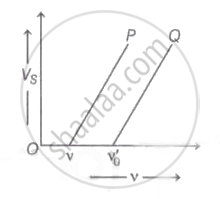
If the maximum kinetic energy of emitted electrons in photoelectric effect is 3.2 × 10⁻¹⁹ J and the work-function for metal is 6.63 × 10⁻¹⁹ J, then stopping potential and threshold wavelength respectively are
[Planck's constant, h = 6.63 × 1034 J-s]
[Velocity of light, c = 3 × 10⁸ `"m"/"s"`]
[Charge on electron= 1.6 × 10⁻¹⁹ C]
When a light of wavelength 4000 Å falls on a photoelectric emitter, photoelectrons are liberated. For another emitter, light of wavelength 6000 Å is sufficient for photo emission. The work functions of the two emitters are in the ratio of ____________.
The work function of a metallic surface is 5.01 eV. The photoelectrons are emitted when light of wavelength 2000 Å falls on it. The potential difference applied to stop the fastest photoelectrons is [h = 4.14 x 10⁻¹⁵ eV sec] ____________.
Photoelectrons emitted from a metallic surface are initially ____________.
In photoelectric experiment, if both the intensity and frequency of the incident light are doubled, then the saturation of photoelectric current ______.
A light of wavelength '`lambda`' and intensity 'I' falls on photosensitive material. If 'N' photoelectrons are emitted, each with kinetic energy E, then ____________.
Two incident radiations having energies two times and ten times of the work function of a metal surface, produce photoelectric effect. The ratio of maximum velocities of emitted photo electrons respectively is ____________.
An electromagnetic wave of wavelength '`lambda`' is incident on a photosensitive surface of negligible work function. If the photoelectrons emitted from this surface have the de-Broglie wavelength '`lambda_1`' then ____________.
Is it always necessary to use red light to get a photoelectric effect?
Photoelectrons are observed to just emit out of a material surface when the light of 620 nm falls on it with the intensity of 100 W m-2. If the light of wavelength 400 nm is incident on the same material with an intensity of 1 W m-2, what would be the minimum reverse potential needed to stop the outflow of the electrons?
A charged dust particle of radius 5 × 10⁻⁷ m is located in a horizontal electric field having an intensity of 6.28 × 10⁵ V/m. The surrounding medium is air with a coefficient of viscosity η = 1.6 × 10⁻⁵ N-s/m2. If the particle moves with a uniform horizontal speed of 0.02 m/s, the number of electrons on it is ______.
For a given photosensitive material and frequency (> threshold frequency) of incident radiation, the photoelectric current varies with the intensity of incident light as:
If the electron in hydrogen atom jumps from second Bohr orbit to ground state and difference between energies of the two states is radiated in the form of photons. If the work function of the material is 4.2 eV, then stopping potential is ______.
[Energy of electron in nth orbit = `-13.6/"n"^2` eV ]
On a photosensitive material when frequency of incident radiation is increased by 30%, kinetic energy of emitted photoelectrons increases from 0.4 eV. The work function of the surface is ______.
Light of wavelength λ, which is less than threshold wavelength is incident on a photosensitive material. If incident wavelength is decreased so that emitted photoelectrons are moving with same velocity, then stopping potential will ______.
If the maximum kinetic energy of emitted electrons in the photoelectric effect is 2eV, the stopping potential will be ______.
The threshold frequency for a certain metal for photoelectric effect is 1.7 x 10¹⁵ Hz. When a light of frequency 2.2 x 10¹⁵ Hz is incident on the metal surface, the kinetic energy of the emitted photoelectrons is 3.3 x.10-19 J. Calculate Planck's constant.
In a photoelectric experiment, the stopping potential is 1.5V. What is the maximum kinetic energy of a photoelectron?
Light of wavelength 'λ' falls on a metal having work function \[\frac {hc}{λ_0}\]. Photoelectric effect will take place only if (λ0 is the threshold wavelength) ______.
A parallel plate capacitor with air between the plates has capacitance 9 pF. The separation between the plates becomes thrice and the space between them is filled with a medium of dielectric constant 6. The capacitance becomes 'x' pF. The value of 'x' is ______.
